


Every year the State of California writes to me about water.
It comes as a folded mailer, the kind that lands between the grocery circular and the dentist reminder and is easy to throw away. Unfolded, in the flat cadence of a statute, the Department of Water Resources informs me that my home sits in a Levee Flood Protection Zone; that the levee between us and the river can fail, overtop, or erode; that if it does, this is roughly where the water would go; and that I should consider purchasing flood insurance.
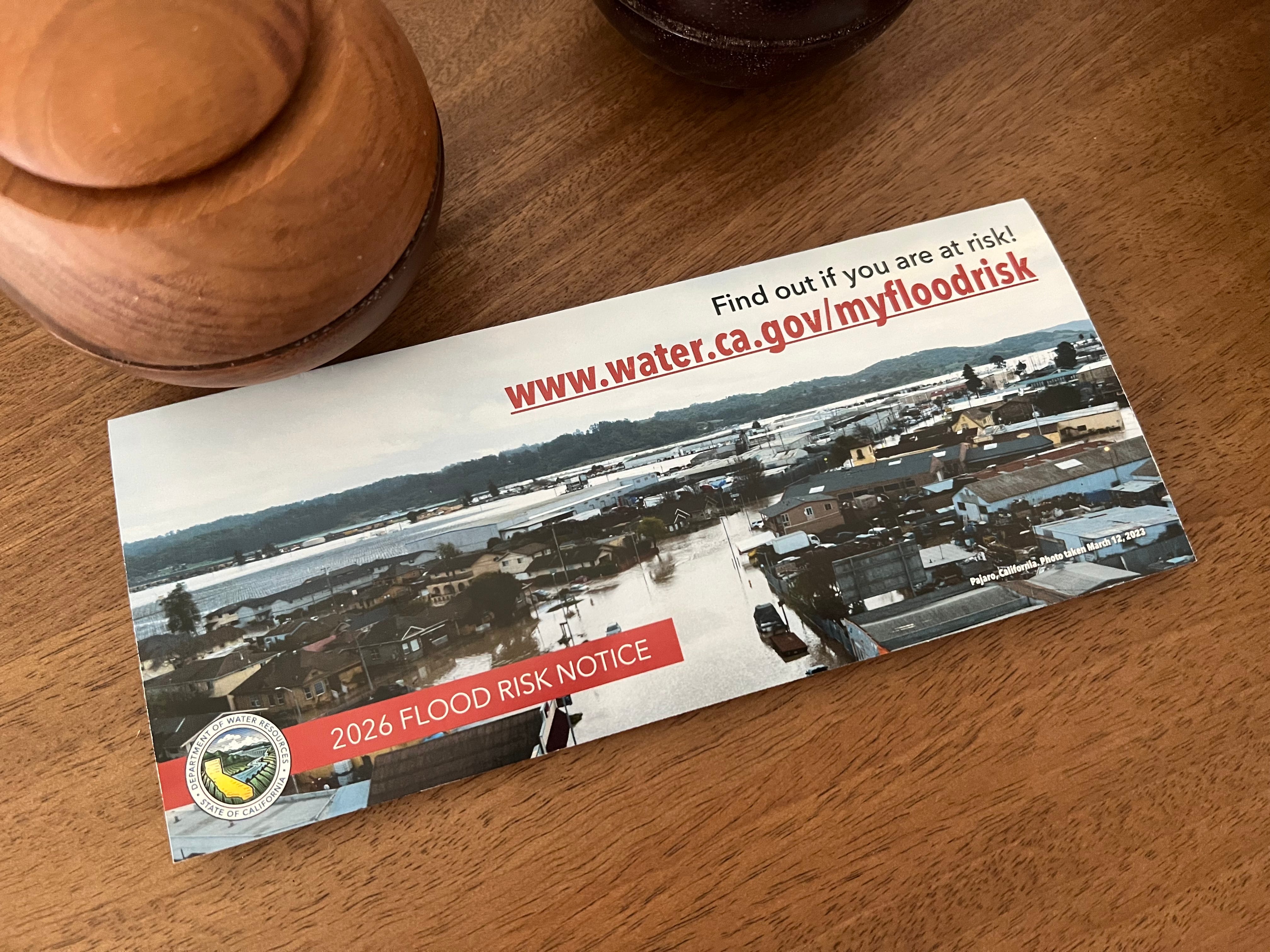
The state is required to send it, to every property owner behind a state-federal levee across seventeen counties, every year, under a law passed two years after Katrina. The same page that explains the program notes, almost in passing, that in many of these places the risk of flooding is greater than the risk of fire. A strange sentence to read in California, yet a true one.
Sacramento exists because of levees. Two rivers meet here, and more than 1,600 miles of state-federal levee hold the Central Valley's water where the valley would prefer it. Every one of those miles is a shared thing. My house does not have its own levee. Which way my neighbor's yard slopes, whether the storm drains were cleared before the first big rain, how much the levee district could afford to repair this year, how much snow fell in the Sierra last winter, these decide whether the notice is just a formality or a forecast.
And yet the letter’s single instruction, the one act the law requires of the state each year, is addressed to me alone: go and buy a product (insurance).
I have kept it on my desk while writing this because it’s what prompted me to go down this rabbit hole of collective risk & how we price it. The state knows the risk is collective. It says so, with a map. Then it hands the remedy to individual households… the remedy (post-disaster), but not as a preventative solution.
It was not always arranged this way.
On the evening of December 7, 1736, twenty-odd Philadelphians signed a set of articles agreeing that whenever fire broke out in the city, each would arrive with at least half his buckets and bags and work to save whatever could be saved. The fourth article is the whole idea in a sentence: that we will, all of us, upon hearing of fire breaking out, immediately repair to the same (the full articles are preserved at Founders Online). Benjamin Franklin was the seventh name on the list. The Union Fire Company was modeled on Boston’s mutual fire societies, and unlike most of those, its members resolved to help anyone in distress, paying member or otherwise. Within sixteen years Philadelphia had eight volunteer companies, and a city built of wood rarely lost more than a house or two to a single blaze.
Notice the sequence. The brigade came first. Only in 1752 did Franklin convene the same men to found the Philadelphia Contributionship for the Insurance of Houses from Loss by Fire — the oldest insurer in America, still writing policies today. Its emblem was four clasped hands. It surveyed every building before agreeing to cover it, and in 1769 stopped insuring wooden structures altogether.
Insurance, in its founding American form, was the financial appendix to a physical mutual. The pooling of labor preceded the pooling of money. We have since kept the appendix and amputated the preceding body.
The unit of loss and the system of risk
We have designed disaster insurance around the unit that experiences the loss, the household, rather than the system that produces the risk.
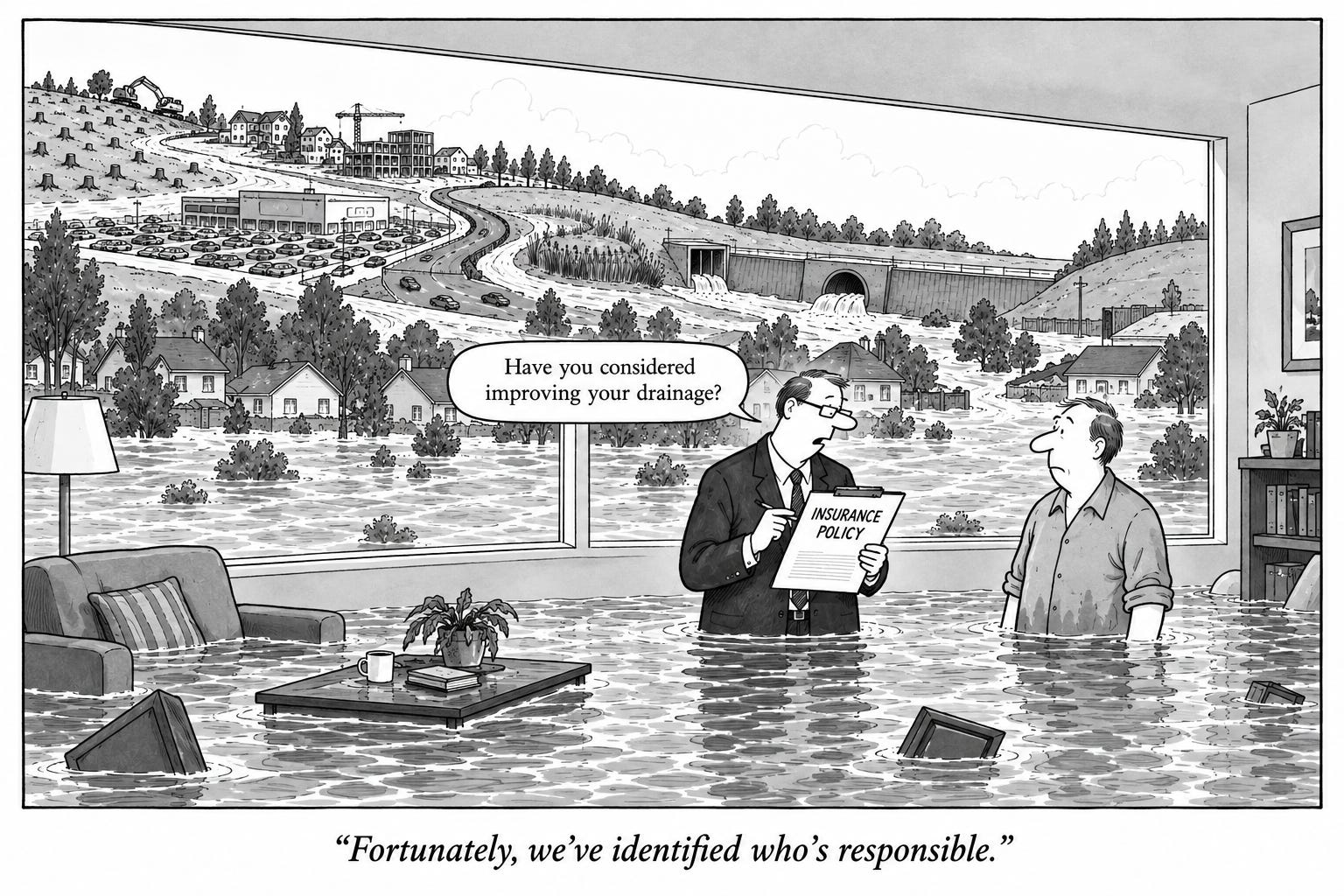
A house floods. But the probability of its flooding is a function of:
upstream land use,
drainage,
levees,
wetlands,
the neighboring parcel’s grading,
municipal culvert maintenance,
building codes,
and watershed management
A house burns. But whether the ember that lands on its roof finds a fuel path depends on:
vegetation across property lines,
prescribed burning on public land,
utility infrastructure,
road width,
water pressure
and what the surrounding five hundred homes did last spring
Asking the homeowner to independently insure against these risks is structurally strange. The principle underneath the strangeness is simple:
Risk is individual at the moment of loss, but collective in its creation and prevention.
Today’s insurance system enters almost entirely at the first half of that sentence. It prices the moment of loss with enormous actuarial sophistication and organizes society around the second half hardly at all. The result is a market that, when the collective risk rises past what individual premiums can carry, does the only thing a loss-financing institution can do: it leaves.
California is the live demonstration. Homeowners premiums rose 84% between late 2020 and March 2026. The FAIR Plan, the state’s insurer of last resort, saw enrollment jump 43% between September 2024 and December 2025 after the Los Angeles fires, now carries roughly $750 billion in exposure, and levied a $1 billion assessment on member insurers, the first in three decades, to pay Palisades and Eaton claims. A Bloomberg analysis found 14% of its policies now sit in largely urban, lower-fire-risk areas. The retreat has spilled out of the wildland-urban interface and into the suburbs.
This is what happens when you pool only the loss. The pool fills faster than anyone is draining it.
I wrote last year about where this goes if nothing else changes. In The Coming Climate Financial Crisis, I traced what fills the vacuum when carriers retreat: catastrophe bonds, weather derivatives, bundled climate-risk securities… instruments that relocate the risk across balance sheets without reducing a single unit of it, in a pattern uncomfortably close to the mortgage securitization that preceded 2008. That essay asked who steps in when the insurers leave. This one is the other half of the answer. The question is what to do so that fewer of them have to.
Two jobs, one wrapper
I would not eliminate insurance. I would unbundle the multi-faceted aspect its attempting to do.
Insurance finances residual loss. Resilience collectively reduces the probability and severity of that loss. These are different jobs, requiring different institutions and we have jammed them into a single product that can only do the first.
The Dutch never made that mistake, because they could not afford to. Around 1122, farmers along the Rhine near Utrecht organized to build and maintain a dam; by 1248 the Count of Holland had chartered the Hoogheemraadschap van Rijnland to coordinate flood protection across a district. These waterschappen are the oldest form of democratic governance in the Netherlands, older than the provinces, older than the States General and twenty-one of them still operate today as a fourth layer of government with their own elections and their own taxes. Their founding logic was that dikes were built and maintained by those directly benefiting from them: every landholder contributed labor and levy, and the motto was he who does not contribute is not protected.
The water board is a resilience institution. It holds no reserves against a breach. Its entire product is that the breach does not happen.
Sacramento, where I live, sits on a living fossil of the same form. The Delta’s levees were mostly built by landowners and are maintained by roughly a hundred reclamation districts, the oldest special districts in Sacramento County, most formed before 1900, that tax themselves through per-acre assessments proportional to the benefit each parcel receives. 65% of the Delta’s 1,115 miles of levee are non-project levees, built and kept by island landowners rather than the Army Corps. The median district runs on about $370,000 a year. When a project qualifies for state cost-share, the district still fronts the money and goes into debt waiting for reimbursement.
These are imperfect, underfunded and often invisible institutions. They are also proof that the form works: a legally constituted body, governed by the people behind the levee, whose job is prevention rather than payout.
What already exists and where it falls short
The closest thing the modern insurance system has to a water board is FEMA’s Community Rating System. A community that goes beyond minimum floodplain standards earns points across nineteen creditable activities:
drainage maintenance,
open-space preservation,
public outreach,
warning systems
and every National Flood Insurance Program (NFIP) policy in that community is discounted from 5% up to 45%.
Philadelphia, Franklin’s own city, entered CRS this year as a Class 7, earning residents a 15% cut.
California has done something similar for fire. The Safer from Wildfires regulation requires every admitted insurer that prices wildfire risk to file discounts for twelve mitigation measures, two of which are community-level: recognition as a Firewise USA site, or designation as a Fire Risk Reduction Community. Filed Firewise discounts run from under 1% to 20% of the wildfire portion of the premium. The FAIR Plan itself offers an additional 10% for Firewise neighborhoods.
So the bridge between collective action and individual premium has been half-built. Look at what it credits, though. CRS rewards municipal programs and documentation… the floodplain manager’s binder. Firewise rewards a neighborhood’s plan and its annual reporting. Neither has a line item for organized neighbor labor. Nobody is counting the hours.
Nobody has built the layer that says: 500 verified volunteer hours clearing a shared ember corridor, or reinforcing a levee toe, or restoring a creek edge, equals a measurable reduction in expected loss, equals a community-wide credit, equals a carrier funding the materials because it beats paying the claim.
That layer is the missing institution.
The Resilience Commons
Call it a Resilience Commons: neighborhood-scale civic infrastructure in which residents, governments, insurers, utilities, lenders, nonprofits, contractors and philanthropies all participate because every one of them benefits when systemic risk falls.
The difference from a tax-funded public works program is participation. Imagine Sacramento saying: here are the 30 things a neighborhood can do to reduce heat, flood, fire and outage risk. We supply the engineering standards, the tools, the materials, the training and the permits. You supply some of the labor, the coordination and the community stewardship.
Then, every weekend, something that looks like Habitat for Humanity for Resilience. Here are some examples of ‘community activities’:
Community days for rain gardens and bioswales.
Clearing drainage routes before the first atmospheric river.
Planting shade trees along the corridors that run hottest.
Replacing combustible fencing where it touches the house.
Cutting defensible-space corridors across property lines, because embers do not read deeds.
Installing ember-resistant vents.
Mapping which neighbors are elderly or medically fragile before the outage, not during it.
Inspecting culverts.
Deploying shared water storage.
Standing up a neighborhood battery.
Keeping the evacuation road passable.
Some of this requires licensed contractors. A great deal of it does not.
An enormous share of resilience is coordination, maintenance, landscaping, observation, and simple retrofits… exactly the categories Franklin’s articles assigned to men with buckets.
People are no longer told to “prepare for climate change” (or El Niño, this year). They are handed something concrete to do together. That is the difference between a public and a population.
The resilience dividend and who owes it
The feedback loop is the economic heart of this initiative:
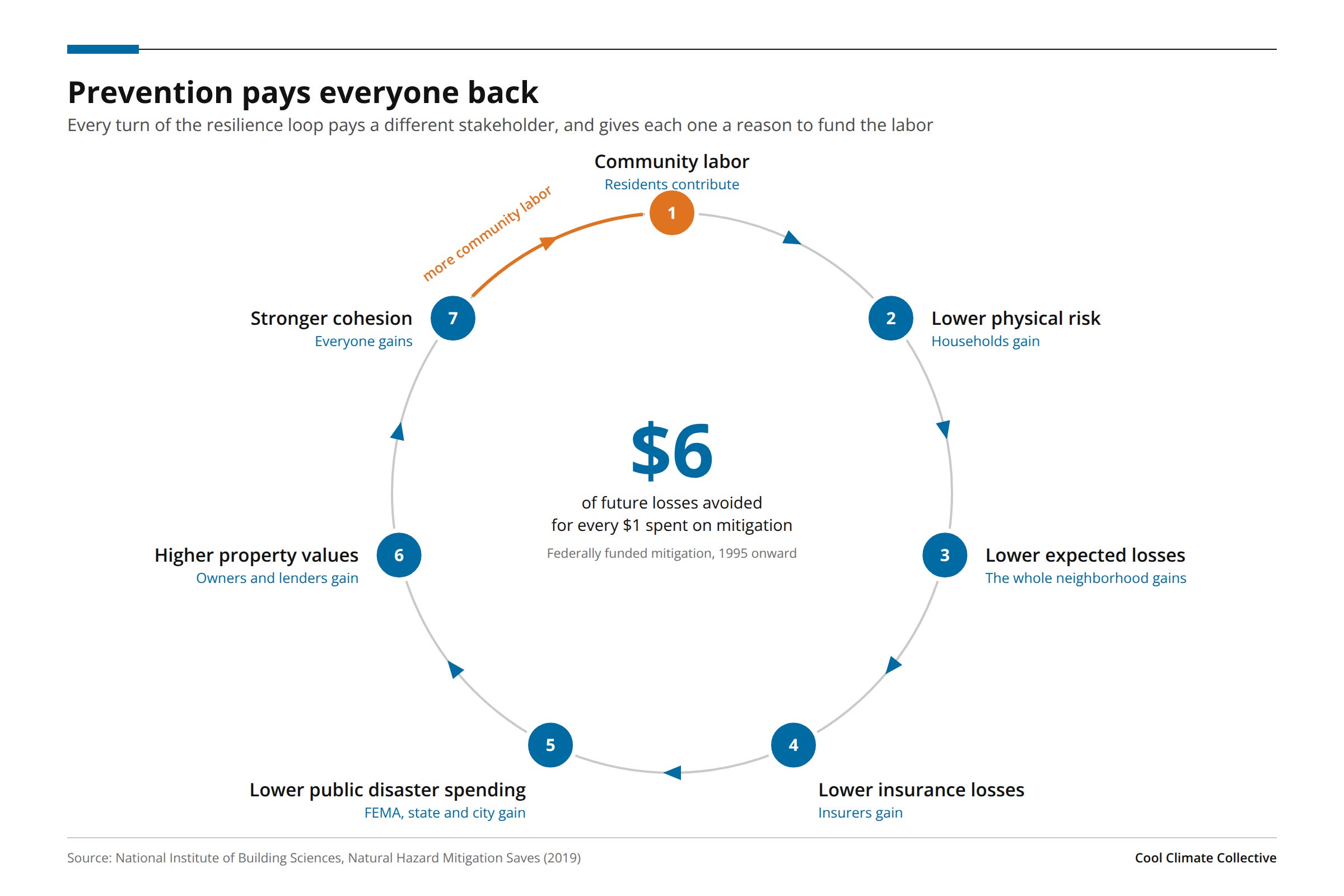
Which raises the financing question in its correct form. If everyone benefits, everyone should be able to contribute.
Today a homeowner is asked to spend $8,000 hardening a property alone. In a Commons, the homeowner contributes time or money; the city contributes materials, permitting and technical expertise (with AI & technology as an accelerant to enabling the technical expertise to be distributed & permitting approval); the insurer contributes because claims fall; the utility contributes because grid-ignition exposure falls; FEMA and the state contribute because future disaster outlays fall; the lender contributes because collateral risk falls; the health system contributes where heat and smoke resilience reduces admissions; and philanthropy covers the households that cannot cover themselves.
The numbers are not speculative. The National Institute of Building Sciences’ Mitigation Saves study, peer-reviewed across seventy organizations, found that federally funded mitigation since 1995 cost $27 billion and will save $160 billion, $6 per $1.
Modern building codes return 11:1.
Riverine flood mitigation runs as high as 7:1.
National Institute of Building Sciences (NIBS) titles one of its own briefing sheets “Everybody Saves: Multiple Stakeholders”, which is the point precisely.
If a dollar today avoids six of expected future loss, those six dollars have several beneficiaries. The institutional innovation is pulling some of that avoided future cost forward to finance the prevention. You could, quite literally, calculate a resilience dividend and write the cap table.
This starts to look less like property insurance and more like preventive medicine for places. We do not want health insurance that merely pays for the heart attack. We want a health system that helps prevent it.
Property insurance today essentially says: we will become deeply involved once your neighborhood burns down. The Contributionship in 1769 said something different… it sent a surveyor first to reduce risk for all beforehand.
Neighboring as Infrastructure
There is a philosophical dimension here that matters more than the finance.
Modern resilience policy imagines citizens as customers of government. Government builds the levee; the homeowner buys the policy; the contractor installs the vent. Each transaction is clean and each party is alone.
Historically, communities maintained vast amounts of common infrastructure themselves, through institutions built for the purpose:
The water boards.
The volunteer companies.
The barn raising.
The irrigation district.
The drainage association.
The mutual aid society.
Also, there is precedent in our electric infrastructure… in 1934, only 11% of American farms had electricity because investor-owned utilities found the countryside unprofitable; the Rural Electrification Act of 1936 offered low-cost loans, the utilities declined them and farmer-owned cooperatives took the money and strung the lines. By 1950 close to 80% of farms had power. The state supplied capital and standards. The cooperatives supplied everything else.
That is the formula climate adaptation needs to rediscover: state capacity x community capacity. Government brings expertise, coordination, financing and heavy infrastructure. People bring distributed intelligence, stewardship, labor and the social coordination no agency can manufacture. And insurers become something more interesting than actuarial casinos sitting downstream of catastrophe. They become risk-reduction investors, with a balance-sheet reason to fund the Commons.
The hard edges
It would be dishonest to leave the Dutch motto out. He who does not contribute is not protected is the enforcement mechanism and a Commons without one becomes a free-rider problem in a fleece vest. The reclamation districts solve this with assessment liens; the water boards solve it with taxation and elections.
A Resilience Commons needs an answer… most likely a hybrid of a modest baseline levy and a labor credit that can be bought out and the answer cannot be that working families are expected to spend weekends on levees while their wealthier neighbors write a check. The credit for labor and the credit for money have to be fungible and the philanthropic layer has to sit under the households for whom neither is easy.
Verification is the second edge. An insurer will not price a credit it cannot audit. Volunteer hours are easy to inflate and hard to map to reduced expected loss. This is where the Commons stops being a nostalgic institution and becomes a data institution: parcel-level risk baselines, interventions logged and geotagged, outcomes measured against synthetic controls, credits issued against demonstrated deltas rather than good intentions. The measurement layer is the product.
And the third edge is the one the Contributionship found in 1769. An insurer that learns which buildings burn can respond by reducing risk or by refusing to cover the buildings. Both lower its losses. Only one lowers the fire. A Commons must be structured so that the cheaper path for the carrier is funding the mitigation, not exiting the ZIP code… which means the credit has to be large enough and the exit costly enough, that the actuary and the neighbor want the same thing.
Begin before there is anything to insure
‘Natural disaster’ insurance should begin before there is anything to insure.
Franklin understood this in 1736 and formalized it in 1752. The Dutch understood it in 1122 and have been re-electing the same institution for nine centuries. The farmers of the Delta understood it well enough to build 1,100 miles of levee before the Corps of Engineers arrived.
We have the pieces… the CRS shows premiums can move with community action, Safer from Wildfires shows regulators can compel carriers to credit neighborhoods, and NIBS’ Mitigation Saves shows the dividend is real and large.
What is missing is the layer between insurance, municipal infrastructure and civic participation: the body that measures neighborhood risk, identifies interventions, organizes residents, finances improvements, and proves the reduction in expected loss to everyone who benefits from it.
That layer is a fund, a data platform, and a Saturday morning with buckets, all at once. It is also, I suspect, an investable institution.
Let us Pool the Prevention.