


Listen to the AI Narrated commentary overview of the post:
When we talk about climate change, we’re describing a tangled web of feedback loops that span everything from local farming practices to global trade and security alliances. Tackling these challenges can feel like trying to solve a puzzle while someone constantly shuffles the pieces behind your back. That’s why climate is often labeled a “wicked” problem: it seems to be unpredictable, deeply interconnected, and perpetually shifting.
In such a setting, simple, one-dimensional solutions rarely work. Instead, we need a lateral-thinking mindset, where we connect dots that appear unrelated at first glance; paired with multi-solving approaches that address multiple challenges simultaneously.
With this perspective, single innovations can become linchpins that solve an array of problems at once, from emissions reduction to public health and local economic development.
Why Wicked Problems Demand Lateral Thinking
Picture a maze that rearranges itself every time you take a turn. A purely linear approach, methodically tracing each corridor, might send you in circles.
Lateral thinking means stepping outside the maze for a moment and asking new, sometimes unusual questions: “What if the walls are movable?” or “What if there’s no finish line?” These off-kilter perspectives often spark insights because they break from conventional wisdom.
Historical Echoes: Climate, Politics, and Ingenuity
Throughout history, some societies have folded environmental challenges into larger, multi-solving strategies, showcasing how climate adaptation often intersects with social, political, and economic dimensions:
Incan Terracing (c. 15th–16th century CE)
Complex Terrain: Farming in the steep Andes meant dealing with limited arable land and extreme temperature swings.
Multi-Solving: The Incas built stone-walled terraces that (1) prevented soil erosion, (2) captured water runoff for irrigation, and (3) stabilized microclimates on each level. This boosted food production while enabling the empire to store surplus and withstand droughts, an environmental, economic, and political win.

Incan Terracing
Indus Valley Civilization (c. 3300–1300 BCE)
Urban Planning: Advanced city grids and sophisticated sewage systems were core to Indus urban life.
Multi-Solving: By channeling wastewater away from residential areas, the civilization reduced disease, improved living conditions, and fostered trade through cleaner, more organized cities. This synergy of public health, economic stability, and environmental management played a key role in their longevity, at least until broader shifts in river patterns and trade routes strained the system.

Indus Valley complex city grid & sewage systems
Dutch Water Management (from Medieval Times onward)
Low-Lying Terrain: Large parts of the Netherlands lie below sea level, prone to flooding.
Multi-Solving: The Dutch approach used dikes, windmills, and later polder systems to reclaim land and manage water. This not only protected communities from inundation but also expanded farmland, catalyzed maritime trade, and spurred innovations in engineering. By aligning agriculture, commerce, and flood defense, they turned a vulnerability into an economic advantage.


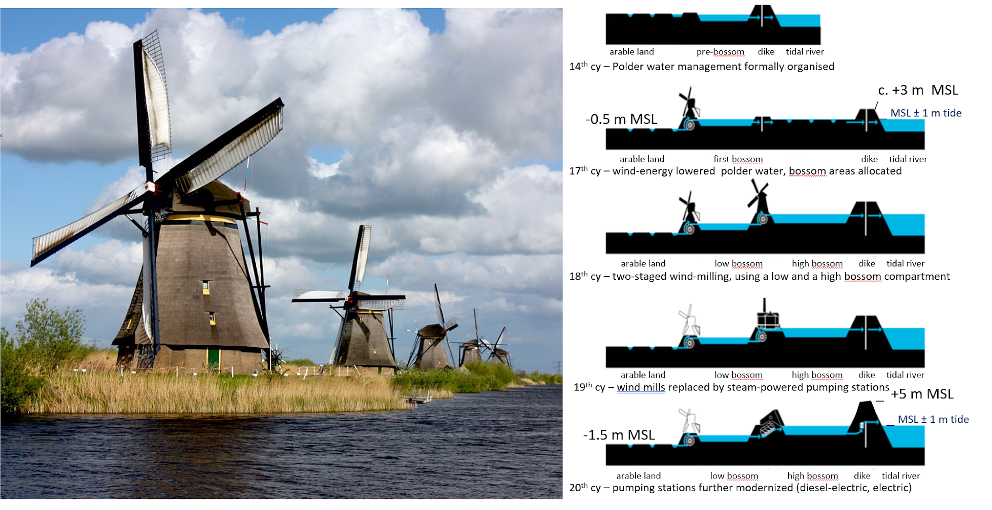
These examples reveal how lateral thinking and multi-solving have ancient precedents, societies that recognized environmental challenges as opportunities to reshape governance, technology, and daily life.
Examples in Modern Climate Context
Pairing Wildfire Management with Flood Prevention
Healthy forests and balanced water tables go hand-in-hand. Thinning forests to reduce wildfire risk also increases soil absorption, stabilizing water flow and mitigating flood intensity downstream.Designing Infrastructure to Capture Threats
Instead of only building flood barriers, cities can create rain gardens or recharge basins to store excess rainfall for future use. By treating water as a resource rather than a threat, we transform a climate risk into a community asset.
Multi-Solving in Action
Within the Cool Climate Collective portfolio, the following ventures exemplify multi-solving.
🌿🐄 Alga Bio - Eliminating methane production and increasing cattle feed efficiency at scale.
How: Alga Bio creates algae-based supplements that reduce enteric methane (a potent greenhouse gas) in livestock, and boost overall feed conversion, cutting emissions while improving farm profitability.
💩🌎 wasted* - Building the circular sanitation economy by unlocking the value of nutrients that pass through the human body. (📺 See it in action)
How: wasted* implements an ecosystem of urine diversion and energy-efficient nutrient recovery, reducing odors, pollution, and greenhouse gases from conventional sewage treatments, while turning waste into valuable resources.
🍄🟫🧱 Mycocycle - Using fungi to remove toxins from construction waste and create renewable, biobased materials.
How: Mycocycle employs specially selected fungi to decontaminate and reconstitute industrial waste into usable products, lowering carbon footprints and supporting a circular economy in the building sector.
It also happens, all three companies are co-founded or led by women, spotlighting the crucial role of female founders in spearheading climate-tech innovations, especially notable since they receive only 7% of overall climate tech venture funding.
Philosophical Underpinnings: Systems Thinking Meets Futurist Methodology
Much of this lateral thinking is grounded in systems theory, popularized by Donella Meadows, and futurist approaches, like mapping out a Cone of Possibilities for how the future might unfold. Instead of planning for one linear outcome, these methods enable innovators to envision diverse potential near-term and long-term trajectories.
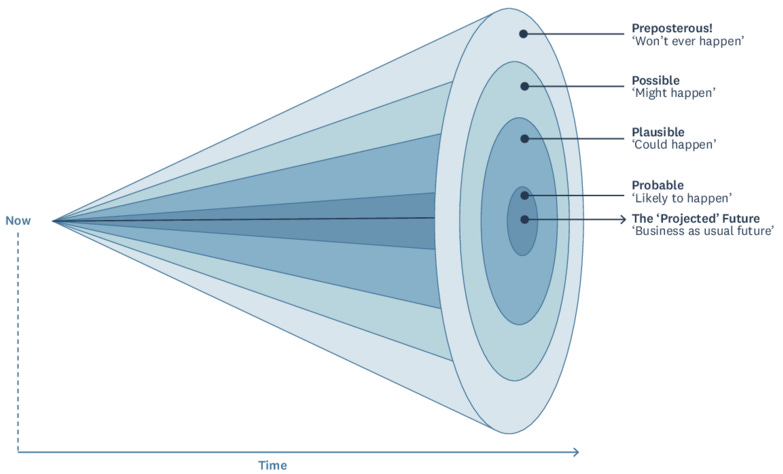
You can even layer in a Three Futures Test to quickly assess whether an idea will hold value across multiple evolving scenarios. By combining the Cone of Possibilities with such a test, you identify solutions that stay relevant even if the world takes unexpected turns.
Engaging Emergent Strategies
A key feature of lateral thinking is embracing emergent strategy, influenced by complexity science. Rather than seeing climate woes as doomsday scenarios, emergent strategy treats them as portals of possibility; sparks that force us to reimagine entire ecosystems.
Seeing Problems as Portals
Each challenge, whether cutting livestock methane or reinventing sewage, catalyzes systemic innovation.Catalyzing Positive Feedback Loops
When a single idea (e.g., fungi-based upcycling) yields multiple benefits (cleaner landfills, new materials, fewer toxins), it chain-reacts across different stakeholders and industries.Iterative Adaptation
Emergent strategies thrive on continuous sensing and responsive adaptation, aligning with multi-solving’s flexibility in changing conditions.
Shifting from problem-fixation to potential-focus means we’re not just fighting crises. we’re co-creating solutions that tap hidden data, alliances, and cultural energy. The result is often a longer arc of transformation than any single, siloed fix could achieve.
Other Multi-Purpose Tech at Work
Beyond these startups, multi-solving has broad applications across several technology areas:
Drones
Delivery & Entertainment: Transporting medicines or orchestrating light shows.
Agriculture: Precision watering and fertilizer management.
Disaster Response: Aiding search-and-rescue after floods or earthquakes.
(For more on drone deterrence strategies, see my post on “Mutually Assured Drone Deployment (MADD)”)
EVs (Batteries on Wheels)
Personal Mobility: Quiet, low-emission travel.
Grid Resilience: Vehicle-to-grid charging during peak demand.
Emergency Backup: Powering homes during outages.
Power Beaming
Defense or Deterrence: Adapting the same tech for strategic security.
Space-Based Solar: Capturing energy 24/7 above the clouds.
Rural Connectivity: Delivering power to remote areas without extensive infrastructure.
Designing solutions with multiple use-cases not only spreads risk if one market falters, but also maximizes impact in a rapidly changing climate and geopolitical landscape. There’s always a discussion of focus & beachhead markets to tackle first, but by having the systems lens opportunity mapped out, we can envision the future we want to create.
A Path Toward Practical and Lasting Solutions
Our best bet for tackling the complexity of climate change isn’t a single technology, it’s a mindset that embraces lateral thinking and multi-solving at every stage. From mitigating emissions to improving public health and stimulating local economies, we can unlock resilient strategies that evolve alongside our rapidly changing world.
Interested in collaborating or have an idea?
Reach out with your concept, just include “Rfx” in the subject line if you’re working on one of our research explorations. We’re always eager to connect with innovators pushing the boundaries of climate resilience, circularity, and multi-solving.