


Listen to the AI Narrated commentary overview of the post:
Earlier this month, I was back at UCSD’s main campus, after over a decade since I graduated, for Agile Electrification, a working convening of California’s Distributed Energy Resources (DER) practitioners: top solar installers, policy teams, utility innovators, founders, and investors.
The brief was ambitious: build a “New Deal for California Energy”, backcast from a High-DER home future, and run 3-month Designers-in-Residence sprints that feed a decision-support platform called GoldenGrid, all focused on engaging prosumer households as the grid’s flexible backbone.
The bet is that existing (& new) solar homes are the fastest bridge to the flexibility the grid now needs.
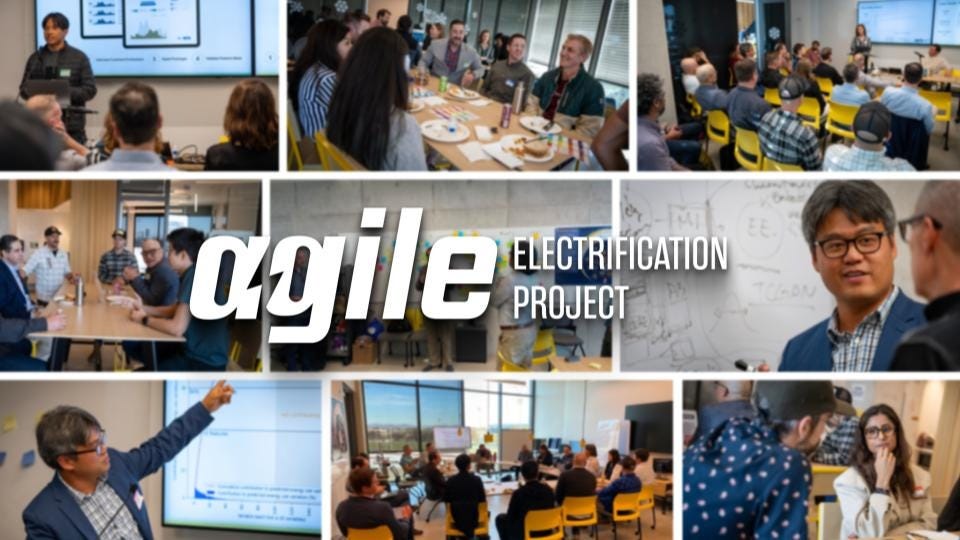
As we dove into various topics and themes, and while Andrew, one of our organizing conveners, was presenting the work they’ve been doing, one slide in particular stood out to me.
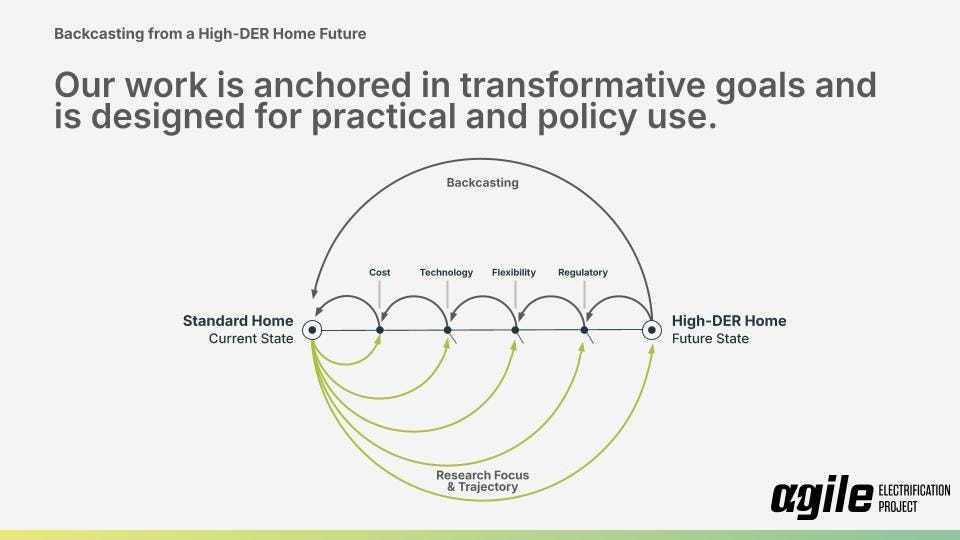
This is the foundational backcast that was presented at the event, from Standard Home to High-DER Home. The inflection points lined up cleanly: cost curves, technical specs, flexibility & policy levers, like footholds on a well-marked trail.
That slide was the invitation that nudged me to apply our Three Futures Test, overlay adjacent plausible futures, and test how the inflection points and our options shift.
A High-DER Future & Present Realities
Let’s take a minute to reflect on the present reality we are living in.
The High-DER future has to be built inside today’s constraints: tapering incentives, rising soft costs, interconnection queues that behave like black holes, and a demand curve that’s finally bending up after decades of flatline. Add in tariff re-writes, re-domesticating energy-intensive industries, transformer shortages, and permitting friction, and you get the operating conditions that innovative problem solvers thrive in.
This is the paradox: the same forces that slow projects also raise the premium value on distributed flexibility. As electrification compounds from EVs, heat pumps, induction, data centers, small-scale automation, the grid wants capacity and behavior. In other words, not just more megawatt-hours, but better timing, better coordination, and better recovery when things go wrong. DERs win when they show up as elastic, fast-to-deploy, and resilient, the very same traits centralized builds can’t deliver on short notice.
The reality is that… headwinds for traditional build-out & deployment are tailwinds for resilience.
The facts on the ground:
Money isn’t doing all the work anymore. Subsidies are flattening while soft costs: design, permitting, interconnection studies, customer acquisition… keep climbing. Projects pencil less on policy and more on operational value.
Queues, not kilowatts, are the bottleneck. Interconnection timelines stretch from months to years; distribution upgrades lag; turbine backlogs; transformer lead-times distort deployment calendars.
Demand is back, structurally. After years of flat consumption, electrification, onshoring, heat pumps, EVs, and AI/data centers are driving a persistent upward slope in load.
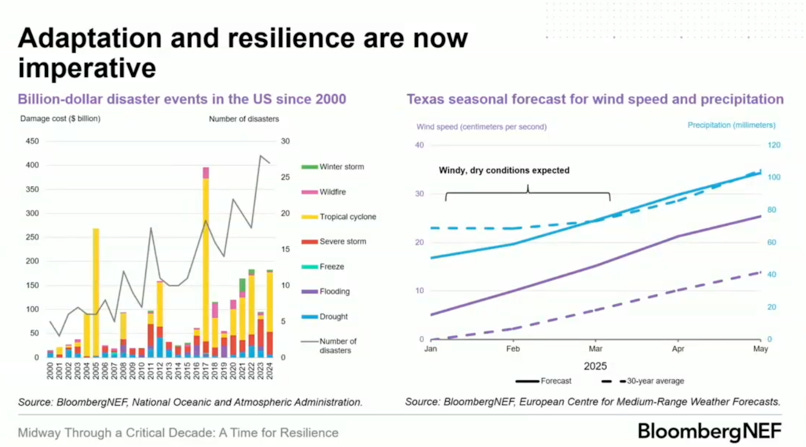
Risk is now routine. Climate volatility from wind, heat, drought, wildfire, floods, turns “rare events” into seasonal features. Reliability and recoverability are no longer add-ons; they’re requisites.
Disaster isn’t an outlier anymore… it’s the baseline, so resilience just became the grid’s uptime budget.
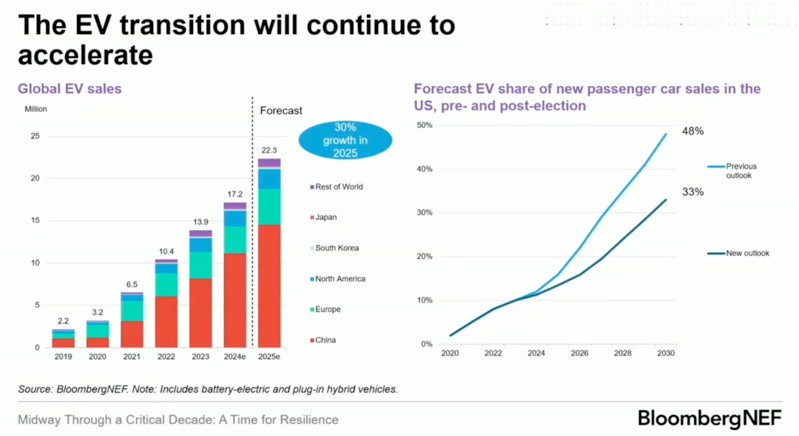
The line may squiggle, the direction doesn’t: we’re driving toward electric.
Put together, these graphs say what the room already feels: resilience is not optional, and electrification is not waiting. That is exactly why the backcast must recognize the world we’re operating within: the queues, the costs, the weather and why the strategy has to reward DERs that are elastic: able to cycle more, coordinate better, and recover faster.
The Limits of Single-Future Backcasting
Backcasting is a powerful strategic foresight method. For those not familiar, it’s a planning approach that starts by defining a specific, desirable future state and then works backward to map the policies, technologies, behaviors, investments, and milestones required to reach it. Unlike forecasting, which extrapolates today forward, backcasting treats the future as a design target, making explicit the constraints, bottlenecks, inflection points, and enabling conditions along the way. It produces concrete transition pathways (who does what, by when, under which assumptions) and clarifies trade-offs, sequencing, and dependencies across adjacent futures.
But any backcast is a story told from one plausible future looking inward. The inflection points along that path… what we fund, what we regulate, what we standardize… are constrained by the assumptions of that chosen future.
A core realization I’ve come to in my work is that: A backcast is faithful to one future, however the inflection points can be, & are often, manipulated by adjacent futures, typically outside the purview of those deep within an industry.
This is why we developed the Three Futures Test and have been refining it to extend beyond just our core investing practice at Cool Climate Collective. As we now use it for further strategic guidance and planning for founders, policymakers, and thought partners. In practice, we hold multiple plausible futures simultaneously, then map how bottlenecks and inflection points in one are interdependent on outcomes in an adjacent future. That interdependence is usually where the real leverage hides. The first backcast isn’t necessarily wrong but it is incomplete without its adjacencies.
Only after examining those adjacencies do the optimal investment, policy & commercialization decisions emerge.
Three Futures around Distributed Energy Resources
So what do these Three Futures look like when plotted against the initial future?
Well, first there’s the future in the slide deck: High-DER Homes, distributed solar, batteries, smart panels, Virtual Power Plants (VPPs) coordinating the evening peak.
There’s a second future standing in our peripheral vision: humanoid and home robotics, moving from warehouses into household routines within the next 10 years. I recently wrote a Virtual Foresight Scenario (VFS) on a plausible future accelerant strategy enabled by a recognizable brand.
A core insight into home robotics economics is that robots won’t sip power. A single useful household robot adds roughly the energy signature of an EV to daily household consumption. Think of one busy home robot as ~½ to 1 EV-day of energy; stack two robots plus light fabrication and you’re into 2–5 EV-days worth of load.
Note on Assumptions: EV ~30 miles/day at 0.30–0.40 kWh/mi (~9–12 kWh/day). Current humanoids ~0.3–0.6 kW while working; 6–10 hours/day ~2–6 kWh/day per robot, higher with tools or longer duty cycles.
That’s not a rounding error; it’s a fundamental shape change as the other reality as most EV owners can attest, we’re not typically charging overnight, every night unless we are doing long commutes daily… but if we assume the household robotics will be daily support for the home, from cleaning or childcare support, as well as the fact we could in theory have our robots work (or charge) overnight, midnight becomes prime time.
Viewed from inside the DER backcast alone, inflection points look like “more rooftop solar, better interconnection standards, one-cycle-per-day batteries, smarter time-of-use rates.”
Viewed from outside, with the robotics future in frame, those inflection points shift: storage specs pivot from capacity to throughput; orchestration shifts from optimization to necessity; modular energy stops being a clever option and becomes how a robot sustains itself.
And lastly, there’s a third future we’re starting to notice re-assert itself across our portfolio, the concept of Electrons-to-X: electrons flowing reliably into heat, mobility, materials, and autonomy because storage and control made them usable everywhere. I originally highlighted this concept in our Rfx (Request for X) at the end of last year.
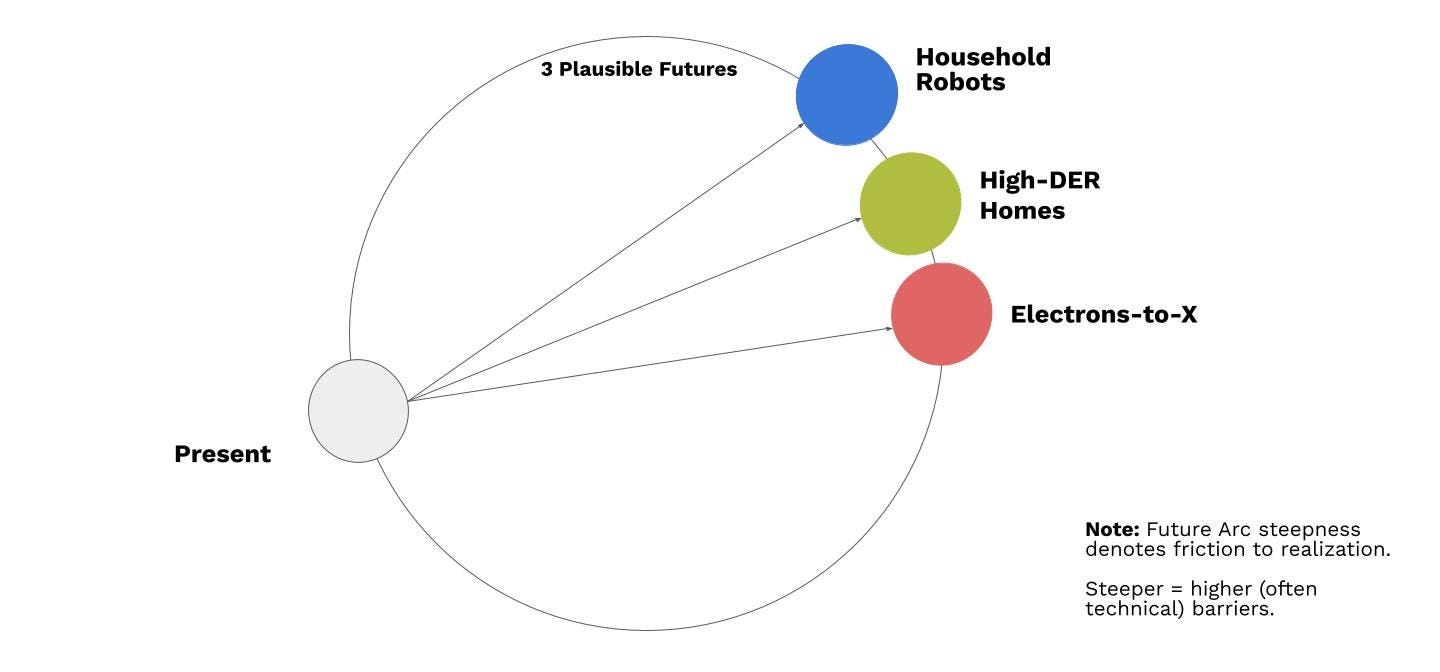
The future rarely arrives alone, so let’s take a closer look at each adjacent future.
Future 1: High-DER Homes (The Foundational Future)
Inhabit only this future and the path is tidy: costs fall, permitting softens, smart panels proliferate, VPPs scale. Most homes that want distributed energy get solar plus a battery that shifts the evening peak. Backcasting from here, your levers are familiar—interconnection reform, incentives rewarding installed capacity, warranties optimized for roughly one cycle per day.
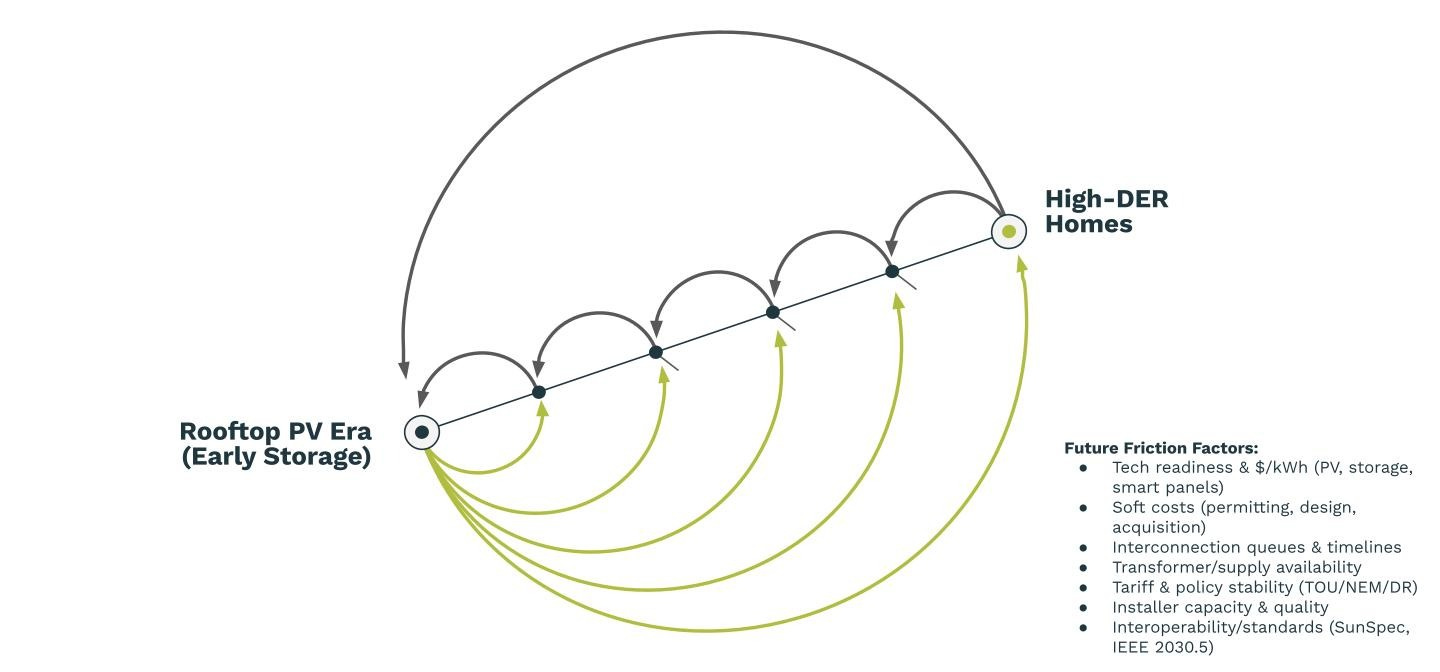
You can build successful companies for two decades within this frame.
But this backcast assumes the night remains quiet and the battery’s job is one elegant discharge after sunset. It’s the right story until its neighboring futures arrive.
Future 2: Robotics at Home (The Adjacency That Moves the Goalposts)
Pull the robotics future closer. The moment a useful robot becomes commonplace, the household gains a persistent overnight load… not a spike, a plateau.
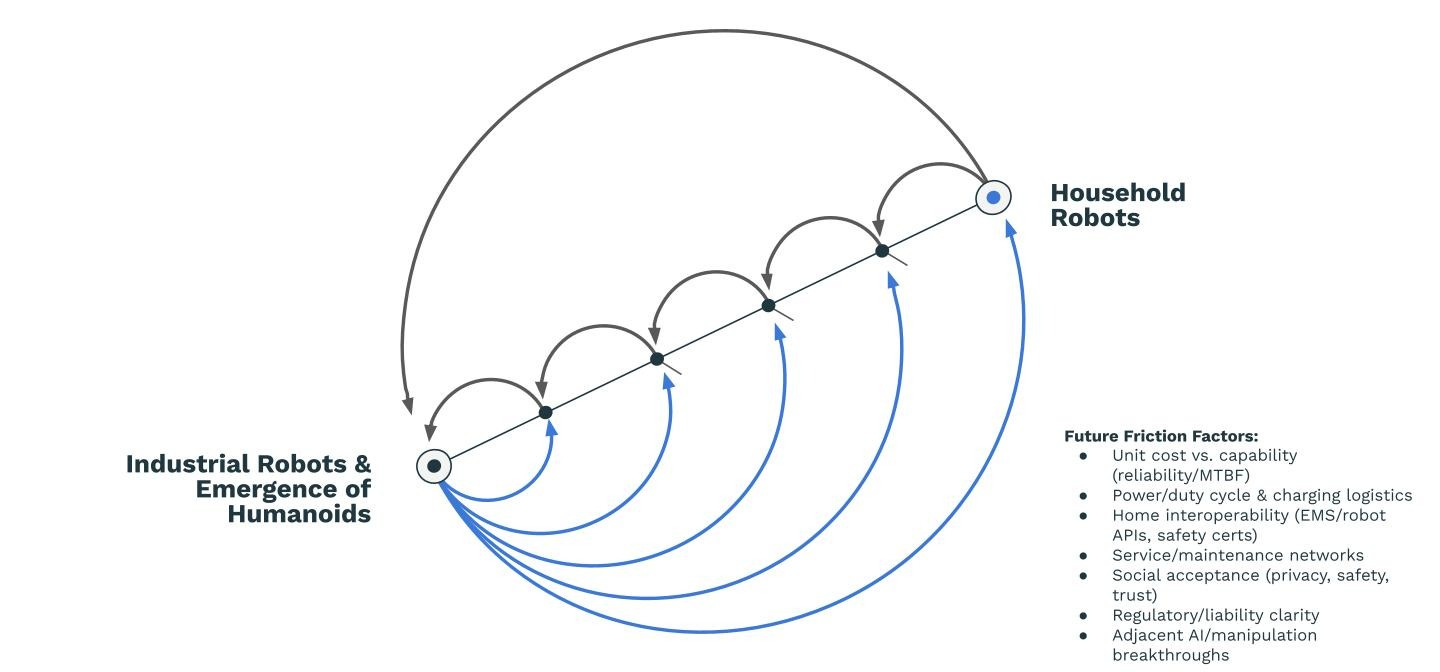
Design DER from inside this reality and different requirements emerge:
Throughput as first principle. Storage operates at 1.5 to 2.0 cycles per day with deeper depth-of-discharge, not a single elegant evening discharge. Design for calendar life measured in kilowatt-hours cycled, not just years installed.
Modularity as infrastructure. Swappable 1-3 kWh packs that robots can dock and share; fixed storage built from standardized bricks, not monolithic slabs.
Orchestration as necessity. Robots, EVs, HVAC, and batteries don’t “schedule”—they negotiate. Without intelligent coordination, midnight becomes a transformer problem.
Here’s the critical insight: these constraints don’t just define the robotics market. They reach back and rewrite the DER backcast. The inflection points in the original High-DER Home slide charted: policy priorities, technical specifications, flexibility requirements—shift under the weight of an adjacent plausibility.
The home becomes a small 24/7 facility. The “right” battery stops being the one with the largest headline capacity and becomes the one optimized for sustained multi-cycle operation.
Future 3: Electrons-to-X (The Spillover That Makes It Systemic)
When storage and control become elastic enough to carry noon into evening and evening across the night shift, electrons stop being fragile. They can credibly flow into heat pumps, induction cooking, mobility, materials processing, and autonomy without overwhelming feeders or utility bills.
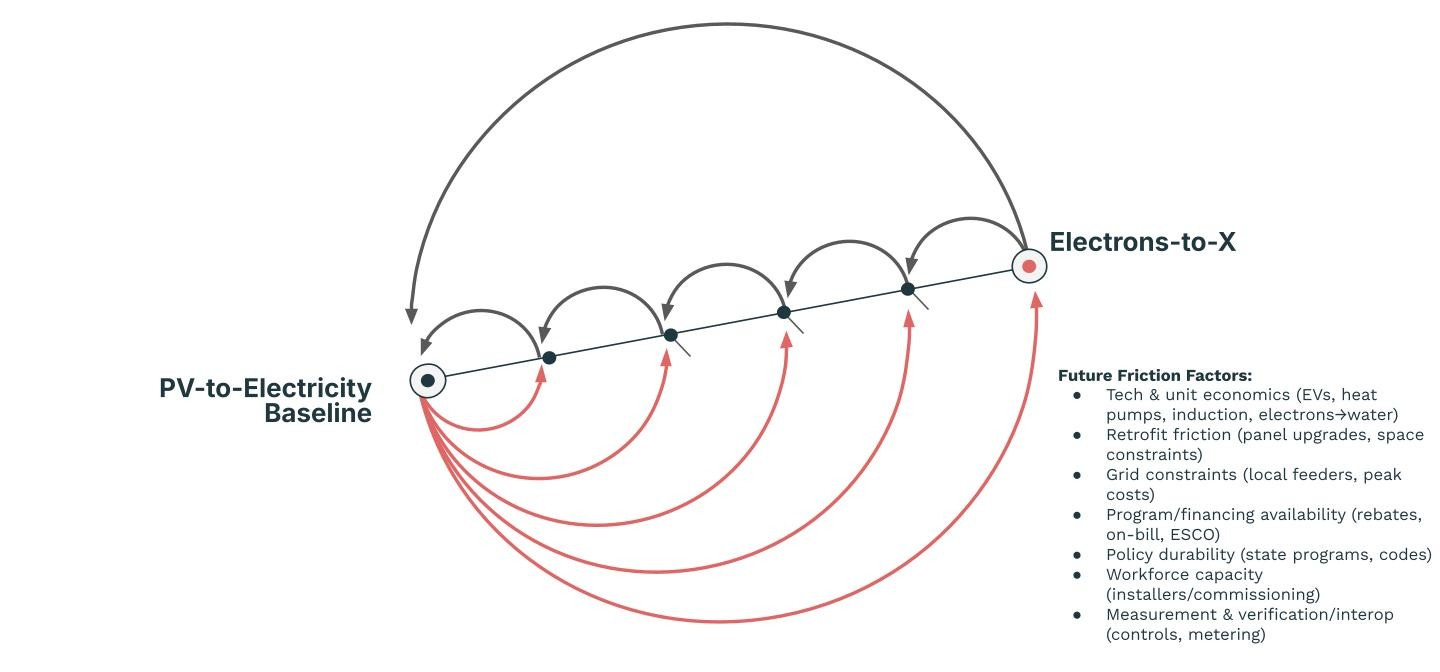
This electrostate future is what an Electrons-to-X future enables: DER as substrate, not accessory. I won’t relitigate our published Rfx framework here, nor fully unpack our Electron Stacks layering model, those warrant separate write-ups. But the foundational realization is that this unlocks a new world of possibility when we can transform electrons into other essentials and enable further utility in our localized spaces & communities. Electrons to water, at an efficient, non-humid required climate (well, our portfolio company Aquaporo is doing that).
When we recognize such adjacent futures exist and closely align in underlying requirements, the original backcast resolves into a larger system. The destination didn’t change; but the constraints, and bottlenecks to prioritize for, did.
This is where the Three Futures Test moves from methodology to capital allocation. Standing outside the futures, watching them illuminate each other, we saw an inflection point invisible from inside any single backcast.
An Elastic Energy Future
When we invested in Elastic Energy, we didn’t place a singular bet on building for the DER future, the robotics future, or the Electrons-to-X future. Elastic was building the connective tissue between all three without necessarily realizing it themselves (at first). That’s often where the best investments hide: founders solving the right problem slightly ahead of when the market can articulate why it matters.
Ben and Brandon built what they call a “micro-grid controller for the home”, a palm-sized Energy Router running local AI to orchestrate every high-load device through universal protocol support. On its surface, it solves today’s High-DER Home problem: your smart thermostat, EV charger, and battery don’t talk to each other, so they’re “grid dumb” even when individually intelligent. Elastic makes them grid smart.
But apply the Three Futures Test and the investment thesis deepens considerably:
In the High-DER future alone, Elastic is essential infrastructure. It abstracts much of California’s Smart-Inverter Operationalization Working Group’s eight years of standards work into a plug-and-play router that ships with SunSpec, IEEE 2030.5, and vendor-specific dialects pre-loaded and updates over-the-air. For solar installers dealing with ~$3,500+ customer acquisition costs and 25% soft-cost line items, adding Elastic’s Router that can pay back in under six months (in high-TOU markets with storage) while creating a new recurring monthly revenue stream. It’s the API layer that turns static installations into revenue-generating assets.
When the robotics future arrives, Elastic’s role shifts from valuable to existential. The moment a household robot becomes mundane, orchestration stops being about optimization and becomes about preventing midnight feeder stress and localized overloads. Elastic’s real-time negotiation engine, already designed to coordinate EVs, HVAC, batteries, and water heaters, simply adds robots to the participant pool. The platform that prevents today’s timer-synchronized EV charging from blowing transformers is the same platform that prevents tomorrow’s overnight robot fleets from doing the same. The architecture doesn’t need reinvention; the load profile just changes.
For Electrons-to-X, Elastic becomes the enablement layer. When storage and control are elastic enough to handle dynamic 24/7 demand, electrons can credibly flow into heat pumps, induction, mobility, materials, and autonomy without overwhelming feeders or bills. Elastic’s edge-AI orchestration, running models locally to keep latency low and privacy high, makes DER resilient enough to become substrate. It’s making energy manageable at the pace and complexity the broader electrification transition requires.
Here’s the asymmetric bet: Elastic Energy doesn’t need all three futures to materialize simultaneously. Any single future makes them successful… when we also ran our Three Futures Test related specifically to energy co-ordination, we also projected 3 plausible winning scenarios (within the confined bounds of the near-term future):
Consumer-led flex markets hitting mainstream? They win.
Enterprise pivot to B2B grid services? They win.
Regulation-driven mass adoption through FERC 2222 compliance mandates? They win decisively.
But the deeper thesis is catalytic: Elastic’s existence makes all three futures more achievable. It’s infrastructure that de-risks the very transitions it depends on. By solving whole-home orchestration before it becomes a bottleneck, they’re not just capturing value from the energy transition, they’re removing friction that would otherwise slow it.
The market is already pulling. After technical demos, major inverter OEMs and VPP operators say: “We didn’t know this was possible—if you can do this, I want 10,000 of them.” A utility capacity manager called it “probably the most compelling solution we’ve seen.”
We invested because the adjacent futures revealed something the DER backcast alone couldn’t show: whoever solves orchestration for the complexity that’s coming doesn’t just win a market, they enable multiple markets to exist. Elastic Energy is that rare infrastructure bet that becomes more valuable precisely because multiple plausible futures depend on it.
That’s the adjacent future opportunity in practice.
A Time-Traveler’s Observation Post
When one stands just outside the futures, we get to take in a systems view of the intersecting future timelines that span across industries that industry experts often don’t have the time or capacity to explore… part of the perks of being a ‘jack of all trades’ with the network to engage with the masters of one.
I often have a chance to engage with domain experts and institutions through my work with Bottlenecks Institute to map where each future’s constraints and inflection points intersect, and transfer those foresights to place capital and convene networks where small interventions can plausibly change trajectories (or accelerate said futures).
Systemic coordination across industries, experts and trends enables an enhanced data-driven foresight framework to guide investment and operational decision-making across the multi-stakeholders these concepts affect.
Backcasting, Reframed
If we are to expand on that High-DER Home future pathway, I’d add adjacent circles for Home Robotics and Electrons-to-X, as an observer, standing outside the future, looking in with a macro multi-future perspective.
From that vantage point, the backcast reads differently:
Today: Admit overnight demand. Spec DER for throughput, not just capacity.
Near-term: Modularize energy infrastructure; enable robots to carry their own operational slack; let homes compose capacity from standardized blocks.
Mid-term: Default to intelligent orchestration; prevent timer-synchronization problems before they form at scale.
Policy: Compensate for kilowatt-hour throughput and flexibility provision; intelligently cap exports and imports; reward demand-response citizenship.
Result: The DER transition doesn’t slow, it locks in more durably and unlocks Electrons-to-X.
We didn’t necessarily change the future that was already being projected, but we would adjust the constraints we designed for. For example, if an inevitability is to arrive via one of those adjacent futures, are certain aspects of policy work/strategy necessary or will they smooth themselves out based on the fundamental realities… or framed differently can we communicate that eventuality to the hold-out stakeholders and accelerate the inevitable?
Beyond the First Layer
But where does this go?
It doesn’t end with one set of plausible adjacencies. If we want to see what gets unlocked once the desired future is unlocked, we simply run the framework one layer out.
First, credit the adjacencies that made High-DER Homes real. EV adoption normalized big residential circuits and smart charging. Heat pumps and induction pulled daytime and shoulder loads into electricity. Installer tech & permitting reform will shave soft costs and cycle time. Financing & tariffs (TOU, NEM variants, VPP payments) taught households to value timing, not just kWh. And yes, home/warehouse robotics will begin shifting chore and micro-fab work into the night, demanding storage that is throughput-capable and orchestration by default. These futures didn’t compete with DER; they will accelerate it.
Now let’s lean out of that ring.
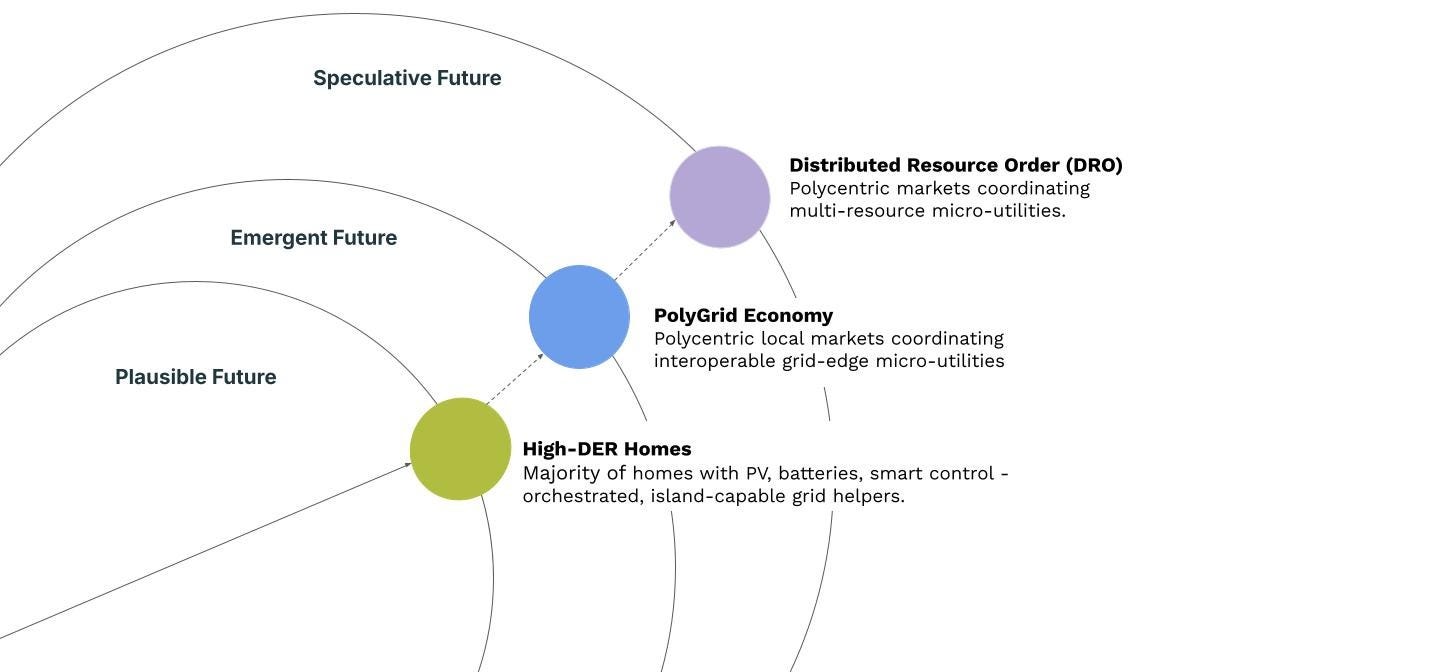
Once most homes are prosumer nodes, the system gains new moves. Local coordination stops being a pilot and starts being a market.
That next layer, an Emergent Future is the PolyGrid Economy: polycentric local markets where interoperable, grid-edge micro-utilities trade flexibility, capacity, and ride-through. Neighborhoods compose resources like Lego, a school’s canopy covers the dinner peak; a block of homes provides frequency response; a cold-storage business sells resilience during heat waves. The roles of “customer,” “asset,” and “operator” blur, by design.
Push one layer further to a Speculative Future and you reach a Distributed Resource Order (DRO): a ruleset where multi-resource micro-utilities (electricity, heat, water, ‘x’) are coordinated by markets and protocols, not one-off programs. Now the unit of action is the polygrid, not the single site. Policy pays for behavioral throughput and system reliability, not just installed capacity. The bulk grid’s job shifts from supplying everything to composing what’s already there.
When these parts interoperate, the system compounds.
Why This Matters
Our investment thesis is operational: build for the world that operates around the clock. Elastic Energy for example is both a bet on DER and infrastructure for DER, pivotal technology that makes distributed energy resilient when the robotics adjacency materializes.
The work is to steward preferable futures. Not by predicting when robots fold laundry, but by ensuring that when they do, homes can breathe and grids can, too.
Back at UCSD, the work Andrew & the Agile Electrification team presented was compelling. It still is. What changed was the vantage point. Stand outside the diagram and watch the futures illuminate each other. That’s where leverage concentrates. That’s where we’ll keep placing capital.
The original backcast illuminated one path forward. The adjacent futures showed which paths could compound and accelerate the inevitable.
This is brilliant! I remember that both Shell and MIT have their own scenarios and I’m curious about whether you have trained your LLM to incorporate some of these other scenario frame works?