


This write-up originally appeared on LinkedIn.
Last year, in Possibilities Come with Responsibilities, I wrote about the Dubai Future Forum as a place that stress-tests our assumptions about progress, prosperity, and climate. This year deepened that exploration, rather than offering another round of glossy “future trends”, the Forum felt like a place where our existing systems were put on the table and pulled apart: how we fund change, govern risk, teach young people, and deploy technology.
Across sessions, the question wasn’t just “What’s coming next?” but “What future are we willing to help bring into being?”.
Government policy teams, NGO leaders, corporate strategists, and capital allocators were all invited into that same conversation, not as spectators to someone else’s forecast, but as co-designers.
In that sense, DFF is less a conference and more a workshop on the wiring of the world: a space where the people who shape regulation, products, and portfolios are asked to rethink the defaults they operate within, and to recognise that the future is not a trend line to observe but a system we are already actively building.
For me, a single phrase from this year’s Foresight & Strategic Philanthropy symposium framed the week: we have an opportunity to earn a foresight dividend and avoid an urgency cost. At its core, a foresight dividend is what compounds when we invest in preparation rather than reaction; urgency cost is what we pay when we wait until a crisis is undeniable and then spend heavily just to stay upright. Almost every session, from philanthropy to AI to climate, was really about which side of that ledger we are on.
💹 The Foresight Dividend
In the Strategic Philanthropy sessions, the most interesting voices weren’t talking about “giving more”; they were talking about building capabilities. Critical thinking, creativity, and futures literacy came up again and again, as infrastructure that is needed. Foundations working in education, youth empowerment, and community development described a pivot from funding projects to funding social architecture: spaces where people can think together, prototype, and contest the future on their own terms.
This is where foresight stops being a niche discipline and becomes a form of risk management. When local organisations gain the skills to scan for weak signals, map systems, and design multiple futures, they are less dependent on distant donors’ priorities. Impact data and listening tools become shared assets rather than reporting burdens. The foresight dividend shows up as fewer firefights, more early interventions, and communities that are partners rather than beneficiaries. The urgency cost is everything we pay when we don’t make that shift in time.
🌍 Foresight for the Planet
That idea crystallized for me during the inaugural Foresight for the Planet awards.
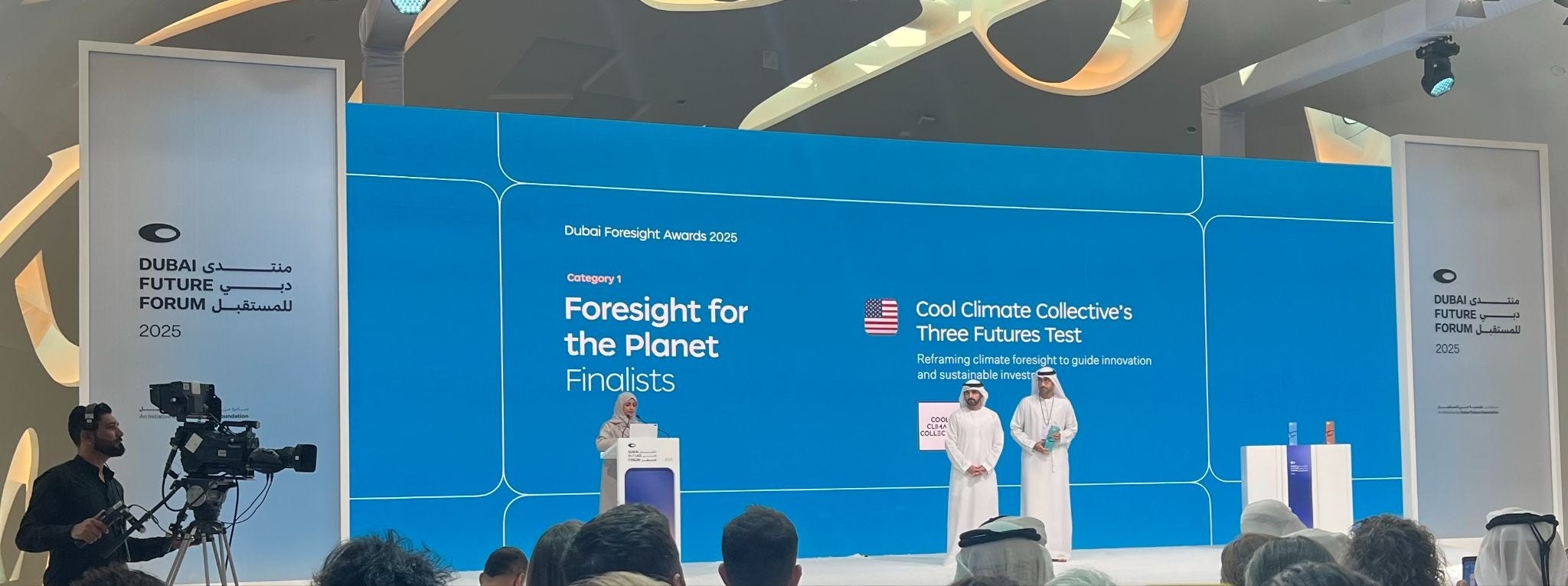
We were honored to have His Highness Sheikh Hamdan bin Mohammed bin Rashid Al Maktoum, Crown Prince of Dubai, present the inaugural Dubai Foresight Awards, and in the category of Foresight for the Planet, three very different “frameworks” were recognized side by side:
Congo Basin Futures,
UNDP’s Seeding the Future in Egypt’s Nile Delta,
and our Cool Climate Collective’s Three Futures Test.
What struck me was the diversity of applications that emerged as the leading finalists for this category from the hundreds of projects & frameworks from over 50 countries.
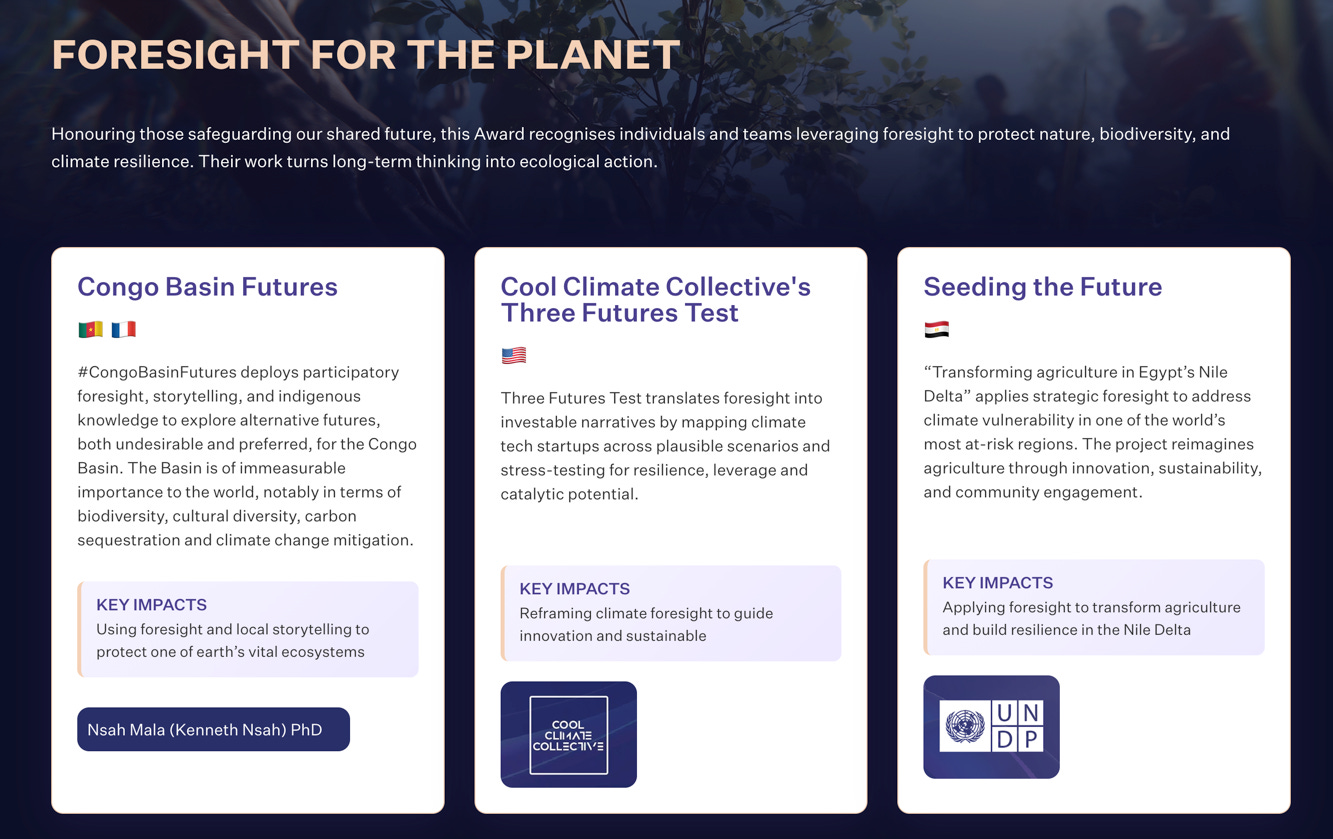
Congo Basin Futures uses participatory foresight and indigenous knowledge to protect one of Earth’s most critical ecosystems.
Seeding the Future applies futures thinking to agriculture in a region where climate vulnerability is already a daily reality.
Our own Three Futures Test applies our foresight framework into climate finance, stress-testing early-stage ventures across multiple scenarios so capital can move earlier and smarter.
One category with three very different arenas: forest, food, finance, linked by a simple conviction: long-term thinking only matters if it turns into decisions that change local conditions.
Standing alongside projects that are delivering tangible impact across a river basin and a delta was a humbling reminder that our frameworks aren’t abstractions; they’re interfaces. If they’re useful, they help governments, NGOs, and private investors see the same system from different vantage points and still agree on what to do next.
🎯 Focus in an Age of Infinite Expertise
Another core theme that was anchored in Khalfan Belhoul’s opening keynote, was the idea that focus is becoming the scarce resource.
With AI at our fingertips, we live in a world where everyone and no one is an expert. Any question can be answered convincingly in seconds; the problem is deciding which answers deserve our finite attention. Corporate leaders from education technology, consumer goods, and finance all described the same tension: information is exploding; decision bandwidth is not.
In that context, foresight is less about producing more scenarios and more about curating the few that matter for a given decision. Focus becomes a governance question: which futures are we willing to spend time on, and which do we quietly rule out because they don’t fit our current incentives?
Organizations that protect deep focus, time for teams to work through uncertainty rather than skim across it, are effectively buying an asset others are giving away for free.
🤖 Generating Futures vs Owning Them
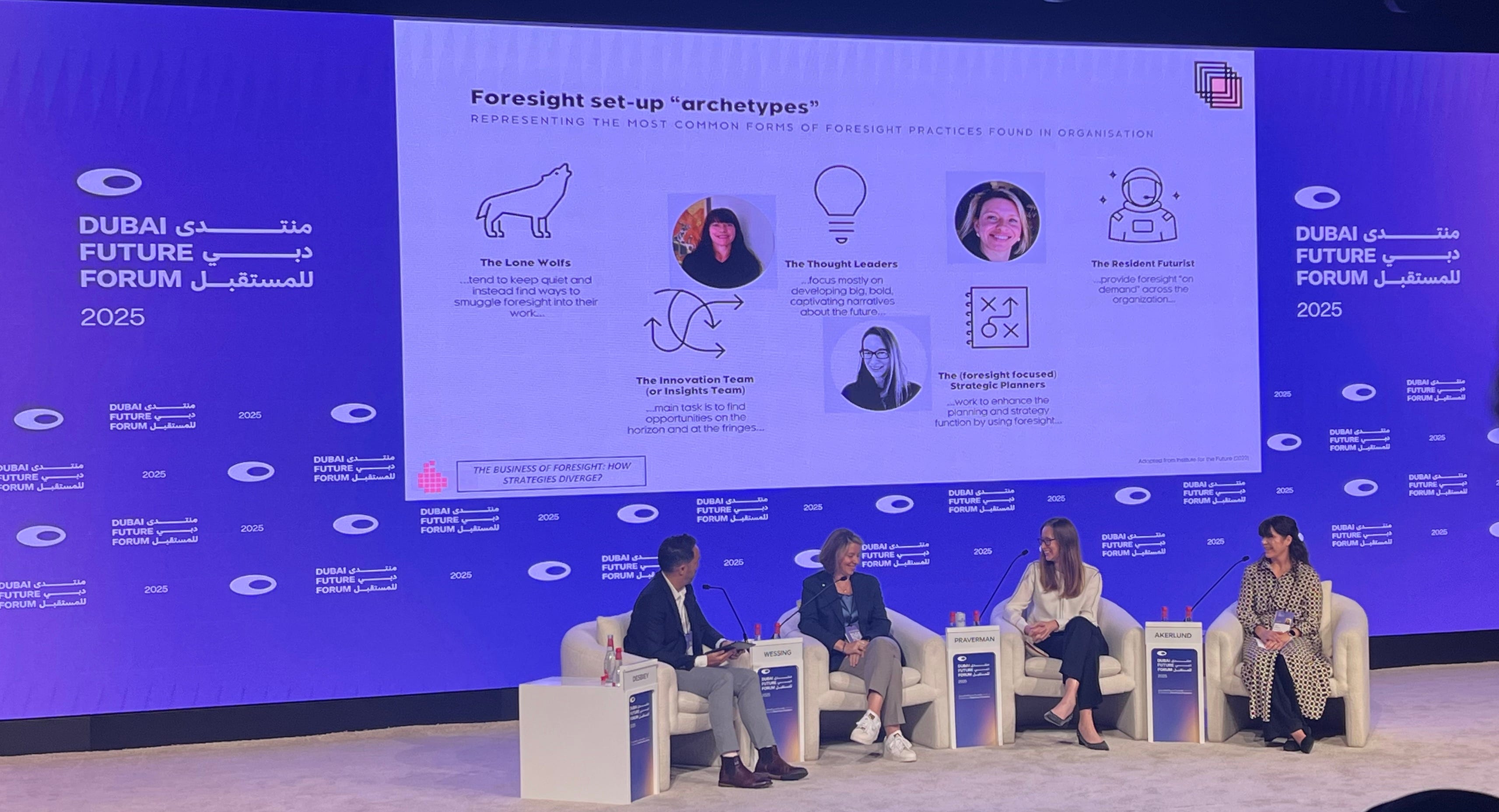
The “Business of Foresight” session, with leaders from Shell, PepsiCo, IKEA and AXA, began with a simple question: what role can foresight practitioners realistically play inside very large organizations?
As they compared where their teams sit in the hierarchy, how close they are to real decision rights, and when they’re brought into the process, a second tension emerged: how to use AI to do more of the analytical and narrative heavy lifting without outsourcing human judgment. Each company is experimenting with AI, using it to scan signals, generate narratives, and translate scenarios into the language of marketing, strategy, or risk. AI can now draft compelling future stories, sometimes faster and cleaner than humans. That is both a gift and a trap.
The gift is obvious: AI expands the option space. It can help teams see adjacencies, edge cases, and cross-sector analogies they would never have time to explore manually. The trap is more subtle: if we let the machine not just draft the story but also decide which stories are worth telling, we outsource our own discomfort.
Foresight is supposed to surface our biases and blind spots, not hide them behind fluent text. The most thoughtful practitioners in that room were clear: AI can amplify foresight work, but the responsibility for choosing a future and being accountable for it, remains stubbornly human.
Our own work to extend the Three Futures Test with AI is still evolving. We’re experimenting with bridges between structural, mechanistic models, like those used by central banks, and statistical approaches to causal inference grounded in real-world data. These are early steps toward a shared Causal Intelligence that, I hope, will become part of the common toolkit for foresight practitioners and climate investors in the years ahead.
I’ll be testing some of these ideas soon in a different arena. At the World Economic Forum session on “Adapting Capital for Volatile Markets”, I’ll be offering the introductory remarks, using that stage as a seeding ground to bring these foresight frameworks and Causal Intelligence explorations into conversation with some of the world’s largest funds exploring Nature Based Solutions.
The real opportunity is not for any single model or manager, but for capital at scale to start treating foresight as standard practice rather than a niche craft, so that, in a more volatile world, long-term responsibility and resilience become core features of how we allocate capital, not afterthoughts.
🪐 What Is Our Future as a species?
The Forum also nudged the conversation beyond sectors and balance sheets to a simpler question: What is our future? Not us as a society, not as a civilization, but as a species.
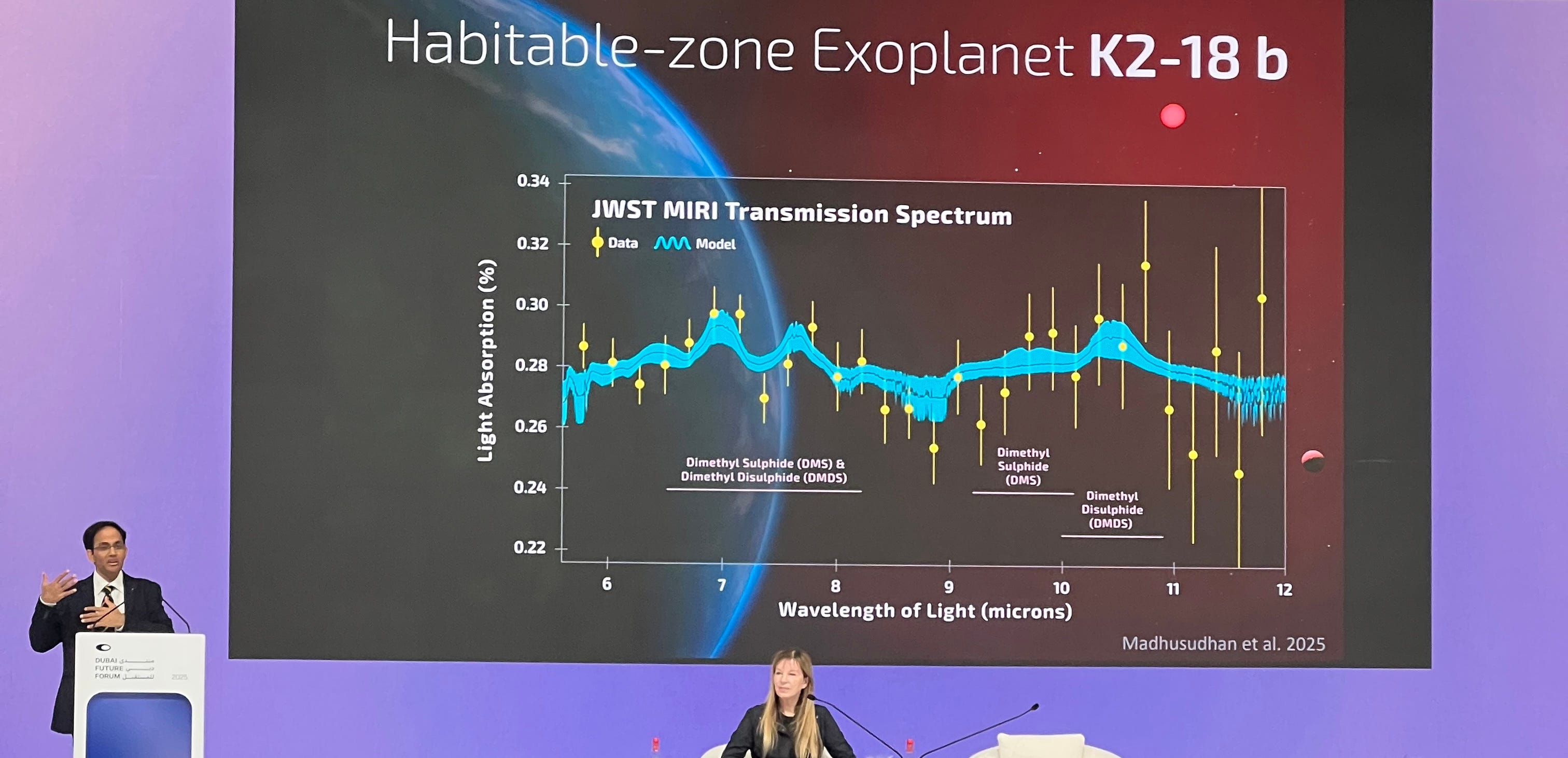
Nikku Madhusudhan reminded us that we now know thousands of planets orbiting other stars, each with its own atmosphere and potential chemistry for life. We are no longer speculating in a vacuum; we’re one data point in a growing catalogue of worlds. The discovery of exoplanets that could host life in forms very different from our own brings a broader question into view:
Are we prepared to find life as we don’t know it. And how does these discoveries shape our universal view and mental models?
Thinking as a species rather than a sector changes the emotional register of climate and biodiversity. It’s one thing to say “our emissions are too high”; it’s another to admit that on a planet teeming with life, a civilization capable of looking for life elsewhere is undermining the conditions for its own. That shift doesn’t give us policy prescriptions, but it does give us context. Climate finance, rights of nature, and strategic philanthropy become less about “impact portfolios” and more about whether we are behaving like a civilization that is thinking about our long term run.
🐙 The Rise of the Black Jellyfish
Risk language is evolving too. Most of us now know black swans (rare, high-impact surprises) and grey rhinos (obvious, lumbering risks we still manage to ignore), but a newer emerging metaphor that resonated with me at the Forum was the black jellyfish: risks we technically “know” about… the “unknown knowns”, we have the knowledge, but fail to grasp the complexity, feedback loops, and potential for systemic instability. Such as microplastics, PFAS, slow-moving shifts in oceans or food systems, that we still treat as background noise until they will likely (eventually) bloom.
Black jellyfish risks are particularly dangerous for NGOs and private markets because they sit in the gap between knowledge and action. The science is often clear enough; what’s missing is an institutional willingness to change course before the costs are undeniable.
In climate tech investing, we see them in sectors where externalities are well-documented but still lightly priced; in philanthropy, we see them in geographies we know are fragile but keep telling ourselves we’ll get to “after this grant cycle”. Foresight doesn’t eliminate black jellyfish, but it can at least move them from the background of the slide to the center of the decision.
⏳Time Is Not Neutral
Beneath all of this sits the question of time. During a panel on that very topic, Patrick Noack described time as the raw material of foresight and the “fourth, invisible dimension” we work in. But it became clear over the discussion that time is not neutral; it is shaped by culture and power. Western institutions tend to treat time as something to be optimized: quarterly earnings, electoral cycles, project milestones. Many Indigenous and Pacific worldviews treat time as cyclical and relational, woven through ancestry, seasonality, and place.
One mental model that frames this well, highlighted by Lisa Kay Solomon of the Long Now Foundation, is Stewart Brand’s “pace layers” view of civilization: instead of a single system running on one clock, it imagines stacked layers, each changing at its own speed, from the flicker of fashion to the deep drift of nature. When those layers stay in healthy relationships, the fast ones learn and adapt while the slow ones hold memory and meaning; when they fall out of sync, the friction shows up as crisis.
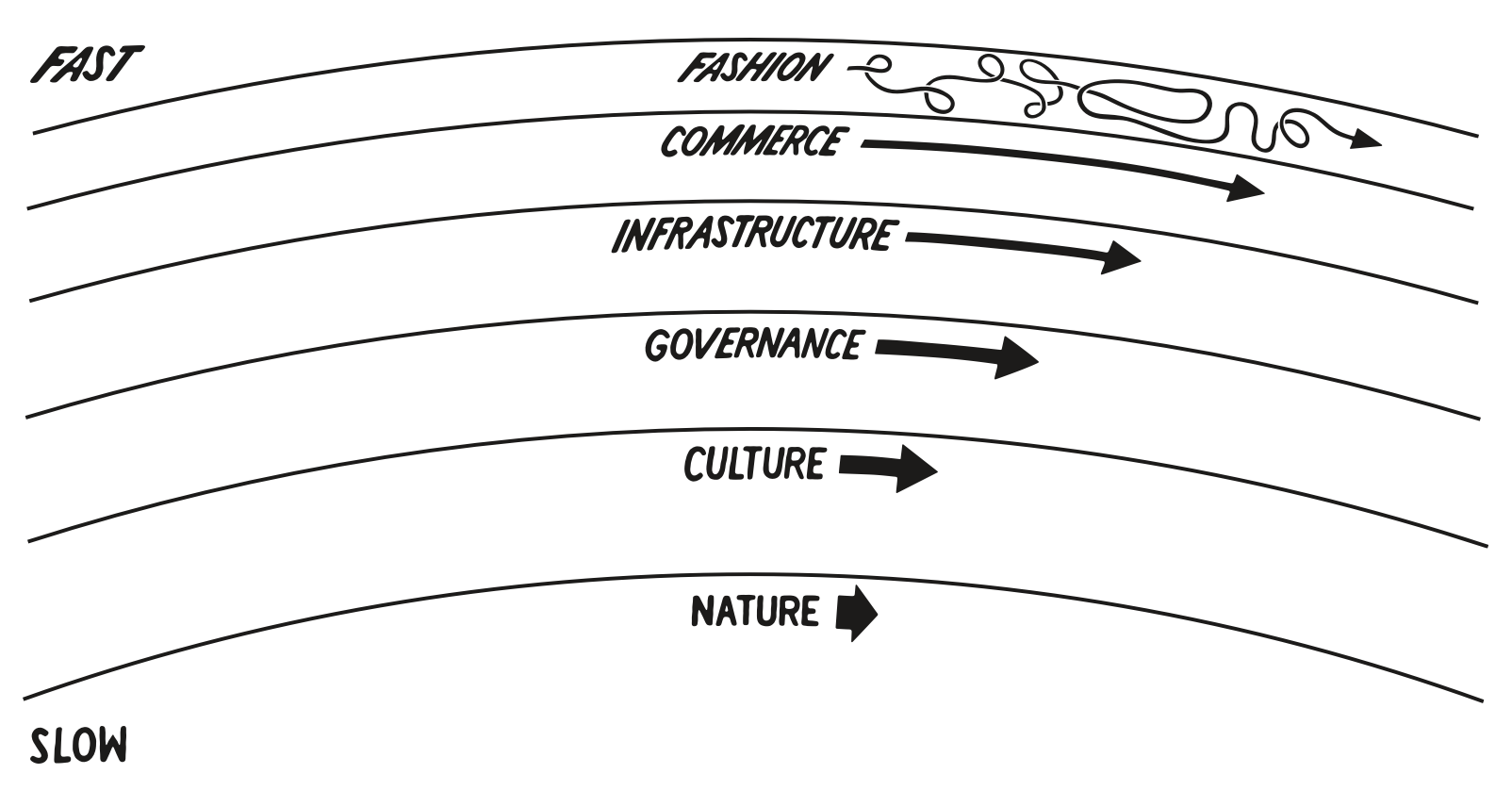
When we let fast layers experiment while slow layers stabilize, we get resilience. When we force the deeper layers (governance, culture, ecosystems) to move as fast as product cycles and stock prices, we get brittleness and revolt. Plastics and forever chemicals are, in that sense, temporal design failures: products whose use-time is measured in minutes but whose harm-time runs centuries.
The real work of foresight is learning to order change in ways that compound regeneration rather than lock-in harm.
Intention Over Reflex
Taken together, these threads, foresight dividends, planetary awards frameworks, AI for causal intelligence, black jellyfish, time, point to a simple, uncomfortable question:
Are we acting with intention about the futures we are building, or just reacting by reflex?
Dubai’s wager, through the Forum and the Foresight Awards, is that foresight can be treated as infrastructure: a capability shared across governments, NGOs, and markets to think longer, act earlier, and design with time instead of against it.
For those of us working at the intersection of climate, capital, and community, that means something practical: fund capability, not just projects; use AI to widen our field of view without delegating responsibility; bring local voices into the room before the crisis hits; and treat every “forever” decision as a last resort.
The future will not reward us for having the most beautiful scenarios or the largest conferences. It will, however, quietly reward those who earn the foresight dividend… by choosing preparation over urgency, regeneration over extraction, and intention over reflex, while there is still time to choose.