


“It’s so hot,” my daughter said in London at three in the morning, exasperated in the precise way a four-year-old delivers a grievance.
The heat had become an imposition. Not a trendline, not a scenario, not a panel topic, but a discomfort that reached into sleep and pulled her out of it. She was feeling the thing itself, while I had spent the week in events and roundtables talking about everything that follows from it.
I lay there after she’d gone back down, listening to the Dyson push warm air around a warm room and thought about how far the heat had travelled to reach her... out of the charts and the scenario decks and the panels I’d spent the week inside, across the city, through the window, into the bed of someone who has never heard the word “anomaly.”
The climate crisis becomes real when it stops being a chart and starts waking up your child.
Fluent in Relief
We were in London for Climate Action Week, the largest climate gathering in Europe, and the city was breaking records while we talked about it. On the 25th, Heathrow hit 36.7°C, the hottest June day Britain had ever logged.
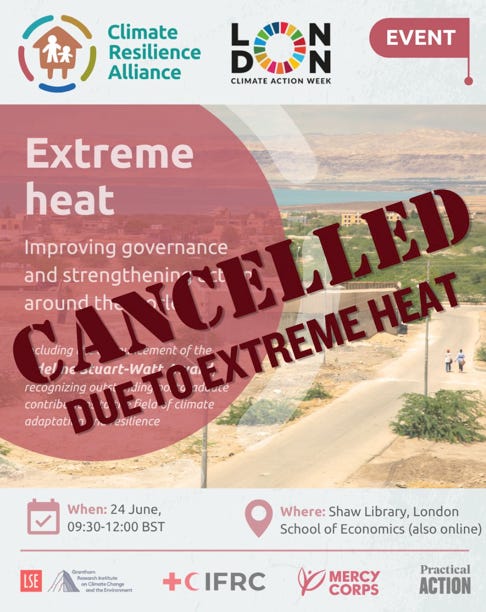
Somewhere on the schedule, a session on extreme heat was cancelled on account of the extreme heat. I have been to a lot of these weeks. This was the first where I watched the subject matter walk into the room and stay... the future, arrived early, a specter haunting the very week we had gathered for.
Underneath the panels, one question kept surfacing all week: how did we get so fluent in expensive relief and so clumsy with cheap prevention?
We have learned how to pay for the damage. We have not learned how to pay for the avoided damage.
Cold, Without Making It Hotter
It started at the World Economic Forum dinner gathering. I was seated next to `Aulani Wilhelm, who runs Nia Tero and has spent a career on Indigenous guardianship of land and water. She has a phrase, becoming an ancestor, building the thing whose benefit outlives your claim on it.
We talked our way into resilience and what she kept returning to was that resilience, in the traditions she works with, is not a feature you bolt on. It is inherent. The old systems were resilient because the people who built them had no way to be anything else.
This made me think of the wisdom that exists within our etymology, for instance in Farsi, the yakhchāl is simply the word for refrigerator. The older meaning is better: yakh, ice; chāl, pit. A domed mud-brick structure that made and kept ice in the desert without electricity... thermal mass, evaporative cooling, a baad-gir, windcatcher, drawing air over qanat water, and at night a clean radiative dump of heat to a dry sky. It made cold while sending its heat somewhere that cost no one... up to the dry night sky, a sink that asks nothing back.
That is the part worth keeping... a compressor moves heat rather than losing it, warming the air outside to cool the air within; multiply that across a dense city and all those rooms cooling themselves nudge up the temperature everyone shares. The desert gave the yakhchāl an open sky to throw heat into that a crowded city can’t, so the two are not a fair fight. But the principle outlasts the mismatch: the cooling worth wanting sheds its heat to a sink no neighbour is asked to pay for.
Good infrastructure does not make its comfort someone else’s problem.
I recall seeing parts of this idea a few years back, an updated blend of old knowledge & new tech, at the House of the Future competition in Dubai, a government-run search for what a desert home should be.
One entry stayed with me. It took the baad-gir and wired it into the newest hardware on the market: an atmospheric water generator, solar PVT panels, a heat pump and earth and palm-fibre walls for thermal mass. Old geometry, frontier equipment, almost fossil-fuel-free and close to self-sufficient.
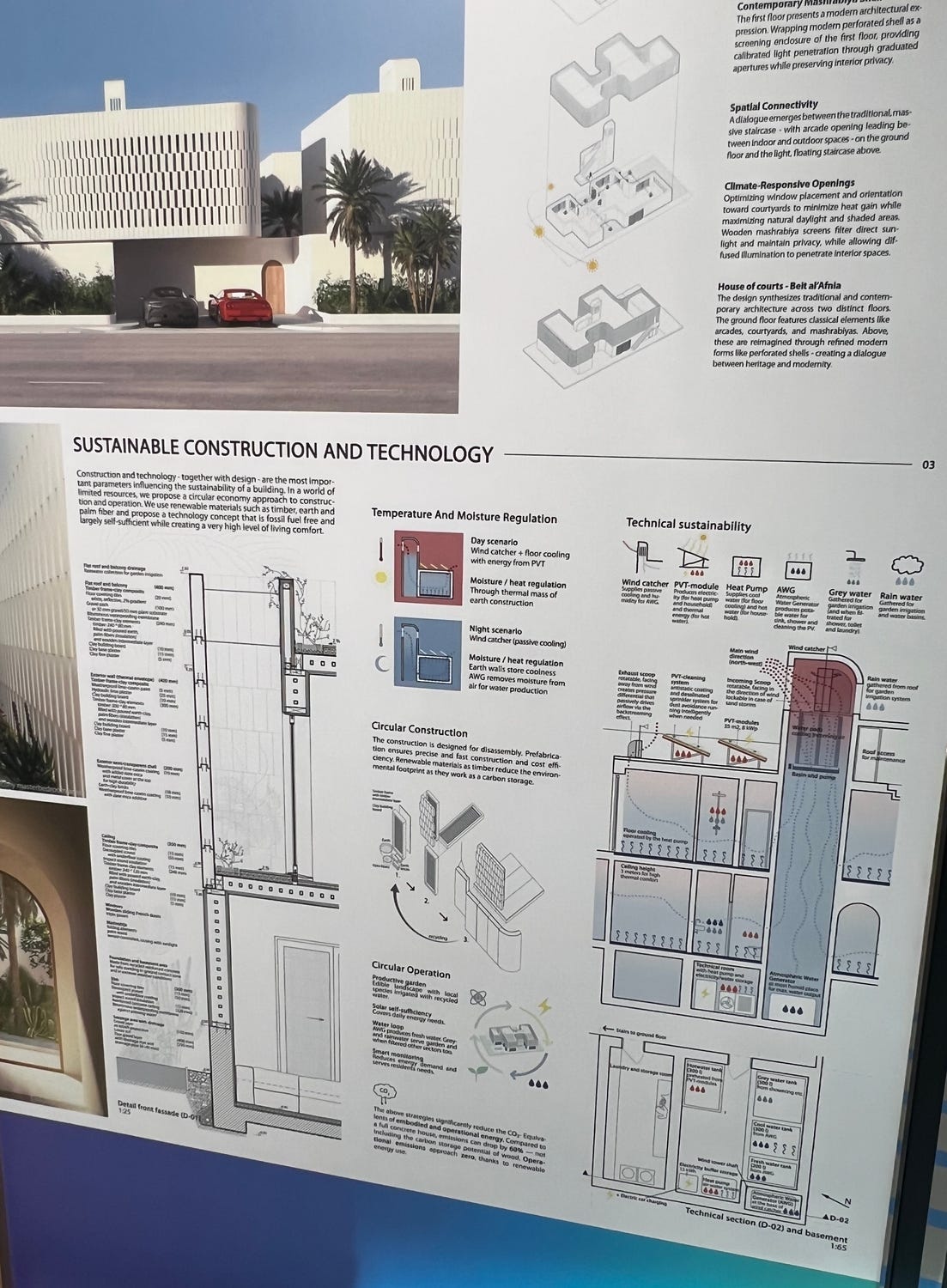
Old geometry, frontier equipment morphed into a passive home for the same desert. The windcatcher kept its place because it still reads the wind better than anything we have built to replace it. These solutions were almost always multi-functional, for the same unglamorous reason: their makers lived downstream of every choice and could not externalise a single one.
By midweek I was muttering my daughter’s line myself, crossing a baking city between venues. It was, in fact, so hot.
From Nowhere in Particular
This is where I become unreasonable about air conditioners...
The room I sat in stayed cool the way most rooms do now: a unit on the wall moving heat from inside to out, buying us a bearable meeting by making the street worse, warming the city in aggregate to do it. It is the same box, sold into every climate on earth... Phoenix, Lagos, London, indifferent to the place it lands in. A solution from nowhere in particular, shipped everywhere in general.
The box scales because it ignores place. Resilience works because it does not.
The yakhchāl was the opposite kind of object: designed from inside one place, almost unintelligible from a continent away. Its intelligence was local because its inputs were: the wind it caught, the sky it radiated to, the water it drew. The most durable solutions are of a place; the exported ones are merely for it. (I’ll save my views on: Sovereign Intelligence is also Resilience Intelligence for another write-up)
We have grown very good at the second kind and impatient with the first. The reflex now is to find one answer and scale it to the world, which might be a fine instinct for software, a costly one for resilience, which is built of soils and slopes and watersheds that refuse to standardise. And the knowledge that fits a place is usually already in that place, held by the people who have lived its failures. We keep flying over it on the way to a product.
A first-principles look says a great many of these placeless solutions should not have to exist, or could be answered by something drawn from the ground they stand on. And somewhere, I will come back to it, there is a solution that runs the other way, rooted so deeply in its place that it earns more the more it prevents.
Does Prevention Pay?
The banker’s objection arrived the next day and it was a fair one. Tim Lord runs climate and energy for HSBC UK; before the bank, he ran the country’s decarbonisation strategy. His point was not philosophical and rather poignant: Prevention has to be bankable.
It needs revenue certainty: a predictable line of cash a lender can underwrite, and a financing ladder patient enough for returns that arrive slowly. The trap is obvious once you see it... the placeless product already has the certainty. The same air conditioner sells into every climate on earth, a clean standardized line item and the hotter it gets the more of them ship.
A solution cut to a single place carries no such guarantee... it is viewed as bespoke by definition and bespoke is hard to underwrite. We finance what scales identically, so we keep buying the box from nowhere, again and again.
Capital likes repetition. Nature pays for fit.
The Cheapest Thing We Own
The answer, or the start of one, came in at an intimate United Nations Office for Disaster Risk Reduction (UNDRR) event. The frame that organized the room: nature is the cheapest infrastructure we have and we keep buying the expensive version anyway. It came with receipts, each a case of prevention made bankable.
Thames Tideway — London’s super-sewer, built as a separate regulated company and paid for, slowly, by the people of the city through their water bills. The city funds it because the city is the beneficiary.
DC Water’s environmental impact bond in Washington, where the payment between the utility and its investors flexes with the outcome: the return rises or falls on how well green infrastructure holds stormwater.
The Greater Cape Town Water Fund, which found that the cheapest way to give the city more water was to clear thirsty invasive pine and eucalyptus from the catchment; trees drinking the supply before it reached a tap. Restoration, run as a water utility.
Quito’s FONAG, an endowment that pays upstream to protect the watershed that waters the city below, and has done for a quarter of a century.
Every one of them is the same move: an intervention that stacks benefits, financed by handing each benefit to the party that values it: the city, the ratepayer, the insurer who no longer has to pay the claim.
The taxonomy of how you wire that together: the credit enhancement, the resilience monoline, the floor-and-upside structures, is for the notes. The headline is that prevention can be made to pay and the banker’s objection has an answer.
What the Stewards Know
And here is the solution I promised, the one that runs the other way. ʻAulani had handed it to me back at dinner and it took the rest of the week to see why it mattered.
Take a hillside that slips and potentially devastates a whole town. The engineered answer is a retaining wall: one function, pure cost, depreciating from the day it is poured. The answer the land’s stewards carry is older and more productive: terrace the slope into small plots and farm them along the contour.
The same earthwork that holds the hill grows food: subsistence in one place, a high-value market crop in another. One act, doing prevention and production at once. The slope holds, the plot earns, the place feeds itself.
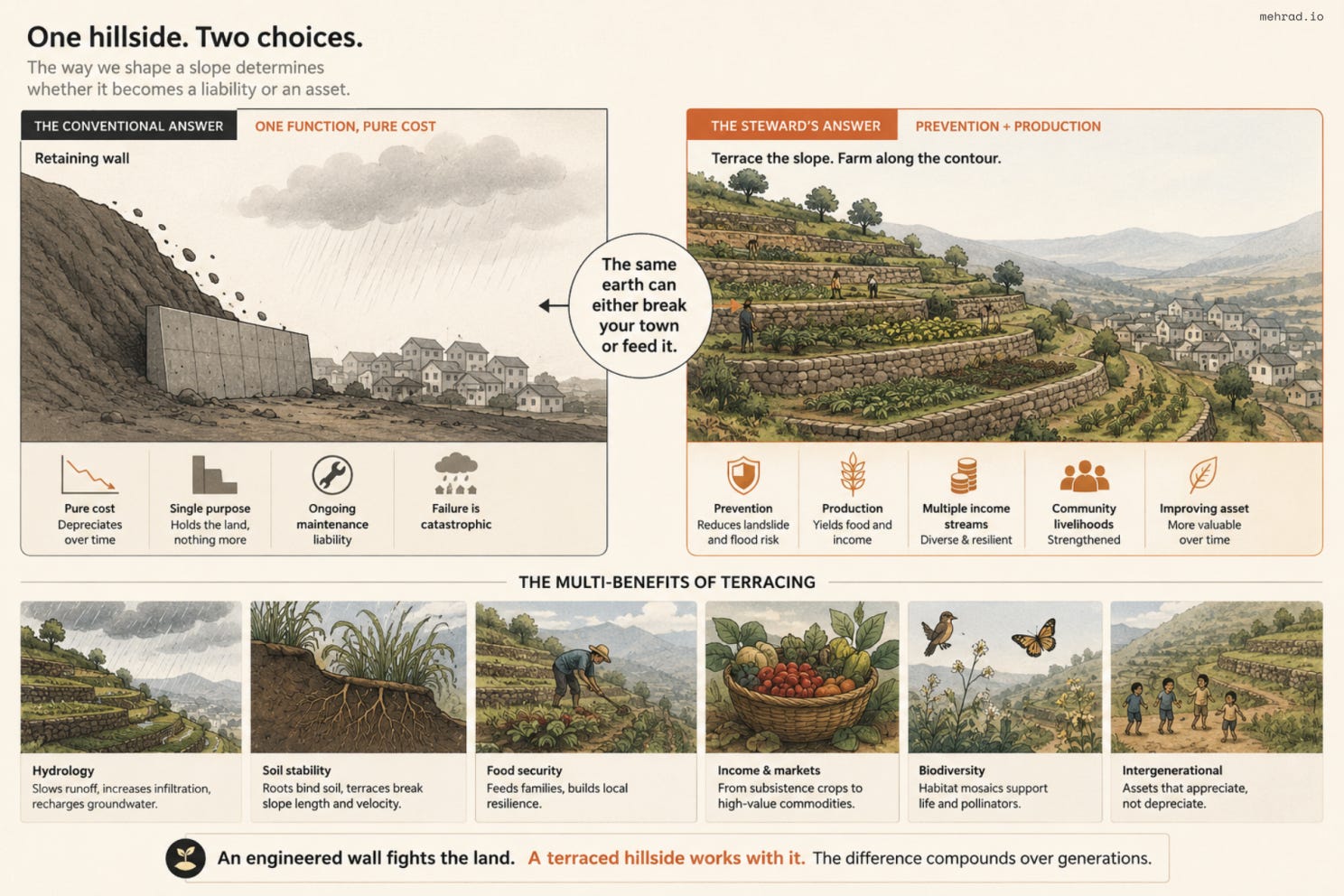
It is the exact inverse of the air conditioner: an answer grown from the specific hill and the hands that work it, worth more the more disaster it quietly prevents.
That is the whole argument of the week, that could be seen from atop this ‘hill’.
The Operating Envelope
It’s important to remember that every asset has an ideal operating envelope. For instance, solar output derates in heat. Batteries behave differently across temperature ranges. Data centers throttle when their cooling fails. People sit inside an envelope too. Human performance is infrastructure, studies cluster the peak of cognitive and physical work in a narrow band, roughly 21 to 23°C, with output falling away as a building runs too hot or too cold. Read this way, comfort is a resilience input and cooling is part of the envelope that keeps the system running.
Comfort is not softness... it is the condition under which people and systems perform.
As volatility turns heatwaves from anomaly into operating condition, the live question is whether we are willing to let our buildings, grids, data centers and people quietly derate. Scarcity thinking rations cooling, accepts the lower performance and dresses it up as virtue.
Resilience thinking designs the system so that clean, abundant energy and efficient, place-fitted cooling keep high performance available to everyone, and not only to the people on the top floor. The place-based designs do half the work here: a yakhchāl, a windcatcher, an earth wall lowers the load before a single watt is spent and clean capacity covers the rest. Build enough of both and human performance stays protected as the climate gets harder to operate in. That is the whole game: enough clean headroom that productivity and the planet stop being a choice anyone has to make.
2040, Again
This past week, I was reminded of a moment I have written about before. Years back, I was setting up a custodial account for the same little girl who had awoken to the heat this past week, I filled in her birth date, and the screen returned the year she turns eighteen and the account becomes hers: 2040. It landed like an alarm bell.
At that time, 2040 was the year I noticed the IPCC and the net-zero reports keep circling, the one they flag as a critical point, drawn, if anything, by models that stay shy of tipping points, the feedbacks that do not move in straight lines. In that moment it stopped being a figure in a deck and became a date inside my own family: the maturity on a child’s brokerage account and a climate horizon at once, a number I will be underwriting against for the rest of my working life. London handed it back to me a second time, in a hot room, in a hot week.
The week did not hand me a new conviction. It reached back, found the one already sitting with me and refreshed it with a new sense of urgency. The cheapest infrastructure we have has been here all along... in the catchment, the watershed, the terraced hill, the mud-brick dome that made ice in the desert. We keep declining to buy it and reaching for the box that ships anywhere instead, because we never built the instrument that pays for everything prevention does at once. This week I watched that instrument get assembled in pieces, in separate rooms, by people who mostly had not met.
Built to Hold
This is the work we are now trying to make investable at emrgnce: not resilience as a side benefit, but resilience as the underwrite. The first of these initiatives have begun modeling their systemic potential with our friends at Anthos, where we have been early design partners and first investors.
Our goal is to catalyze a portfolio of platforms across sectors, geographies and industries that hold prevention and production together, where resilience and growth are underwritten as a single position rather than traded against each other.
The underwriting is causal, it looks upstream, for the one place where a single intervention pays into several markets at once: the slope that holds and earns, the watershed that supplies and stores. It prices the whole bundle, instead of the one slice a single desk can see.
What pulls the strategy together is the length of the assets. Most of what matters here has to last. A ship is a thirty-year asset; a port, a grid, a coastline, a watershed, longer still. You are underwriting it against four decades in which the climate, the map, and the rulebook all keep moving... heat and storm rewriting the operating envelope, geopolitics redrawing routes around chokepoints and sanctions, decarbonization rules and carbon pricing arriving on a schedule of their own. For an asset like that, resilience is the underwrite itself, the question the model opens with.
A long-lived asset is a bet on the world it will have to survive.
So you stop forecasting a single future and underwrite across several, holding the position that keeps its value whichever one arrives. The place-based logic scales straight into this.
The hillside held because it was matched to its slope; a fleet holds because it is matched to its routes and its regimes, built and run with the operators closest to them, the people who have read those waters and those rules for a living. Maritime is where the thesis cuts sharpest, because a ship meets all three forces at once, every voyage, for thirty years, and where the partners nearest the asset are most worth listening to.
There is a horizon hidden in all of this. A thirty-year asset bought today is still working in the 2050s. The horizon I underwrite against and the one I parent against turned out to be the same horizon. That is the quiet alignment the week in London kept handing me: place-based resilience, underwritten across futures, built with the people already closest to each coastline, grid and community.
The horizon I underwrite against and the horizon I parent against are the same horizon.
The table is small and still being set. I find that the people who belong at it tend to recognize the shape of the problem a few sentences before I finish describing it.