


I’ve made it a tradition to write reflections after New York Climate Week. Not just as a recollection of events & panels, but as an attempt to synthesize the flood of ideas I’m immersed in. This year, the thread I was following revolved around the narrative of shifting economics: migration, resilience, adaptation. Or in one word: continuity.
A wedding, a storm & a flight that never boarded
In the lead up to NY Climate Week, I was in Florence for my cousin’s wedding. The next day, I was meant to begin the chain of flights that would take me to New York for Climate Week. Bags in hand, rental car returned, we enter the terminal… and then: cancelled.
The Mediterranean this summer ran hotter than usual, loading the air with moisture like dry tinder. A late-September shift in the atmosphere struck the match, and storms bloomed out of clear skies. In today’s climate, overheated seas are the quiet accelerant, turning blue skies into cancellations in minutes.
That moment reminded me of something we rarely name but all depend on: continuity is the first thing we assume, and the last thing we insure.
We flick a switch and expect the lights to come on.
We turn the tap and expect water to flow.
We book a flight and expect wheels to leave the runway.
Modern life is built on the unspoken assumption that tomorrow will look like today, that the system will keep humming. It’s the most valuable thing we own, and yet we treat it as free… until the weather, the grid or politics prove otherwise.
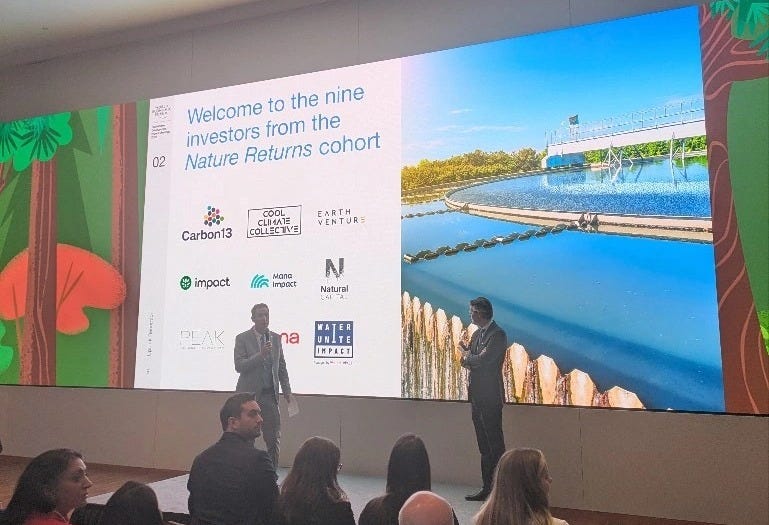
Water as a Foundational Economic Catalyst
One of my first stops in New York (once I finally made it into the city) was a session at Goals House with Matt Damon and Vedika Bhandarkar of Water.org. It’s easy to dismiss Damon as the celebrity face, but what struck me was the financial architecture behind their model and how fluently he articulated it. His grasp went well beyond advocacy; it was systems design, explained with clarity and conviction.
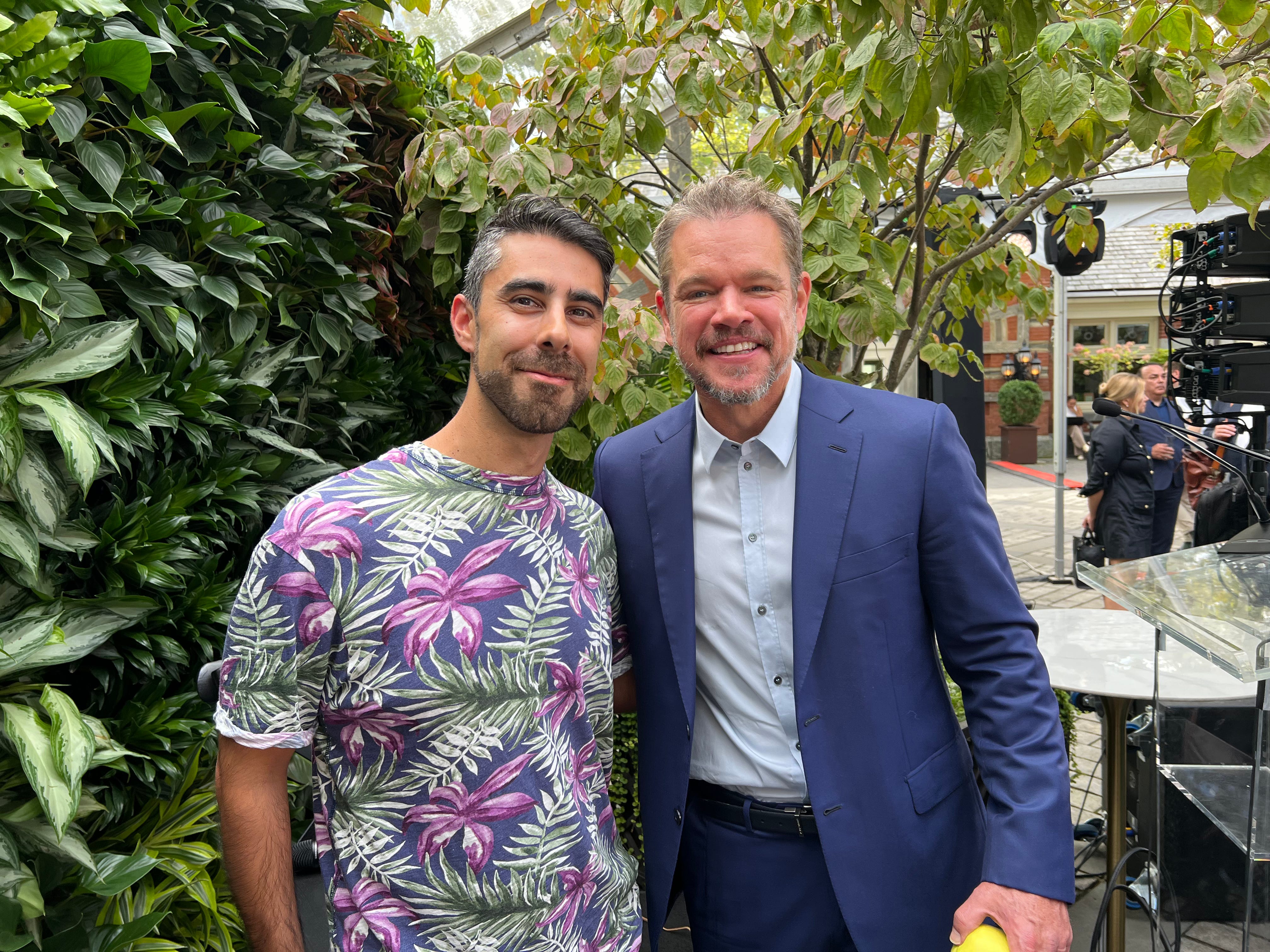
Water.org doesn’t just dig wells… although many still think that’s their work. Today, they’re a force in leveraging micro-loans for water resilience, delivered through local micro-finance institutions. And their repayment rates? ~98–99%.
Why? Because water is essential, and because access frees up & enables real value flows for household income or education.
It’s a masterclass in leverage: philanthropy as the catalytic layer, pulling in multiples of commercial capital. A design shift so $1 donated can crowd in $20 of lending.
Two lessons stuck with me:
Access beats charity. Families repay not out of gratitude, but because water compounds into income, dignity and economic stability.
Blended capital isn’t a bug. Philanthropy de-risks, investment scales, local lenders sustain.
In finance we call it crowding in capital. In human terms, it’s called futures.
From Leverage to Lived Practice: Financing Climate Deals
That insight from Damon’s session echoed in my own panel later in the week, where I spoke alongside peers on “How Climate Deals Really Get Financed.”
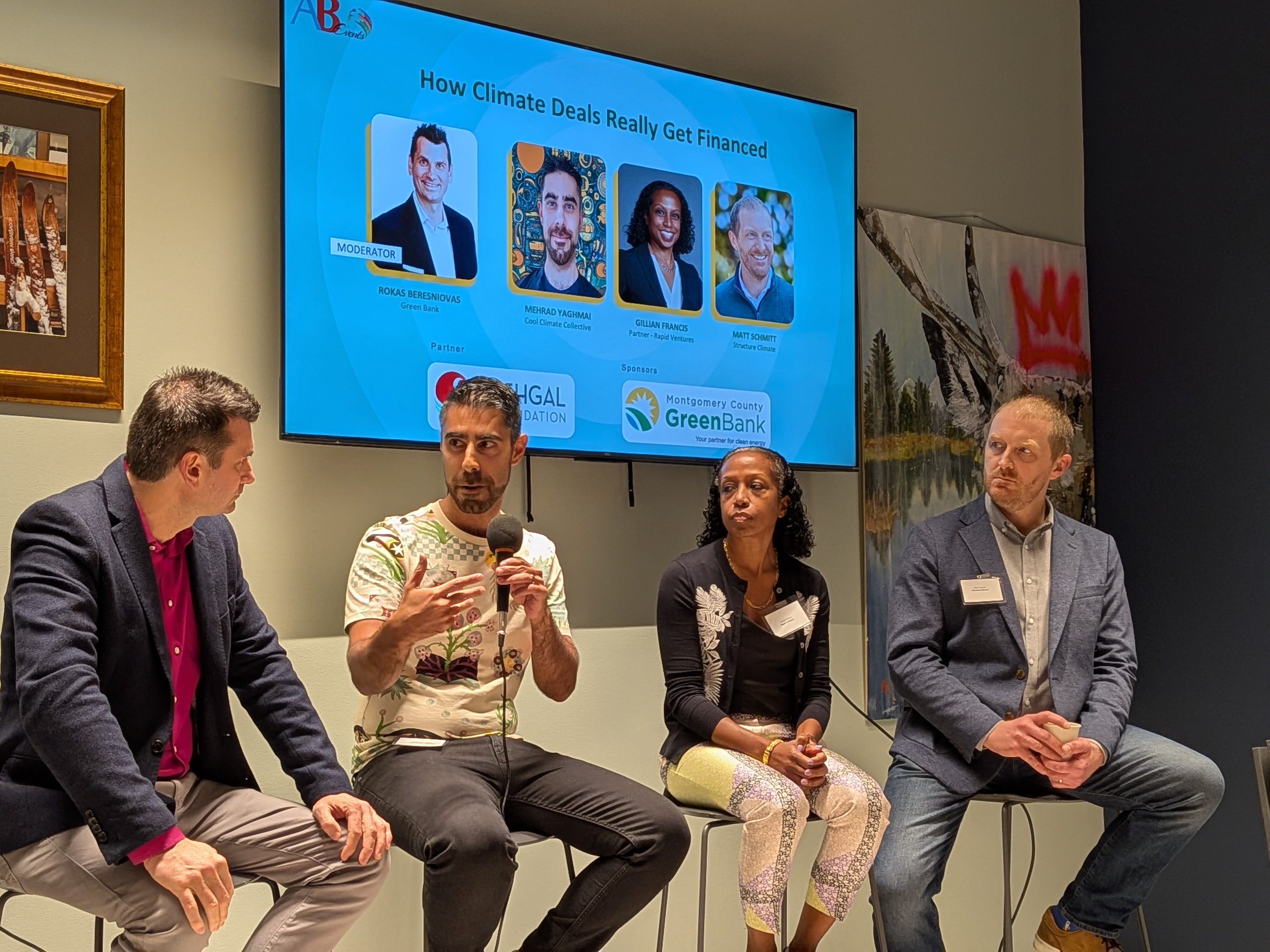
Our discussion unpacked the capital stack for hard-to-abate sectors — cement, chemicals, steel, etc. Exploring what it takes to move projects from pilot to portfolio:
Public incentives (IRA credits, or what remains of them, state programs).
Mission-driven capital (green banks, guarantees, philanthropy).
Private markets (project finance, debt, insurance, securitization).
The lesson is the same as Damon’s microloan story: capital structure is destiny. Get it wrong, and breakthroughs stall. Get it right, and pilots scale into industries. Continuity is manufactured through design of contracts, incentives, and guarantees.
When the Well Runs Dry, So Do Options
The absence of water is not just thirst; it is the foreclosure of futures.
Water is the first credit line we all draw upon. Without it, no loan of education, health, or opportunity clears. A child walking hours with a bucket is not in school; her balance sheet of options never compounds.
A village without water doesn’t just lose its crops, it exports its children. Migration begins not with ambition, but with scarcity.
In financial terms, water is principal, not interest. Every other investment: microloans, schools, clinics, accrues only once water is secured. Scarcity turns continuity into a privilege, and the decision to stay or leave is often written in the aquifer.
The underlying reality is stark: mass migration will define the coming decades as the continuity of a stable climate unravels. That is why so much of our recent foresight work and research, has focused on the foundational resources that anchor stability and enable resilience in shifting futures.
Our latest investments span from cost-effective water technologies that can operate in energy-limited, arid regions, to innovations that expand global cooling capacity, from skyscrapers to data centers, where continuity of climate control is itself a survival constraint.
Comedy as a Constant
Beyond finance and industry, I make it a habit to immerse in another dimension of Climate Week, specifically exploring how entertainment and culture metabolizes crisis.
At one gathering, creatives and policymakers unpacked how shows like The Diplomat or The West Wing don’t just dramatize politics but seed expectations of what government can and should do.
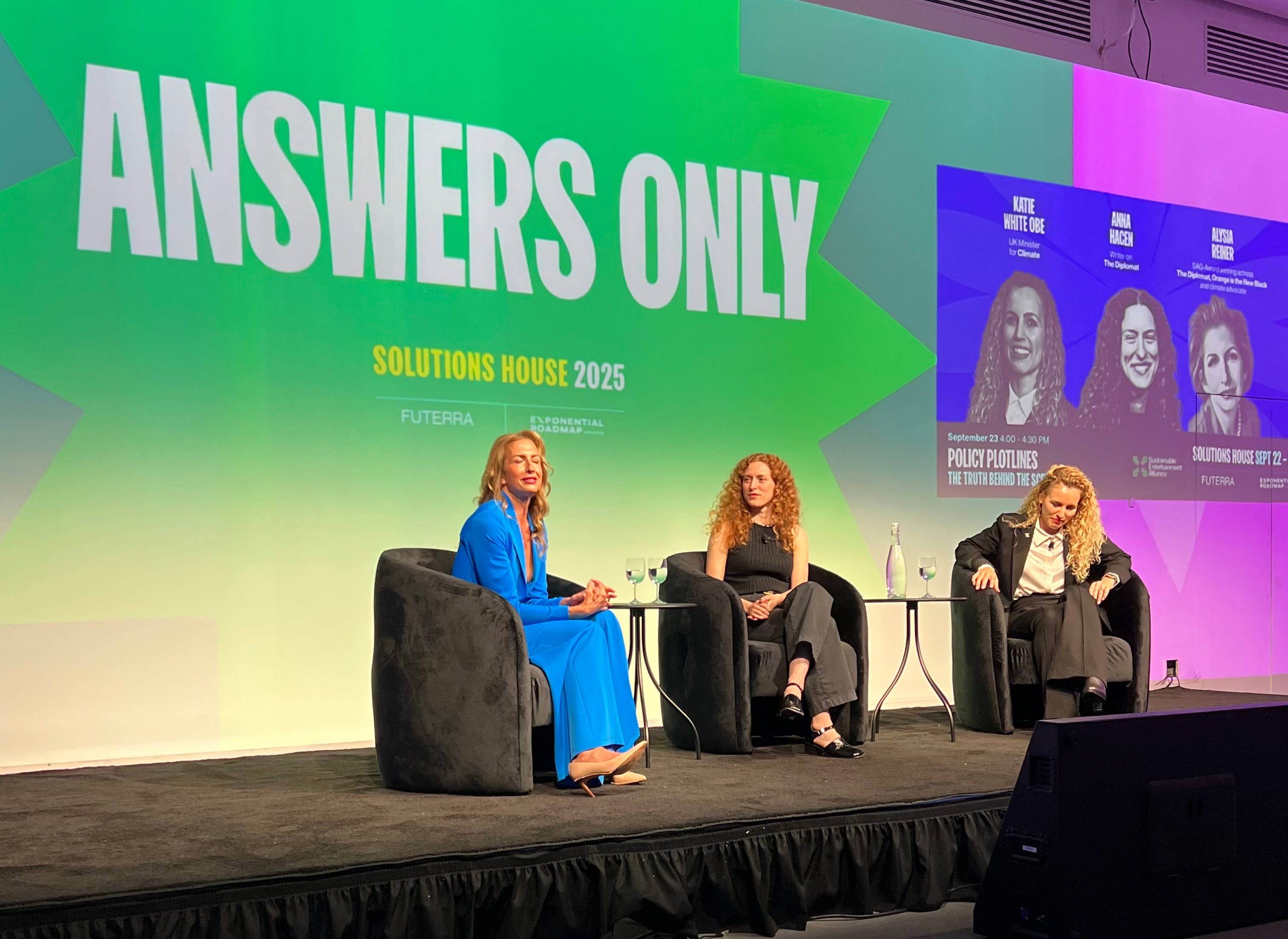
Followed by a late-night event, From Monologue to Momentum, a program presented by the Hollywood Climate Summit and WGA East, in partnership with the Sustainable Entertainment Alliance, I listened to late-night veterans lay bare the mechanics of comedy as translation.
The comedically stacked panel with Emily Erotas (Late Night with Seth Meyers), and Sofía Manfredi (Last Week Tonight with John Oliver, Patriot Act), joined by Nicole Conlan (The Daily Show) and Rollie Williams (Climate Town).
Together they showed how satire can carry audiences across the gap between dread and dialogue, breaking down headlines that might otherwise paralyze us.
The insight was blunt: narratives are leverage too. Just as micro-loans multiply capital, jokes multiply comprehension. A one-liner can bypass defenses that a 40-page report never will. Policy writes rules; culture writes defaults.
And yet, even this continuity is precarious. With late-night shows under pressure, Jimmy Kimmel’s (temporary) suspension being only the latest reminder, comedy itself risks interruption.
Which brought to my mind the recurring Kimmel gag where Damon never gets his slot: “Sorry, Matt Damon, we ran out of time.”
At Climate Week, the irony cut deep: in a climate-shocked world, running out of time is the only punchline we can’t afford.
Continuity in a Changing Climate
Continuity of flights, harvests, elections, and balance sheets is the foundation we never price properly and the first thing climate disruption unravels.
An update to my worldview, sharpened by Climate Week:
Continuity will be the binding constraint. Not water, energy, or capital in isolation, but the unbroken sequence of small things that must go right.
Our models are now actors. Once published, forecasts shape politics and markets. Call it Schrödinger’s climate model: observation alters the outcome.
So model the modelers. Anticipate not just the climate curve, but the reactions of insurers, regulators, and investors.
Finance is the fastest lever. Physics unfolds over centuries, culture over generations, but capital moves tomorrow.
The lesson of Climate Week was that continuity is our most fragile asset, yet also our most overlooked form of wealth. Whether in a household tap, an industrial capital stack, or a late-night joke that metabolizes dread into dialogue, continuity is what allows everything else to compound.
Leverage isn’t only financial, it’s cultural.
Migration isn’t only geographic, it’s economic.
Resilience isn’t only infrastructure, it’s narrative.
If we design for continuity… of water, of capital, of stories… the storms will still come, but the futures they interrupt won’t collapse so easily. Continuity is the quiet scaffolding of modern life. And in a climate-shocked century, it may be the only constant worth insuring.
Continuity budgeting, treating resilience not as a footnote but as cost of goods sold, may be the most radical accounting shift of our age.
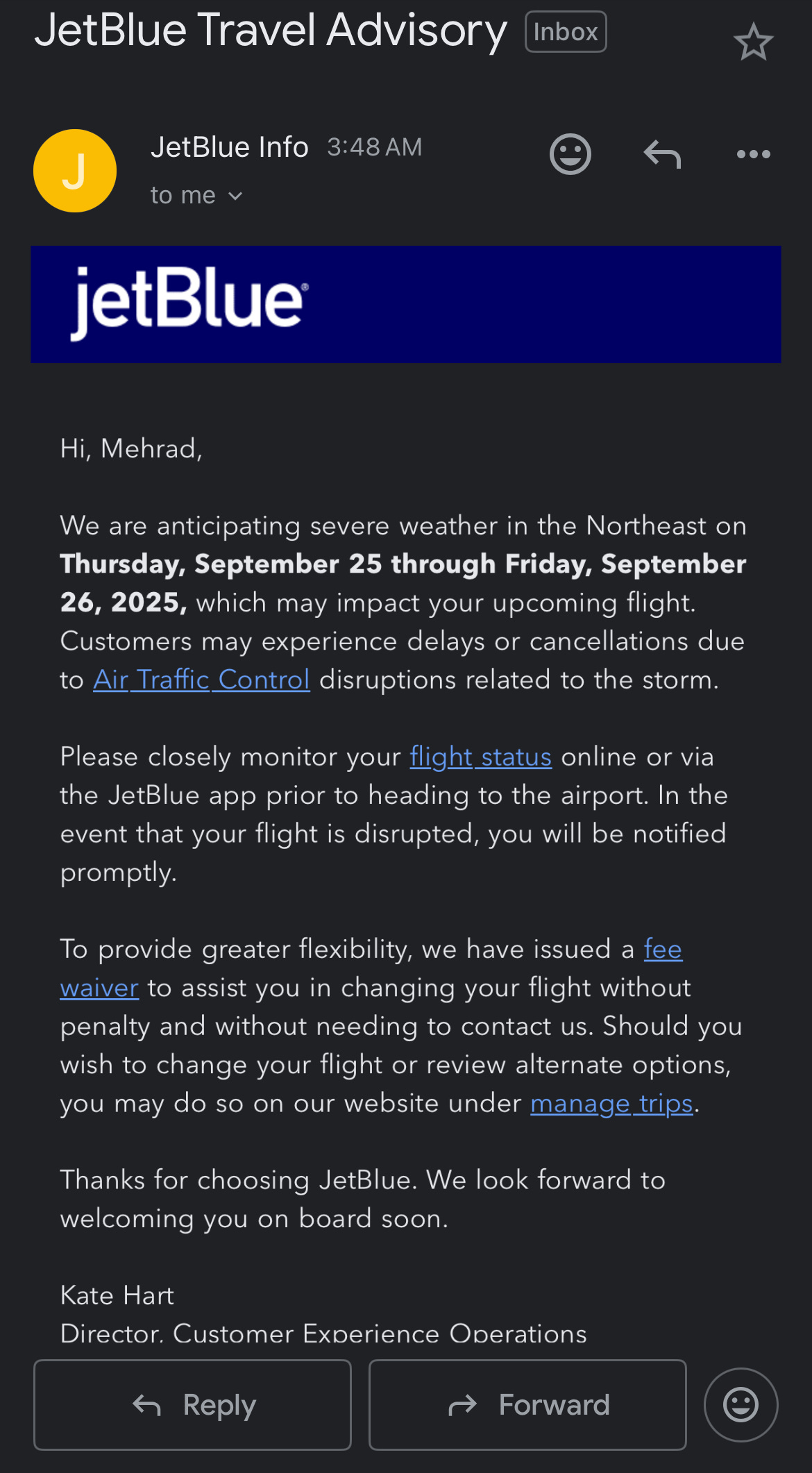
P.S. As if to underline the point, the day before my flight home from New York I received this email from JetBlue… ‘severe weather…. may experience delays or cancellations…’
This post originally appeared on LinkedIn.