


Listen to the AI Narrated commentary overview of the post:
There is a certain kind of room that changes how you think. The ideas inside it may not be entirely new, but the people holding them are, for once, in the same place at the same time, and the friction of that proximity produces something no white paper or conference panel can replicate.
Villars-sur-Ollon sits in the Swiss Alps, roughly equidistant from the frictions of Davos and the comforts of Geneva. The Villars Institute convenes there each year with a mandate that sounds almost quaint until you see it in practice: bring together the people who think in systems, not sectors, and see what they build. This year’s gathering drew sovereign finance architects and coral reef scientists, indigenous land rights leaders and luxury brand CSOs, structured finance architects and deep tech founders… the kind of intellectual cross-section that makes you realize how siloed your individual conversations have actually been.
I was invited to present as part of a working group on emerging innovations and their pathway from proof-of-concept to market relevance. What I brought was a framework. What I left with was considerably more.
These are my notes & the ideas that sharpened my thinking, as well as the provocations I am still working through and directions I am now actively pursuing. In keeping with the Chatham House rules under which the summit operates, no remarks are attributed. The ideas are what matter here.
The Animating Paradox
Every substantive conversation at Villars eventually arrived at the same clearing: nature has value, we just failed to finance it.
This sounds simple, but clearly it is not. It represents a significant maturation in how serious people are framing the problem… away from moral obligation and toward something far more tractable: a financing failure. A structural one, with identifiable causes and, in principle, identifiable remedies.
The societal consensus that nature has economic value is no longer contested ground. The World Economic Forum also recently released their latest report, which quantified over $44 trillion in economic value, more than half of global GDP, as moderately or highly dependent on nature. Governments, corporations, and institutional investors have signed enough frameworks and pledges to paper several conference halls. The bottleneck is belief no longer, but architecture.
For decades, the dominant approach treated nature protection as a government function, funded by taxation and administered through regulation. That model produced real outcomes: national parks, marine protected areas, species recovery programs, but failed to scale anywhere near the rate required. The private market has been handed the baton and it is standing at the line without a clear lane to run in. You cannot finance what you cannot measure, and you cannot measure what you have not yet decided to value on a balance sheet.
What the Villars conversations made clear is that we are now in the architecture phase. Climate and nature have moved from environmental policy issues to global capital allocation issues. The question is how…? That is a very different, and much harder, problem than the one we spent the last decade answering.
We’ve been treating nature like a charity case when it’s always been a compounding asset.
The Archetype the Room Was Asking For
If there was a single phrase that echoed across sessions, it was this: “We need system leadership.”
The framing offered was deceptively simple: think holistically, feel empathetically, act with purpose. What made it land rather than float was the specificity of what it was pointing at. The problems that persist in nature finance, the gap between pilot and scale, the failure of instruments to aggregate into markets, the inability of good science to translate into investable propositions, are coordination failures. Coordination failures require a different kind of leadership than execution challenges do.
The systems leader is the person who holds the boundary itself. The place where the ecologist’s model meets the banker’s spreadsheet, where the regulator’s mandate meets the community’s livelihood, where the startup’s technology meets the institution’s procurement process. These are the inflection points where value is either created or lost, and they require someone whose mental model is wide enough to see all of them simultaneously. The expert goes deep in one domain and hands off at the edge. The systems leader lives at the edge.
This is, not incidentally, the animating idea behind the Bottlenecks Institute. The hypothesis is that the most leveraged interventions in complex systems are almost never the obvious ones, they are the small, structural constraints that, once removed, allow everything downstream to accelerate. Finding those constraints requires exactly the kind of systems view the room kept calling for and rarely found.
Nature as Infrastructure… and Why the Distinction Matters
One of the cleanest reframes to emerge from the summit was also one of the most practically consequential: nature is infrastructure.
The distinction matters enormously for how capital engages with it. Infrastructure carries assumptions that charity does not. It is essential, it requires ongoing maintenance, it generates returns over long time horizons, it can support public-private financing structures, and its degradation is a cost, measurable and attributable. A bridge requires inspection, repair, and eventually replacement. A power grid requires continuous investment to remain reliable. A mangrove system protecting a coastline from storm surge, a watershed providing clean water to a city, a kelp forest sustaining a fishery, these are assets with operating costs, performance metrics, and quantifiable returns. They have been consistently underpriced because we chose not to read them that way. That choice is now expensive.
The 30x30 framework: protecting thirty percent of land and ocean by 2030, was cited frequently as a policy anchor. The more interesting conversation was about which thirty percent. Protecting the easiest or most politically tractable areas produces a number, not an outcome. Biodiversity hotspots, the concentrated zones of irreplaceable endemic species, represent a small fraction of total land area but a disproportionate share of ecological function. The targeting problem is as important as the financing problem, and the two are inter-connected: a financial instrument built around a precisely defined and measurable asset is categorically more bankable than one built around a diffuse, politically determined one.
Infrastructure isn’t built once and forgotten. Neither is a forest.
The Food System Is Where Theory Meets Urgenc
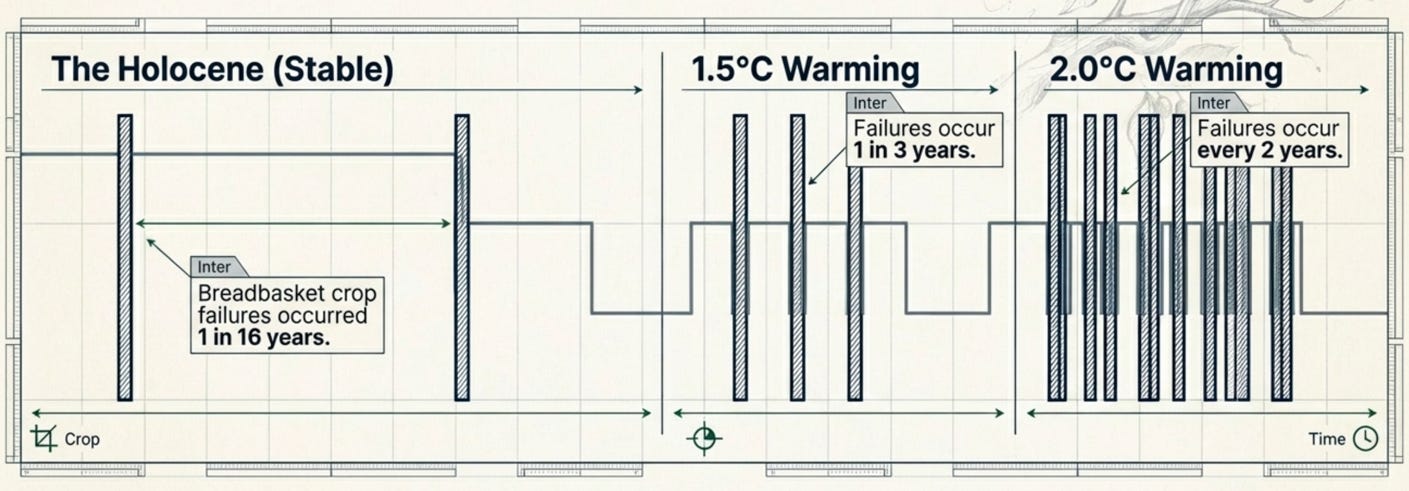
If there is one data point from Villars I expect to be quoting for years, it is this: in the Holocene, the climatically stable period in which human civilization developed, breadbasket crop failures for staples like corn and maize occurred roughly once every sixteen years. At 1.5 degrees of warming, that becomes once every three years. At two degrees, it is every other year.
Read that again slowly. A system designed by agriculture, supply chains, commodity markets, food policy to handle a failure event once in a generation will face that same event in consecutive years within the lifetime of infrastructure being built today.
The actuarial math of feeding humanity has already changed yet most of the financial models have not caught up.
The food system conversation moved quickly from the statistical to the structural. Monoculture at global scale, optimized for yield and commodity price, is elegant in its efficiency and catastrophic in its fragility. More than 60% of global calories currently come from just three crops. The system was not designed for redundancy; it was designed for throughput.
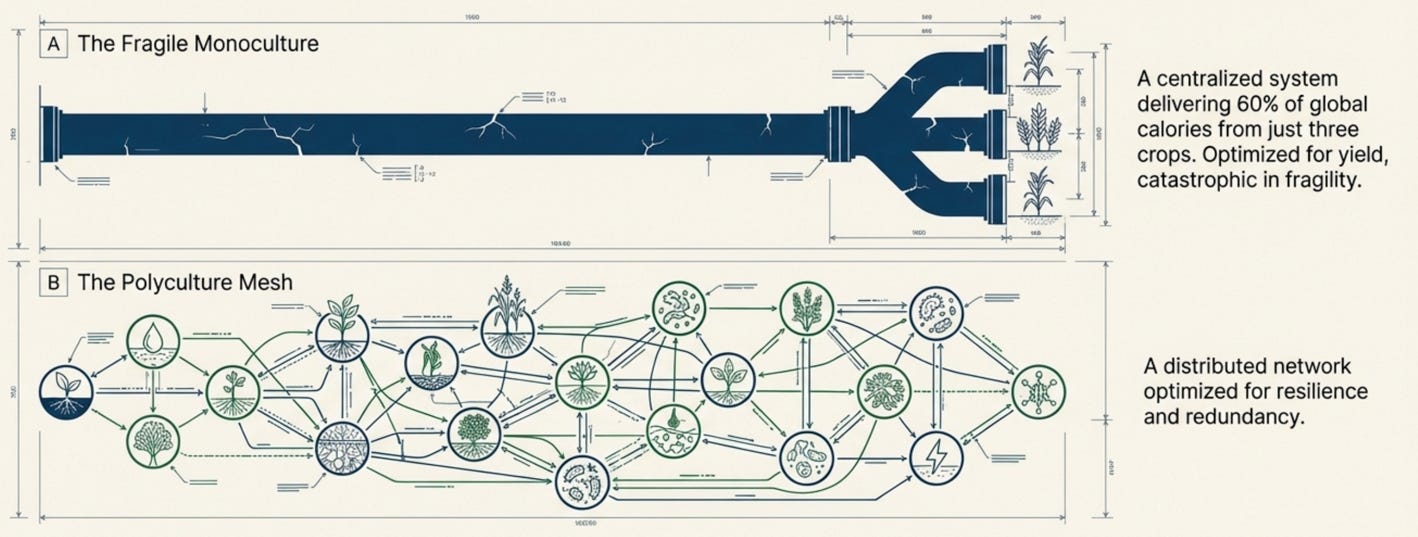
The alternative requires rethinking the entire economic architecture of agriculture: what is subsidized, what is insured, what is exported, what is consumed locally, and whose cuisine gets treated as heritage versus commodity.
This provoked an idea I am still developing: the localization of food systems may be primarily a cultural story, not an agricultural one. Regenerative, polyculture farming genuinely rooted in local terroir and culinary tradition creates a cuisine that cannot be replicated at industrial scale and that rarity is precisely what makes it valuable. The high-end restaurant in Tokyo or London serving a dish anchored in a specific microregion’s biodiversity is simultaneously a conservation finance story, a rural development story, and a sovereign identity story. The export premium funds the local ecology that makes the product possible. The cuisine is the business model.
The transition cost question was put simply in the room: who will pay for growers to change? The answer that resonated most was not governments or philanthropists but the value chain itself… spreading transition risk across every party that benefits from a more resilient food system. That logic connects directly to the financial architecture discussed later in this piece. And separately: agricultural subsidies in most major economies are weight-based and crop-specific, which means the most effective reform strategy may be to redirect their intent rather than challenge their existence.
If an enhanced or alternative crop meets the qualifying criteria on fewer acres and generates more economic value per unit of land, the subsidy program effectively becomes a transition mechanism. The government doesn’t change the policy. The farmer changes the crop and the system shifts.
There are no non-radical food futures. The question is only which kind of radical we choose.
The Financial Architecture: What’s Emerging
The summit’s finance conversations were the most technically dense and, in places, the most generative. Several structural ideas surfaced for me that deserve wider circulation.
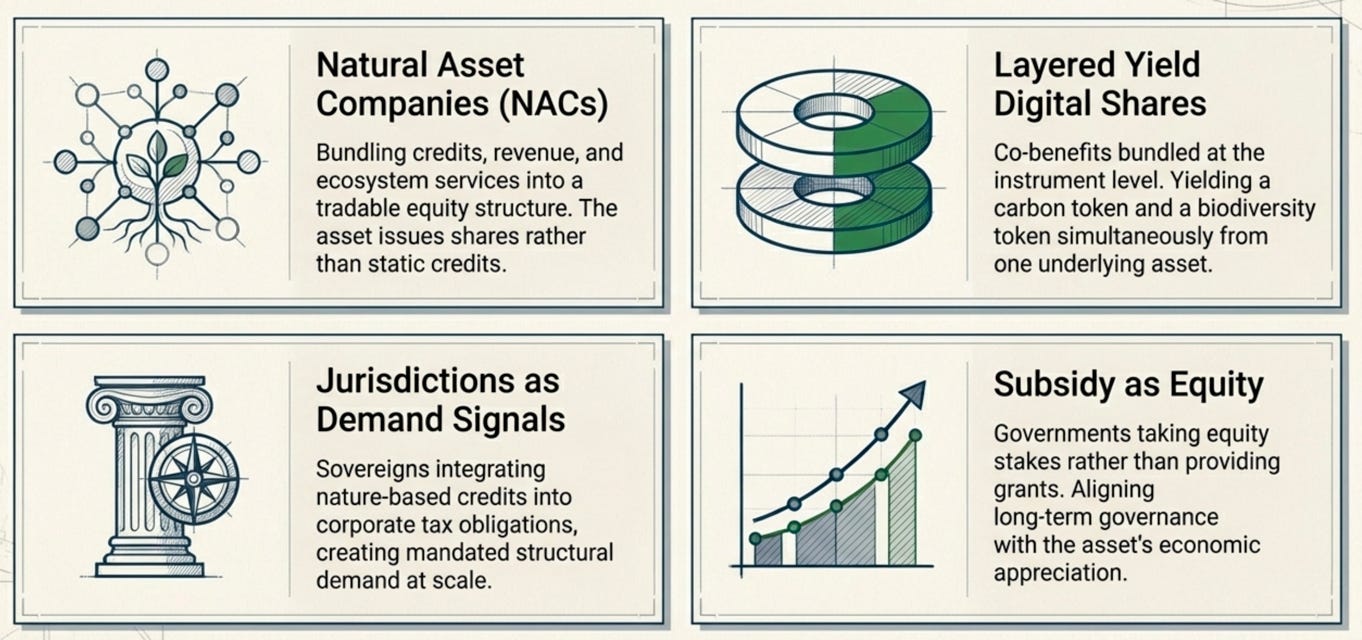
Natural Asset Companies represent perhaps the most architecturally interesting instrument. The concept: bundle all the credits, revenue potential, and ecosystem services associated with a natural asset into a share structure, something that trades and behaves like equity, with all the liquidity and transparency implications that brings. The asset issues shares. Investors buy exposure to the compounding value of a living system, not just a static credit. The critical design constraint is cash flow: a natural asset company without embedded revenue streams is conservation philanthropy in new clothing. The ones that will work are those where the protection of the asset is operationally necessary for a downstream commercial activity — fisheries, tourism, watershed services, raw material supply chains.
Digital shares with layered yields extend this logic to the instrument level. Assign a credit to a digital share that yields a carbon token and a biodiversity token simultaneously. Co-benefits bundled at the instrument, not the project. Most current instruments force investors to choose a primary benefit: you buy a carbon credit or a biodiversity unit, when the underlying asset produces both. Separating the benefits at the instrument level may reduce the value of each, while bundling them more accurately reflects the real economics of a healthy ecosystem.
Jurisdictions as demand signals was one of the more practically actionable ideas to emerge. We spend enormous energy persuading individual corporations to voluntarily create demand for nature-positive instruments, with modest results. Jurisdictions such as cities, regions & nations can mandate that demand at scale, with immediate effect. The example discussed: a sovereign integrating nature-based credits into corporate tax obligations, so that a defined percentage of tax liability can be discharged through qualifying nature finance instruments. Suddenly the question of whether a market for biodiversity credits exists becomes very straightforward.
Subsidy as equity inverts the typical public finance logic. Rather than structuring government support as grants or transfers, which exit the system at project close, structure them as equity stakes. The government remains on the cap table. If the asset performs, public capital appreciates alongside private. This aligns incentives over the full life of the asset and gives governments a legitimate basis for long-term governance involvement that is economic rather than purely regulatory.
The Turning Point was defined with unusual precision: systemic change becomes self-sustaining when a negative externality is both priced and communicated. Pricing alone changes the economics for sophisticated actors. Communication changes the behavior of everyone else. A carbon price with no narrative is a compliance mechanism. A carbon price embedded in a legible consumer story is a market signal. Both matter. The sequence matters too.
Price the externality. Then tell the story. In that order.
The Demand Problem Nobody Wants to Own
Across every session on nature finance, the same structural gap reappeared: the supply of nature-positive outcomes is constrained by the absence of demand signals strong enough to justify investment.
The compliance market has created a floor, but a fragile one, vulnerable to political reversal, methodology disputes, and the reputational contagion that has periodically collapsed voluntary carbon markets. What is missing is demand that is structural: baked into operating agreements, procurement contracts, regulatory frameworks, and financial covenants, rather than contingent on a CSO’s budget cycle or a CEO’s tenure.
The clearest diagnosis I heard across the narrative sessions was blunt: we are good at stats, but not at stories. And because of that, we are not winning. The cleanest structural articulation: “Transactions need to become transitions.”
Individual deals at pilot scale, however well-designed, do not build markets. Markets emerge when transactions aggregate into a repeatable pattern, when the deal structure becomes a template, when the template becomes a standard, when the standard becomes an expectation. That aggregation requires deliberate architecture. More pilots will not produce it.
The analogy that surfaced for me goes back more than a decade… to my time working with the Dubai Future Accelerators and early meetings at the Prime Minister’s Office, rooms where the question was always the same: how do you finance an outcome that doesn’t yet exist?
The instrument we kept returning to was the income share agreement. A student defers payment and repays from future earnings as a percentage of income, aligning incentives across student, institution, and lender around a single outcome: productive employment. The beauty of the structure is what it assumes: that the outcome is real, that it is measurable, and that the financial instrument can be built around the delta between where someone starts and where they end up.
That logic travels. The question worth asking seriously is whether you can build the equivalent for natural capital, an outcome-based agreement where the end buyer commits to a price for a defined ecological outcome, and the delta between current state and that target is what gets financed.
The mechanism exists. It is the Advance Market Commitment architecture, which successfully accelerated vaccine development by pre-committing to purchase at scale before supply existed. Applied to natural capital: a defined buyer commits to purchase a verified ecological outcome at a set price; that commitment is treated as a receivable by the project developer; the receivable supports project finance at commercial terms without subsidy. The Catalytic Cashback Facility framework we have been developing across our portfolio is one expression of this logic — applied initially to operational efficiency gains in maritime and agricultural settings, but pointing at something considerably wider.
An idea without a way to finance it is just aspiration dressed up as a plan.
The Mountain Notices
Between sessions, the summit took us out onto the mountain. The hikes were stunning in the way the Alps always are… the kind of landscape that makes you feel briefly and usefully small. But something was off, and it took a few minutes to name it.
We were walking on ski runs. In March. The snow had already gone.
It happened to fall on the vernal equinox, which for Persians marks Nowruz, the new year, the return of spring, the oldest celebration of nature’s renewal I know. I have spent enough Nowruzes in my life to carry a felt sense of what the season should feel like when it arrives. This did not feel like spring arriving. It felt like winter having already left.

The alpine village of Villars has built its economy, its identity, its entire sense of place around snow. The hotels, the lifts, the restaurants, the families who have run the same chalets for three generations, all of it predicated on a seasonal certainty that is quietly becoming unreliable. We were inside spending three days discussing biodiversity finance and planetary boundaries, and outside the mountain was making the same argument without PowerPoint slides or panel discussions. It was simply showing us.
I asked the question in one of our sessions and it landed harder than I expected: what happens to the ski instructor, the lift operator, the hotel owner, the village economy, when the snow stops coming on schedule? These are not abstract future risks; they are present-tense disruptions to real livelihoods, in a place that happens to host one of the world’s most sophisticated conversations about climate and nature. The irony is not subtle. The mountain is not waiting for the policy frameworks to catch up.
This is the human narrative that tends to escape the technical science of the predicament. The data on crop failure frequencies and biodiversity loss is important and necessary. But the moment that actually lands, the moment that moves from information to understanding, is standing on a bare ski run in the middle of March, in a place that has known snow for as long as anyone can remember, realizing that the transition is not coming. It is here. It arrived while we were still debating the architecture.
What I Brought, and What It Became
My presentation at Villars was built around a simple provocation: early-stage venture investing is foresight, applied to capital. And when that foresight is trained on systems rather than sectors, venture transcends being just a financial returns mechanism and starts to act as a catalyst.
I spent my professional formation in Dubai, working on public-private initiatives designed to catalyze new industries from relatively thin air to attract companies and capital into sectors that did not yet exist in the region and to build the regulatory and commercial conditions that would make them stay. The core lesson from that decade: policy does not create industries. It creates permission structures. Innovation fills them.
That reframe has shaped everything about how we approach venture investing in climate systems. We are looking for the moment before a market discovers what something is actually worth; the inflection point where the scientific evidence is clear, the regulatory trajectory is legible, and the commercial infrastructure is just beginning to form. That is where early capital is most catalytic, and most asymmetrically rewarded. Foresight-driven venture is, in this sense, financial alchemy: the transformation of an undervalued future into a present-day instrument.
The Collective VC model we have been evolving is what makes this possible, and what distinguishes it from the corporate venture architecture that dominates the field. A chemicals company’s CVC finds chemistry. A food company’s CVC finds food technology. Each is structurally confined to the perimeter of its parent’s capability map. Our collective model that is now expanding into new domains, carries no such constraint. We follow the bottleneck wherever it leads.
My presentation used seaweed cultivation as the worked example, chosen deliberately because it illustrates a dynamic that sits at the heart of our investment thesis. Seaweed farming itself is not venture-backable; it is a regenerative practice, ancient and relatively low-margin. But the moment you apply innovation to what that cultivation produces, feed additives that measurably reduce livestock methane emissions, alternative packaging feedstocks, marine habitat restoration, aquaculture inputs… you have transformed a biological process into a platform. The same organism, viewed through a systems lens, becomes simultaneously a maritime play, an agricultural play, a packaging play, and a biodiversity finance instrument. A corporate investor, constrained to their own capability map, sees one of those. Collective venture holds the whole prism. It is, at its core, a formalized method for executing systems-level solutions through the mechanism of venture risk and reward.
What I Brought, and What It Became
My presentation at Villars was built around a simple provocation: early-stage venture investing is foresight, applied to capital. And when that foresight is trained on systems rather than sectors, venture stops just being a returns mechanism and becomes a catalytic one.
I spent my professional formation in Dubai, working on public-private initiatives designed to catalyze new industries from relatively thin air to attract companies and capital into sectors that did not yet exist in the region and to build the regulatory and commercial conditions that would make them stay. The core lesson from that decade: policy does not create industries. It creates permission structures. Innovation fills them.
That reframe has shaped everything about how we approach venture investing in climate systems. We are looking for the moment before a market discovers what something is actually worth; the inflection point where the scientific evidence is clear, the regulatory trajectory is legible, and the commercial infrastructure is just beginning to form. That is where early capital is most catalytic, and most asymmetrically rewarded. Foresight-driven venture is, in this sense, financial alchemy: the transformation of an undervalued future into a present-day instrument.
The Collective VC model is what makes this possible, and what distinguishes it from the corporate venture architecture that dominates the field. A chemicals company’s CVC finds chemistry. A food company’s CVC finds food technology. Each is structurally confined to the perimeter of its parent’s capability map. Our collective model, developed at Cool Climate Collective and now expanding into new domains, carries no such constraint. We follow the bottleneck wherever it leads.
My presentation used seaweed cultivation as the worked example, chosen deliberately because it illustrates a dynamic that sits at the heart of our investment thesis. Seaweed farming itself is not venture-backable; it is a regenerative practice, ancient and relatively low-margin. But the moment you apply innovation to what that cultivation produces, feed additives that measurably reduce livestock methane emissions, alternative packaging feedstocks, marine habitat restoration, aquaculture inputs… you have transformed a biological process into a platform. The same organism, viewed through a systems lens, becomes simultaneously a maritime play, an agricultural play, a packaging play, and a biodiversity finance instrument. A corporate investor, constrained to their own capability map, sees one of those. Collective venture holds the whole prism. It is, at its core, a formalized method for executing systems-level solutions through the mechanism of venture risk and reward.
Where I Am Exploring Next
The summit clarified several directions I am actively developing, and where I am genuinely interested in collaboration.
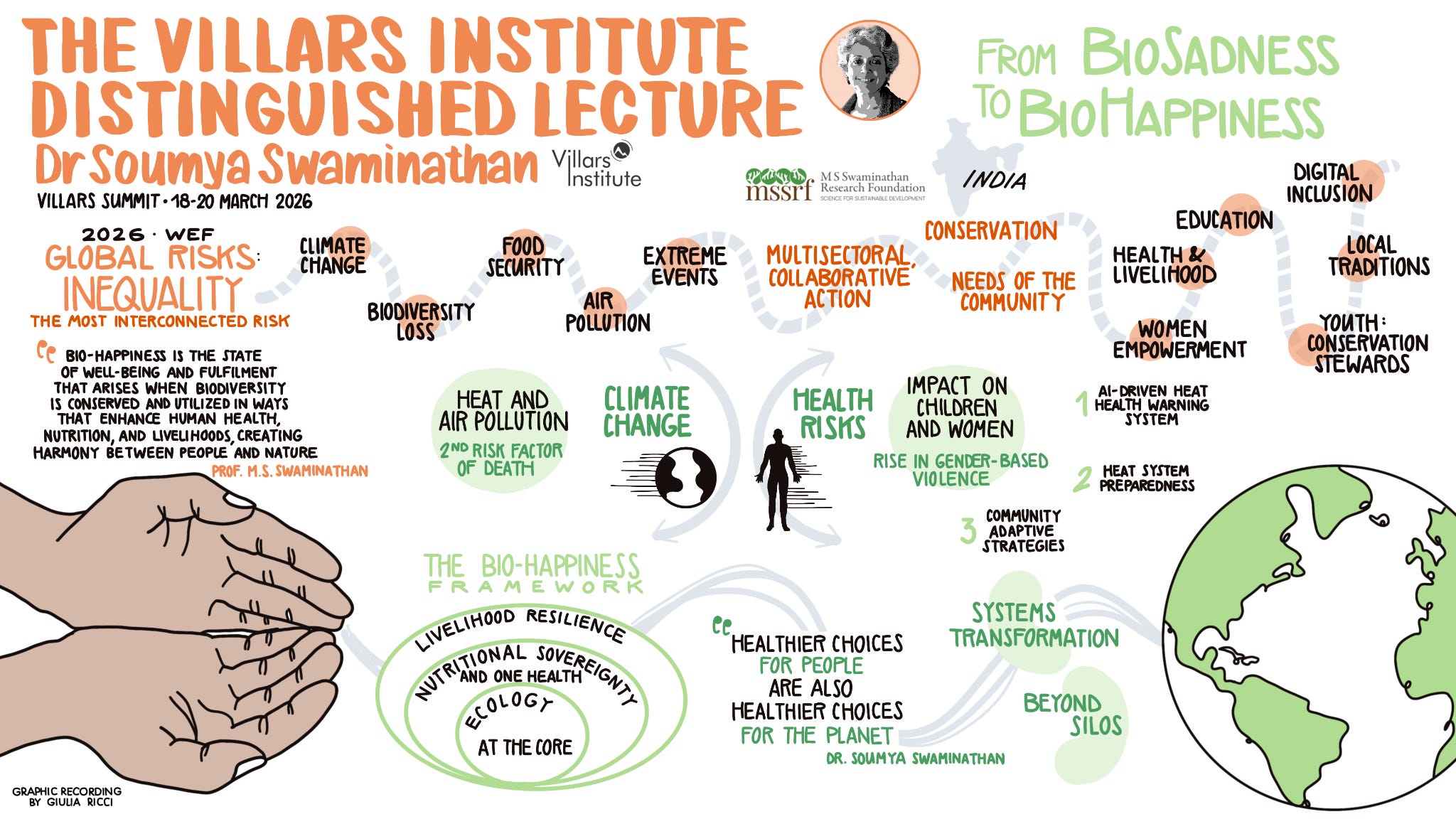
The Bio Happiness Index. Dr. Soumya Swaminathan’s distinguished lecture at the summit offered one of the most precise definitions I encountered across the three days: bio-happiness is the state of wellbeing and fulfillment that arises when biodiversity is conserved and utilized in ways that enhance human health, nutrition, and livelihoods, creating harmony between people and nature. Her corollary was equally sharp: healthier choices for people are also healthier choices for the planet. This is one of the most important measurement frameworks currently underway. Our work on a causal intelligence platform is designed precisely for this kind of work: a permissionless, locally-pluggable index infrastructure where communities and researchers can input their own data and generate a standardized output without requiring a centralized authority to validate or publish it. We are actively exploring what that collaboration looks like.
Jurisdiction as demand signal, practically applied. The Singapore model, corporate tax liability partially dischargeable via nature-based credits, is one expression. The underlying logic applies at city scale, at regional scale, and at the level of development finance conditions. I am interested in working with municipalities and regional governments that want to structure themselves as demand anchors for nature-positive instruments, and in building the financial architecture that makes that practical.
Catalytic Cashback Facility, expanded. The CCF is a framework we’ve been developing and exploring applications in maritime and agricultural context, but has wider applicability than we have yet publicly articulated. Any operational setting where a nature-positive input generates a measurable efficiency delta: energy, water, materials, logistics, is potentially a candidate. If you are working on the measurement side, the structured finance side, or the commercial offtake side of this kind of instrument, I want to hear from you.
The food system inversion. The localized polyculture-as-cuisine-as-conservation thesis is early and underdeveloped, but pointing at something real. Connecting regenerative agriculture to premium culinary identity and export positioning requires collaborators not typically in the room for nature finance conversations: chefs, cultural institutions, tourism boards, premium food retailers. If you are working at that intersection, reach out.
A Closing Observation
The week at Villars produced more concrete follow-up conversations, partnership explorations, and collaborative commitments than any summit I have attended in recent memory. Some of that is the caliber of the room. Some of it is the Chatham House format, which allows people to speak with a candor that on-the-record settings rarely permit. Most of it, I think, is the result of spending several days in the presence of people who have accepted that the problems we are working on require more than any individual organization can deliver and who have therefore arrived ready to collaborate.
That orientation is the actual shift. The field does not lack capital, science, or ambition. It has lacked and is beginning to develop, the willingness to treat coordination itself as the work, and systems thinking as the discipline it genuinely is. The shorthand that emerged from one session said it best: beyond silos, beyond ego. Stop fragmentation, start convergence.
If any of the threads in this piece resonate with work you are doing on measurement, financial architecture, food systems, demand signal design, or causal intelligence; I would genuinely like to hear from you. The conversations already emerging from this week are among the most substantive I have had in years.
The problem was never that we didn’t care enough. It was that we hadn’t built the structures that let caring become investable.
This piece originally appeared on Mehrad’s LinkedIn.
Interesting point of view!
An interesting parallel exists in the textile industry, where the cost of using conventional dyes is beginning to reflect the environmental costs associated with wastewater treatment, auxiliary chemicals, and high energy consumption.
Chemical compliance frameworks and emerging traceability systems may accelerate this shift. The conversation is already happening, gradually pushing environmental externalities into the economic equation.