


Listen to the AI Narrated commentary overview of the post:
Over roughly a decade in and around place-based investing; first across the Gulf, more recently across California, one view has only strengthened for me: resilience is one of the easiest theses to admire and one of the hardest to underwrite cleanly.
California alone is the world’s fourth-largest economy, the most powerful regulatory leverage point on the planet and the front line of nearly every climate stress test the rest of the country is about to take in the coming decades. The dollars are large. The need is unambiguous. So in theory, the narrative writes itself.
But in this case, the scale narrative is not necessarily an advantage. And the importance of a question, even one as plainly important as this, is not the same as the investability of an answer to it.
I have, more than once, seen investors let a strong place-based narrative carry weight that only a balance sheet should carry, and I have done it myself. The error is not in believing the place matters. It does, and the rest of this piece argues that it does. The error is treating that belief as a substitute for the underwrite rather than an input to it. Place feeds the company’s economics through customers, regulation, labour, and physical risk. It does not do the work of underwriting how any one firm captures and compounds inside it.
The investor’s question is therefore not whether a place matters. It is where value accrues, who captures it, whether the advantage can compound at the company level, and in any portfolio built around resilience whether the return travels in the same direction as the resilience it claims to produce. A return that erodes the system that made it possible is not a return. A resilience play that does not compound is philanthropy.
That tension, return and resilience, compounding in the same direction, in a specific place, is the reason we built the Capital Valleys Forum.
One state. Many valleys.
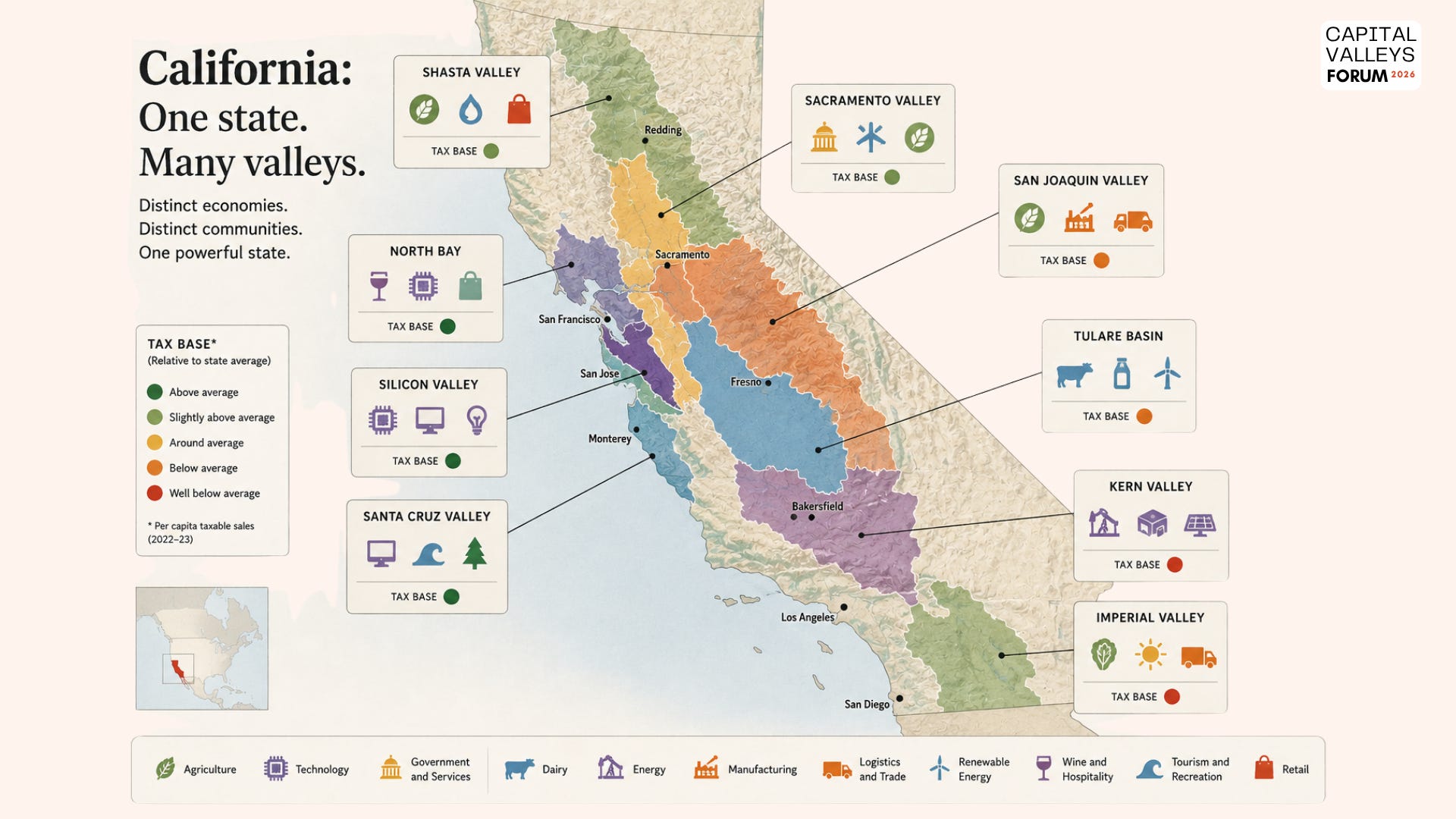
The Forum’s name carries an argument in its plural. There is no California, singular. There are valleys. The valleys in question: Sacramento. Silicon. Santa Cruz. North Bay. San Joaquin. Tulare. Kern. Imperial. Shasta.
Each is its own economy, with its own tax base, its own labour market, its own climate-risk profile, and its own political weather.
Silicon Valley exports software and absorbs electrons. The San Joaquin and Tulare grow much of what the country eats and run a tax base well below the state average. Kern produces oil, solar, and warehouses, and is one of the most physically and fiscally exposed economies in the union. Sacramento is where the rules that govern all of them are written.
A useful way to think about California is therefore not as a single market but as a federation of valleys whose returns, vulnerabilities, and time horizons do not align, and whose only honest synthesis runs through the capital. That is the underwriting reality. A portfolio that buys “California resilience” without naming which valley, whose tax base, and whose physical risk is buying a slogan.
A city most people in climate do not talk about
When we announced the Capital Valleys Forum last month, I wrote that Sacramento may be the most important climate city in America that almost no one in climate is talking about. The case is structural, not sentimental.
CARB sets the tailpipe and clean-fuel standards that move every major automaker from Detroit to Stuttgart. The California Energy Commission and the CPUC shape how compute, transport and buildings consume power. CalSTRS deploys hundreds of billions in pension capital. SMUD remains one of the most ambitious municipal utilities in North America. The Central Valley grows roughly a quarter of the food the country eats. Silicon Valley sits ninety minutes west and consumes a rising share of the state’s electrons.
Sacramento is where those forces meet: the policy seat, the capital seat, the agricultural seat, and, increasingly, the regulatory laboratory whose rules quietly become the de facto national floor.
The mechanism is not subtle. California is now a $4.1 trillion economy, the world’s fourth largest, carrying roughly 14% of global GDP gravity. Above that threshold, regulating one jurisdiction is regulating the firm.
Last September, Baxter International announced it would remove DEHP from intravenous bags in all fifty states because of a single California law. There is precedent in California’s policy strength permeating into other states/nations:
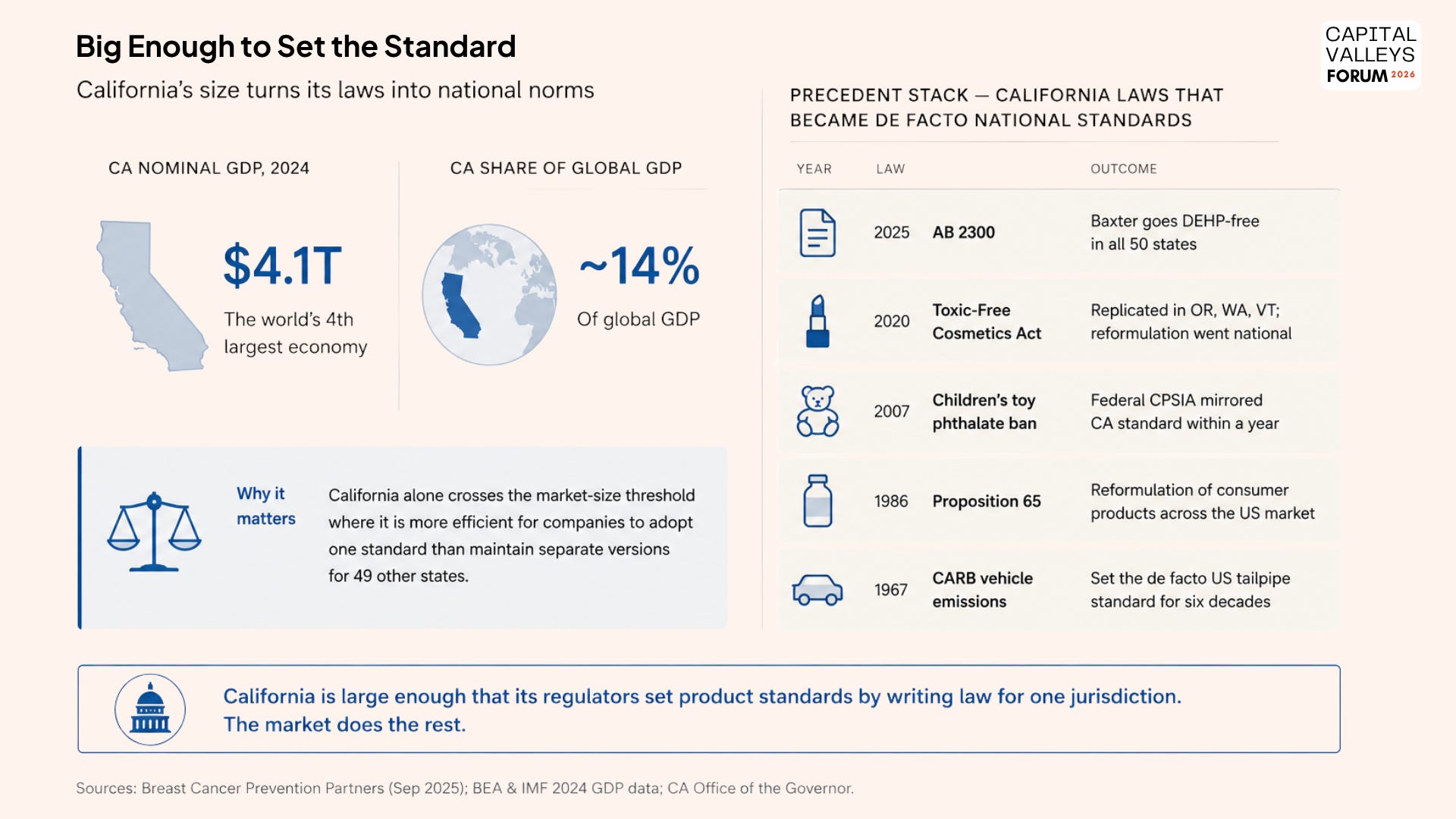
CARB tailpipe standards went national the same way in the 1970s. Prop 65 reformulations followed in the 1980s.
The 2007 children’s-toy phthalate ban became federal CPSIA within a year.
The 2020 Toxic-Free Cosmetics Act replicated across Oregon, Washington, and Vermont before the decade was out.
What looks from the outside like federal policy is often California policy the rest of the market chose not to fight.
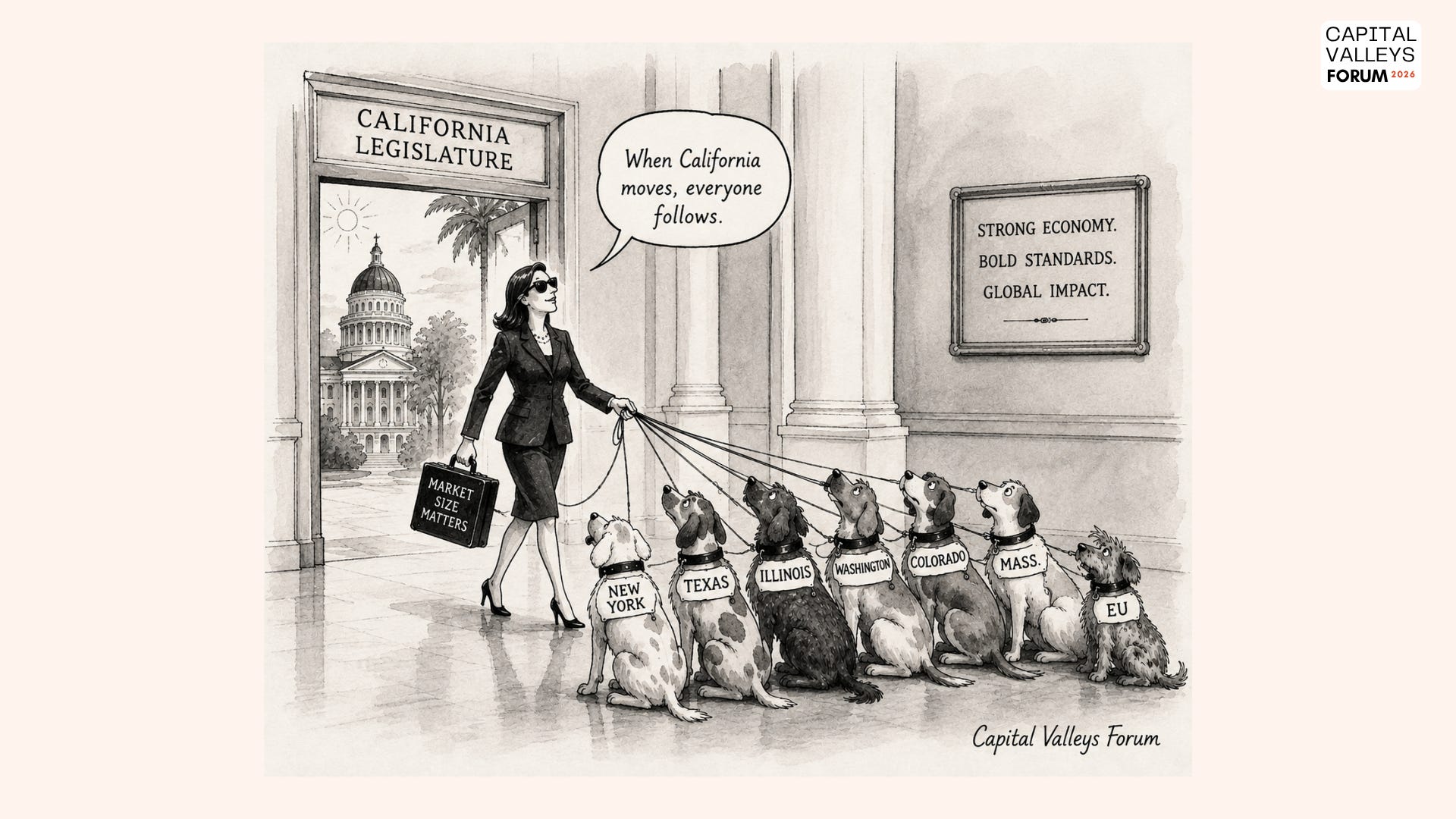
The premise of the Forum was that this concentration of leverage: geographic, regulatory, fiscal, and physical, all converging in one capital city, is itself an investable bottleneck. If you want to underwrite resilience as an asset class rather than a theme, you have to do it where the rules, the infrastructure, the capital and the physical stress all converge on the same table.
The Emerging Cascade
The morning opened on the system everyone in the room had lived through. Thirty-six months that broke the assumptions much of US infrastructure was built on.
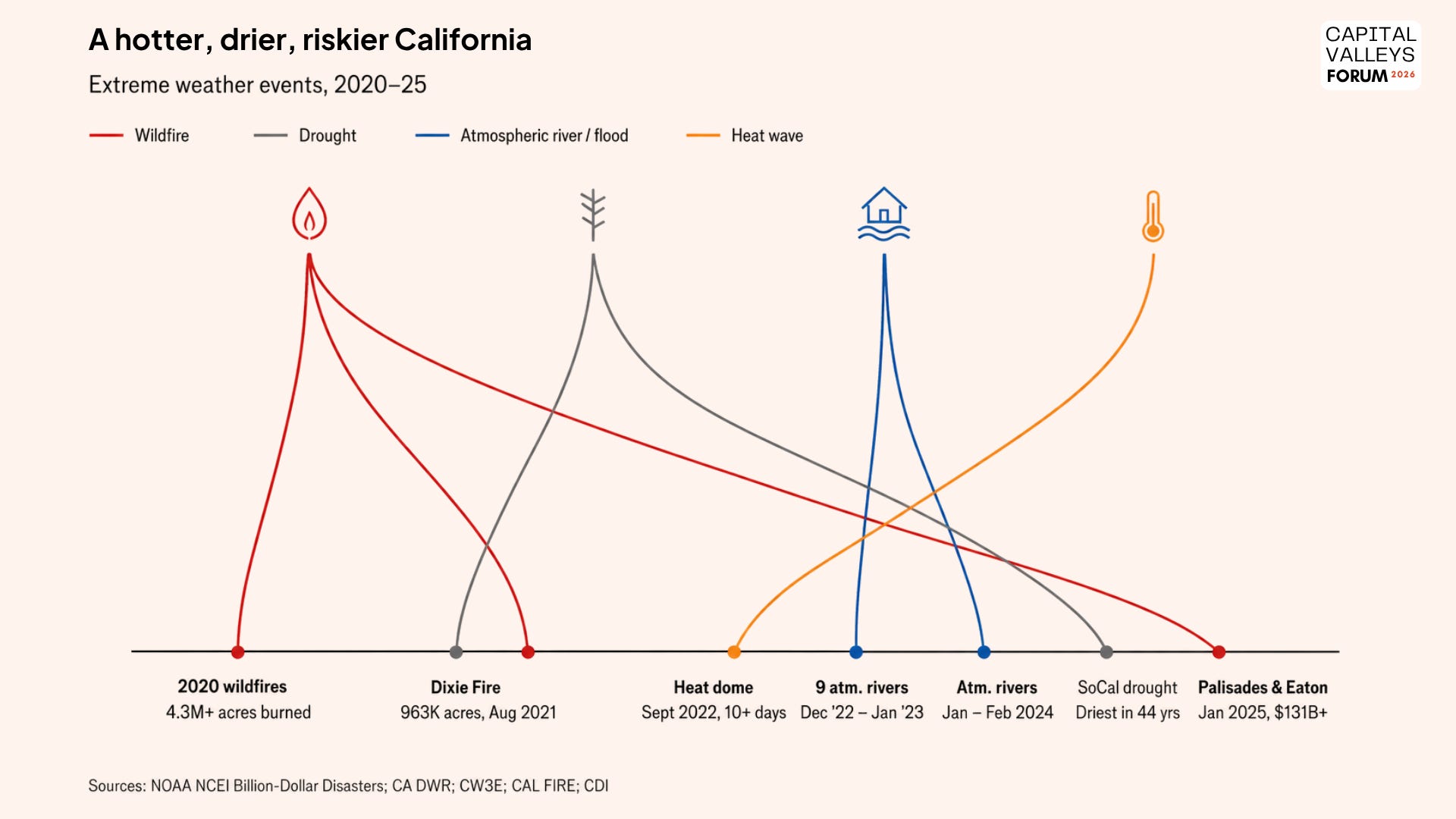
The 2020 wildfires that burned 4.3 million acres. Dixie in 2021.
The September 2022 heat dome. Nine atmospheric rivers in the winter of 2022–23.
A second wave of atmospheric rivers in early 2024.
The driest forty-four-year stretch on record for Southern California.
And then Palisades and Eaton in January 2025: $131 billion in damages, the costliest urban wildfire in American history.
No single event in that timeline is unprecedented on its own. Taken together, they are the new operating environment.
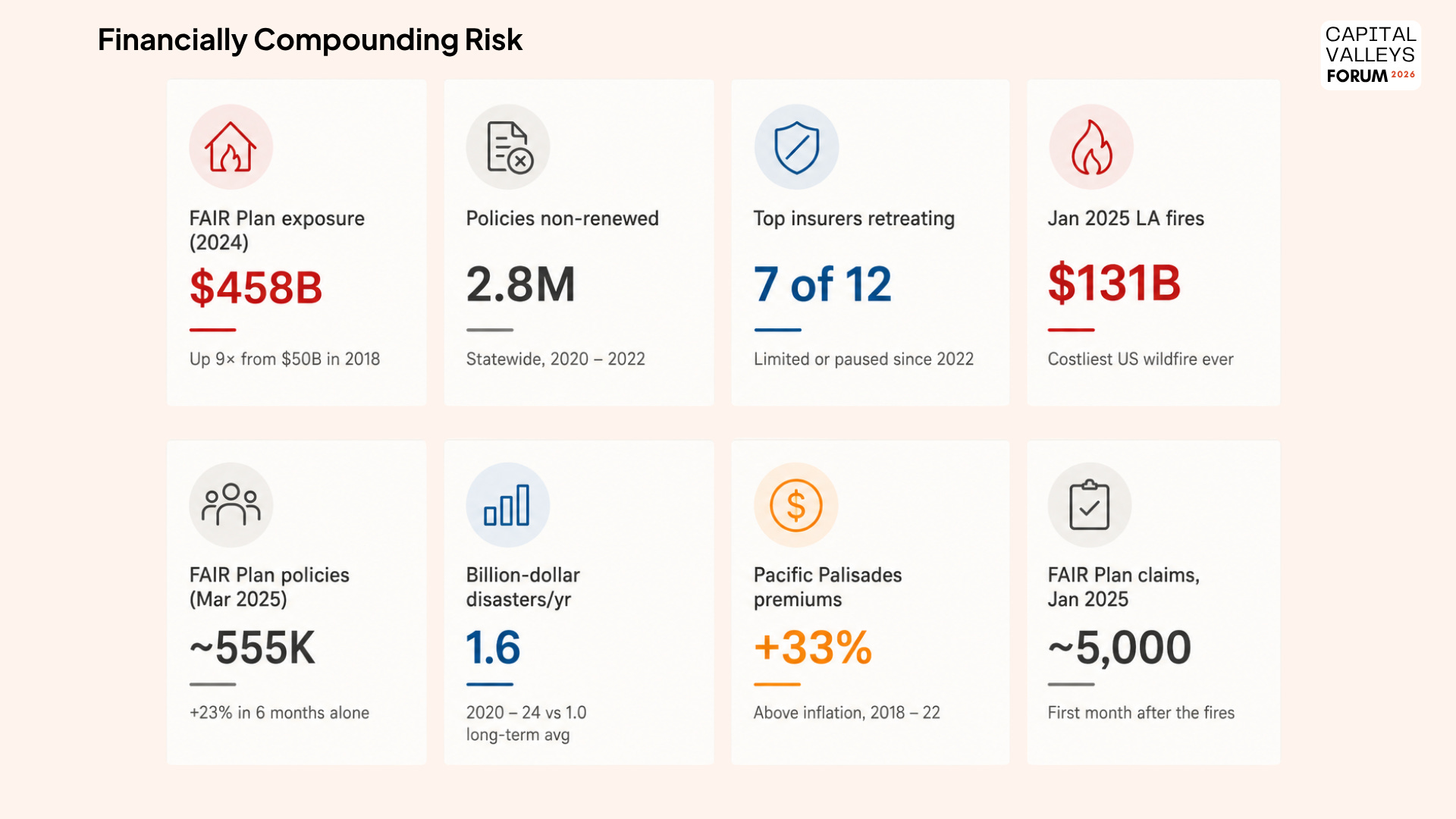
The financial mirror is unforgiving:
California’s FAIR Plan exposure has risen nine-fold since 2018 to $458 billion.
2.8 million policies were non-renewed between 2020 and 2022.
Seven of the state’s twelve largest insurers have paused or limited new policies.
Premiums in the Pacific Palisades zip codes rose 33 per cent above inflation between 2018 and 2022 and the policies that did exist paid out roughly 5,000 claims in the first month after the January fires alone.
As I’ve written before, property insurance is the canary. The mine is mortgages, municipal bonds and household wealth. A Senate Budget Committee report has openly warned of a systemic shock comparable to 2008, perhaps greater.
The corollary
The same state that is the laboratory of climate stress is also the most powerful single regulatory market in the world.
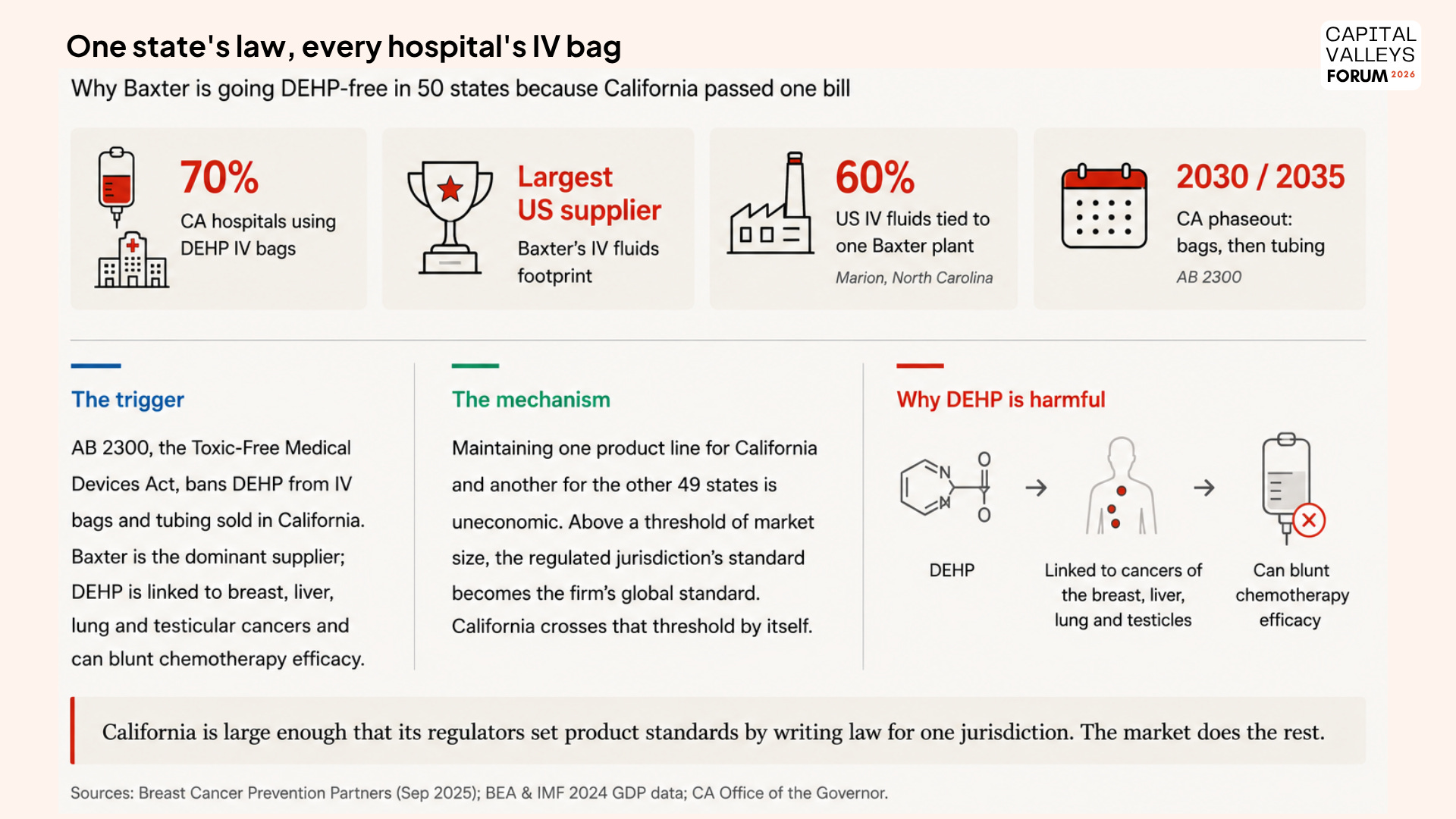
Let’s take DEHP IV Bags as an example:
Roughly 70 per cent of California hospitals were using DEHP IV bags.
Baxter is the largest US supplier.
60% of Baxter’s US IV-fluid output runs through a single plant in Marion, North Carolina.
California’s AB 2300: the Toxic-Free Medical Devices Act, shepherded through Sacramento by Breast Cancer Prevention Partners, phases the chemical out for California alone, bags by 2030 and tubing by 2035. Baxter recognized maintaining one product line for California and another for the other forty-nine is uneconomic, given California’s market size. So the free market does the rest.
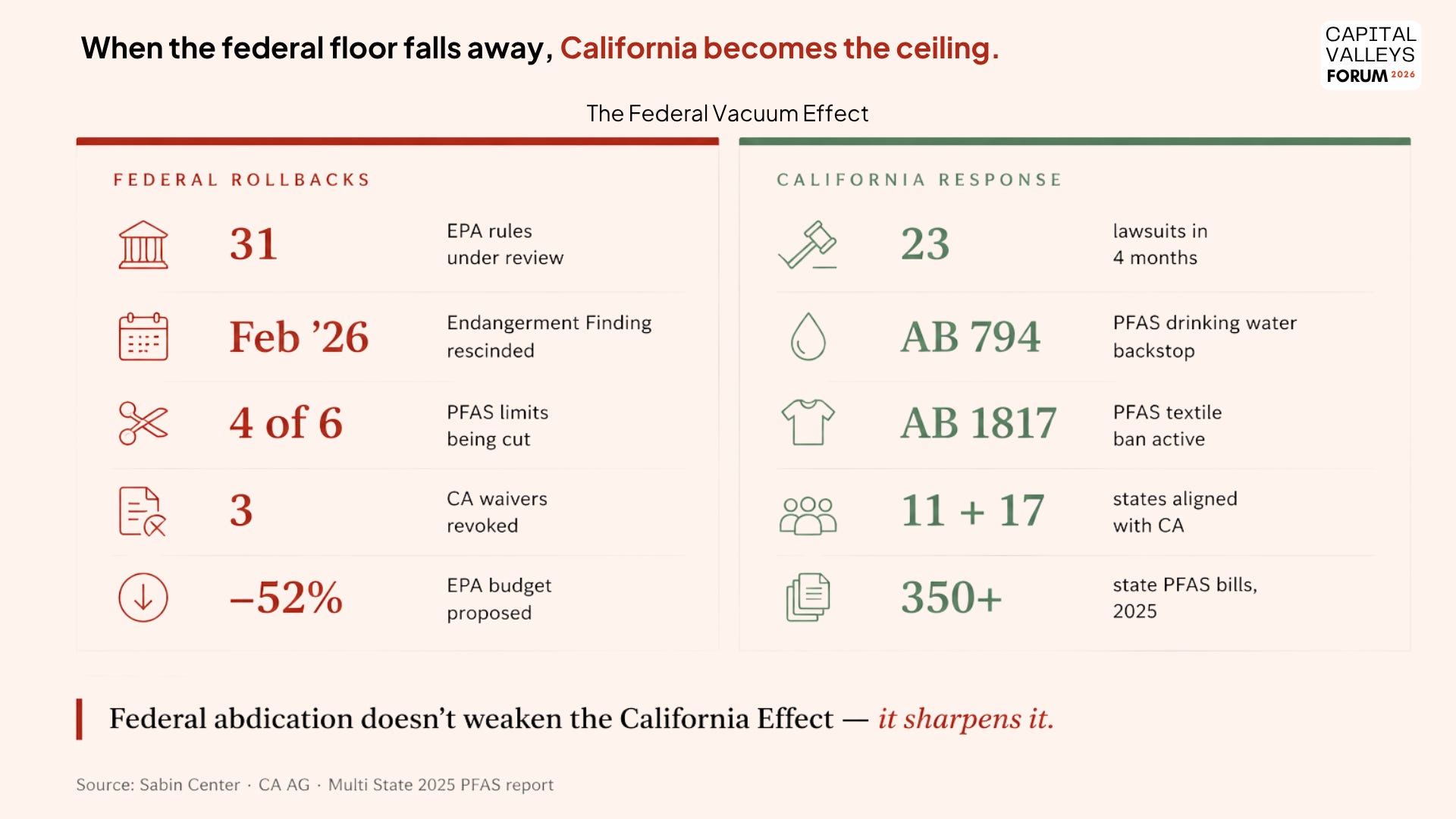
The leverage is growing, not shrinking, as the federal floor recedes. The 2025 federal rollback inventory reads as a vacuum:
thirty-one EPA rules under review, the Endangerment Finding rescinded
four of six PFAS limits being cut
three California waivers revoked
a 52 per cent proposed cut to the EPA budget.
Sacramento’s response in the same four months:
twenty-three lawsuits filed, AB 794 (PFAS drinking-water backstop)
AB 1817 (PFAS textile ban)
twenty-eight aligned state coalitions
and more than 350 state-level bills introduced.
Federal abdication does not weaken the California Effect. It strengthens it.
California as the Climate Capital
The core premise we were exploring at the Capital Valleys Forum is that California truly has been the climate capital for some time. The question that frames the next decade, and that the rest of the day was built to interrogate, is whether the state is still up for the job? It is not a rhetorical question. The answer is contested inside the building, inside the Capitol two miles away and inside the boardrooms of the firms the policies affect.
Policy, Provocations, Prosperity
The day was structured around three movements: Policy, Provocations & Prosperity. We chose that frame for two reasons.
The first is that most climate convenings collapse the three: a panel about “policy” turns into a litany of what is broken, which turns into a wish-list, and nothing in particular gets built.
The second is that the three movements track the actual time horizons of the people in the room. Operators live in the present. Allocators live in the medium. Policymakers, when they are honest, live in both at once.
What the grammar of the day was
The day’s most consequential arguments did not stay inside the compute-and-grid conversation; it travelled across themes. The idea that an AI data centre is not one asset but four: a rack-layer hardware-and-networking problem, a chiller-layer water-and-thermodynamic problem, a generation-and-storage-layer utility problem, and across all three, a capital-stack problem; turned out to be a usable grammar for almost everything else on the agenda. A resilience premium, the additional return that accrues to assets engineered to absorb climate, regulatory, and load-shape volatility, is not a soft benefit at any of those layers. It is the thing that makes a four-layer underwrite hold together at the cost of capital these projects now command. Once that grammar was in the room, it stayed there.
Two of the organixations contributing to the conversations of the day: Cisco, whose networking, compute, and data-centre architecture sit at the operational rack and chiller layer of every hyperscale build and CalSTRS, one of the largest public pension funds in the world and one of the most consequential long-duration allocators of capital anywhere.
Between them is the entire underwriting span of the AI build-out: the operational firm at the rack and the institutional balance sheet at the bottom of the capital stack. What the panel made plain is that the AI-energy build-out is no longer a technology question, an infrastructure question, or a capital question. It is all three, simultaneously, and the firms that win in California are the ones that can underwrite across the stack rather than within a single layer of it.
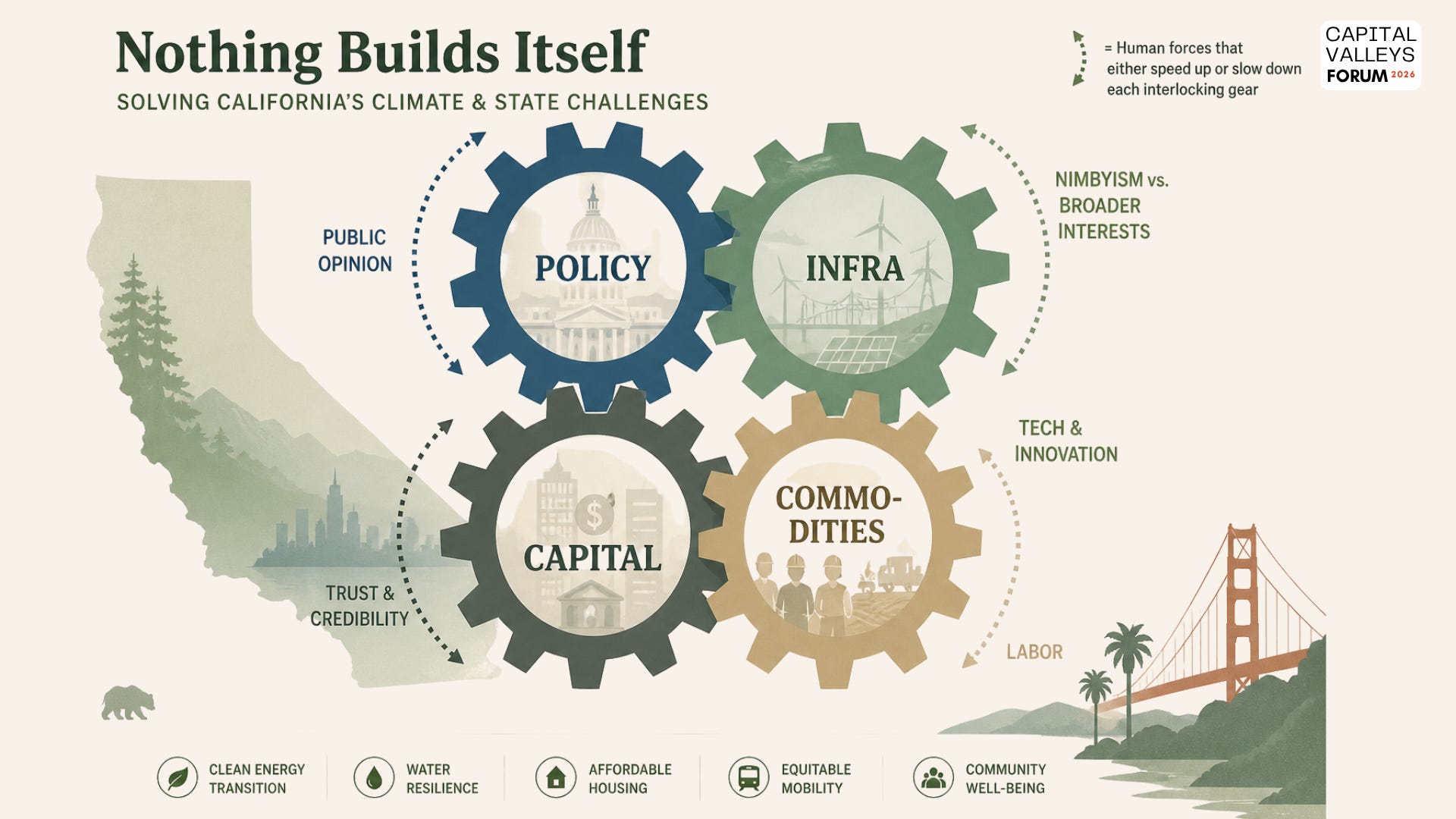
The same insight surfaces, in a different vocabulary, on the systems side. Nothing California needs to build: clean energy, water resilience, affordable housing, equitable mobility, community well-being, builds itself.
Each requires four gears in mesh, all cogs driving the same systems machine: policy that sets direction, infrastructure that carries the load, capital that finances the build, and the commodities and operating layer that turn it from a balance-sheet entry into a real asset.
The human forces between those gears… public opinion, NIMBYism versus broader interests, trust and credibility, technology and innovation, labour, either speed them up or grind them. We developed this imagery as an operating description of why a state with the world’s fourth-largest economy, the most ambitious regulatory floor, and the deepest pool of climate venture capital still cannot, on its own, deliver the build-out.
The four gears do not mesh by accident. Our forum in Sacramento was the seeds of continued working sessions on how they are made to engage with one another.
Returns and resilience, in the same direction
The closing segment was that climate adaptation is no longer an overlay on the operating model. It is the operating model we all will have to engage with. Companies built for California’s emerging market and climate realities… efficient on water and electrons, resilient to disruption, low-carbon in their supply chain, embedded in their communities, earn higher revenue from preferred customers, lower operating costs, fewer disruptions, better financing terms, and a stronger licence to operate.
This breaks out of the ESG/checkbox KPI oriented view and transcends into the EBITDA architecture of growing inside a climate-constrained economy.
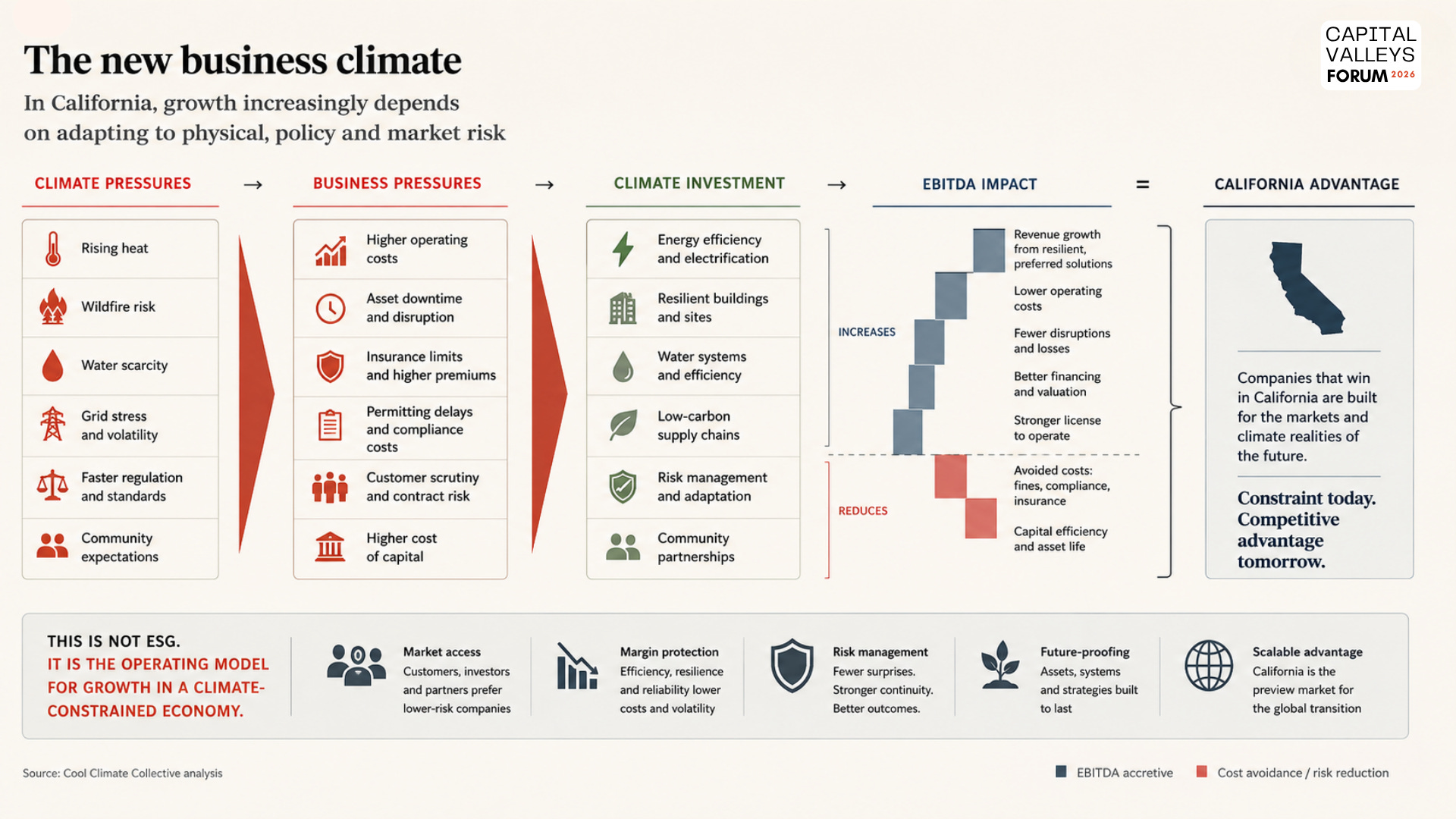
And it is showing up in the returns…
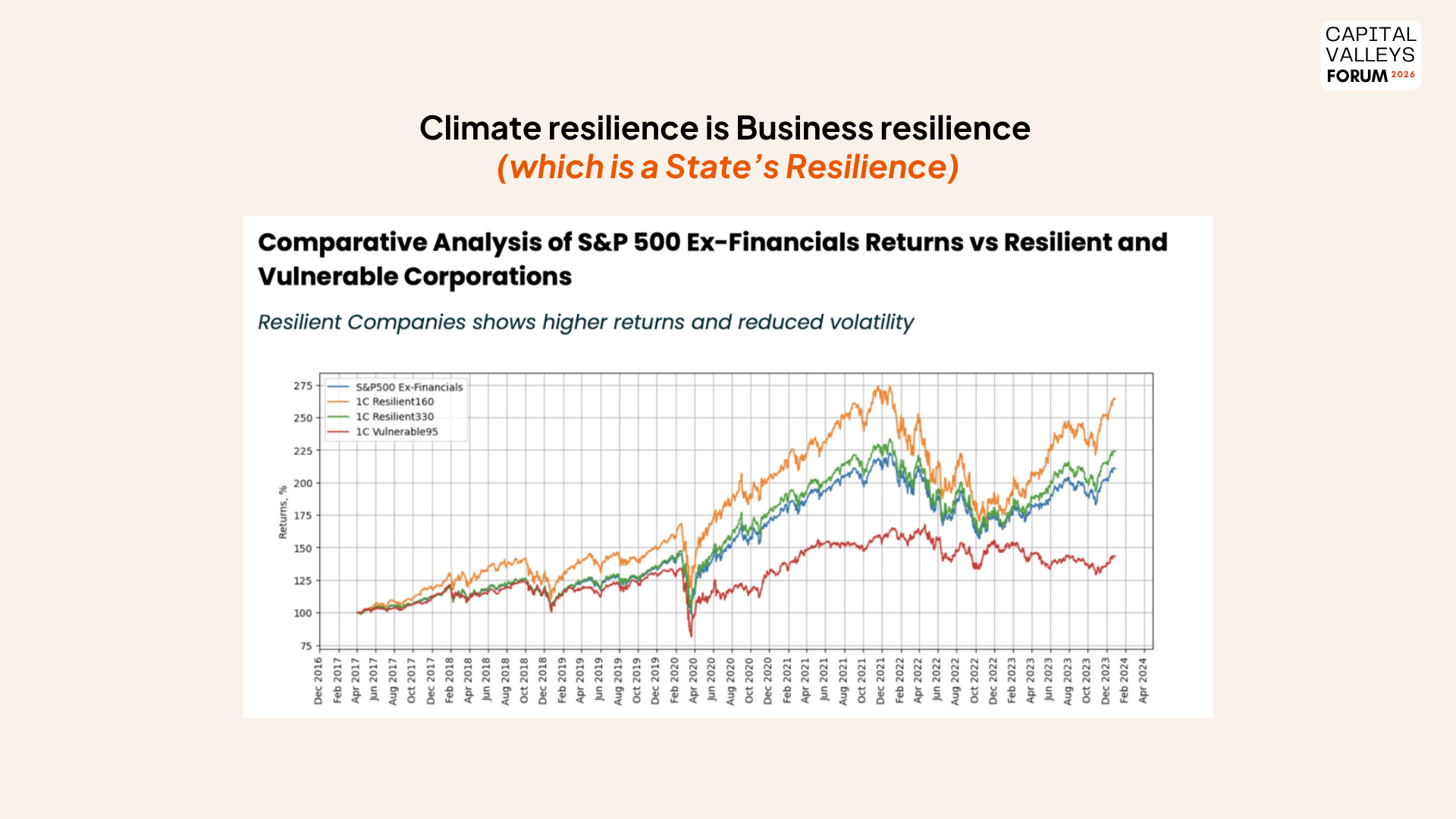
The comparative analysis we put on screen, S&P 500 ex-financials against a portfolio of resilient corporations and one of vulnerable corporations, runs from 2017 through early 2024. The resilient cohort outperforms the index. The vulnerable cohort underperforms. The spread is widest at the moments of greatest stress. Climate resilience is business resilience. Business resilience, in California, is the state’s resilience. The three compound in the same direction, in the same place. The whole argument for the Capital Valleys Forum sits inside that one chart.
The bet on Sac
There is a national conversation about California that runs on a single false binary. Either the state is too consequential to fail… its regulatory leverage, its capital, its scale and the rest of the country is along for the ride. Or it is in cascading decline… its insurance market, its housing, its capital flight and the rest of the country is wise to short it. Both readings treat California as a single market with a single set of vital signs, but as I’ve shared it’s actually a culmination of all the local economies and geographies of the state.
The Forum’s actual argument runs underneath that binary. California is not a single market. It is a federation of valleys whose returns, vulnerabilities, regulatory exposures, and capital structures do not align and whose only honest synthesis runs through Sacramento. Within each valley, every consequential build-out: compute, water, energy, food, mobility, is a four-layer underwrite: policy, infrastructure, capital, and the operating-and-commodities layer that turns a balance-sheet entry into a real asset. No layer compounds at the company level unless the other three are sequenced behind it. No valley compounds at the state level unless the others are coordinated with it.
The investable bottleneck, then, is not California. It is the coordination problem inside California across its valleys and across the layers of its build-out that everything else turns on. And that coordination problem has a physical location. It happens in Sacramento, by default, because Sacramento is the only city in the state where the regulator, the pension allocator, the utility planner, the agricultural producer, the technology operator, and the community organiser can sit at the same table before lunch. The Capital Valleys Forum is a working test of whether that coordination can be made deliberate rather than incidental.
The bet: California’s leverage compounds when the coordination is the asset. Returns and resilience travel in the same direction only when policy, capital, infrastructure, and operations are underwritten as one transaction, in one place, with one set of trade-offs on the table. Sacramento is the only California city positioned to host that transaction.
California will not solve this alone
California will not solve this alone, but it will set the terms. Returns and resilience compound in the same direction, but only in the places where capital is patient enough to learn the place. Sacramento, on May 8, looked like a place willing to learn and like a market that the rest of the country, whether it knows it yet or not, will end up trading against.
What follows is the a snippet of the programming on the day itself: the sessions, the speakers and some recaps of their days. The list below is a sampling rather than a complete recap; most of what was useful in the room was conversation rather than transcription and these parts that made it into this write-up are the parts I happened to capture.
Sessions from the day
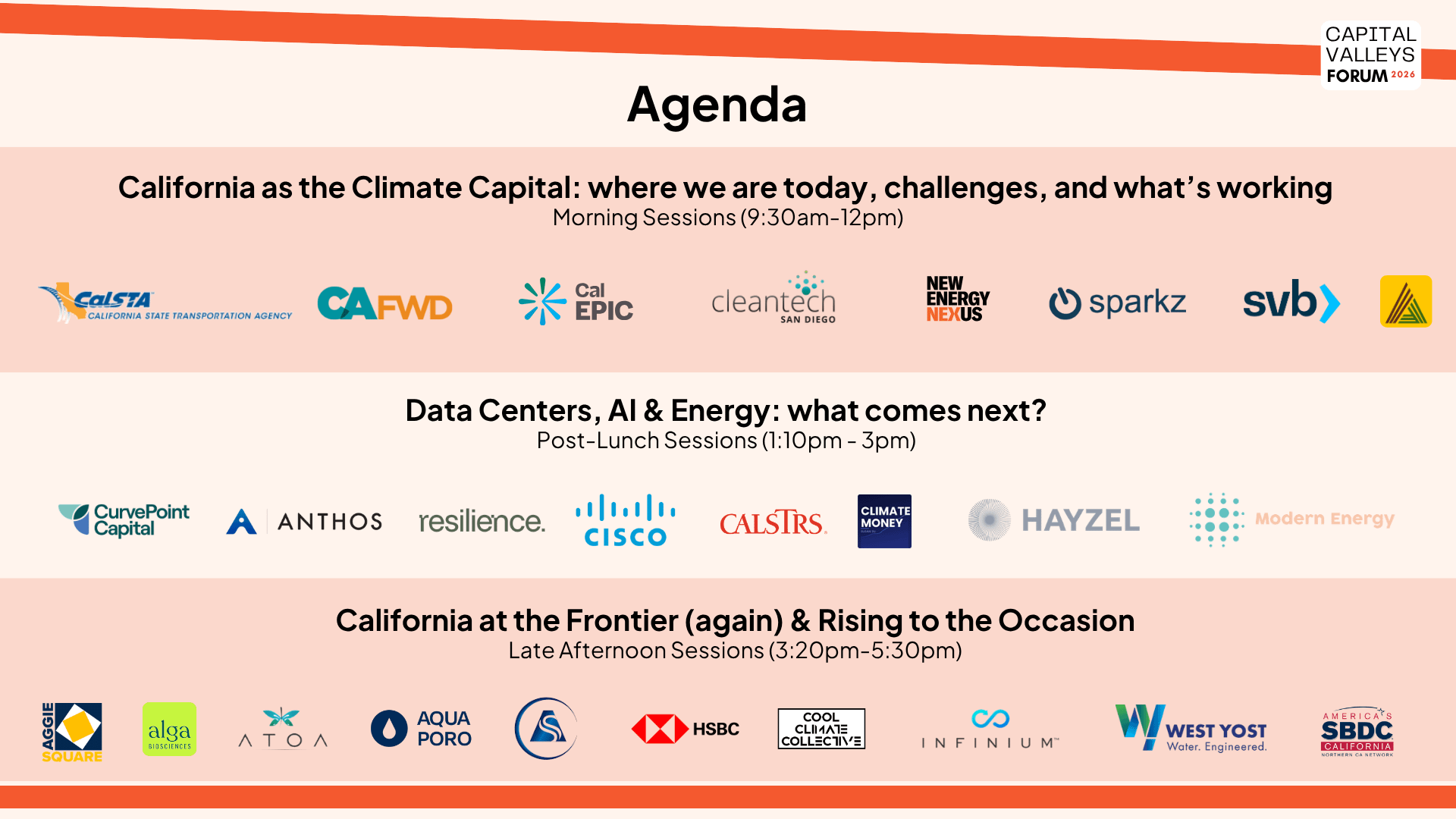
The day ran thirteen sessions across the three blocks: keynotes, firesides, panels & lightning talks. A few moments from the room, captured below, are a sampling rather than a full account. What follows is the handful where I wasn’t too distracted to capture a shot.
Grateful to have had great sessions and panels exploring topics from:
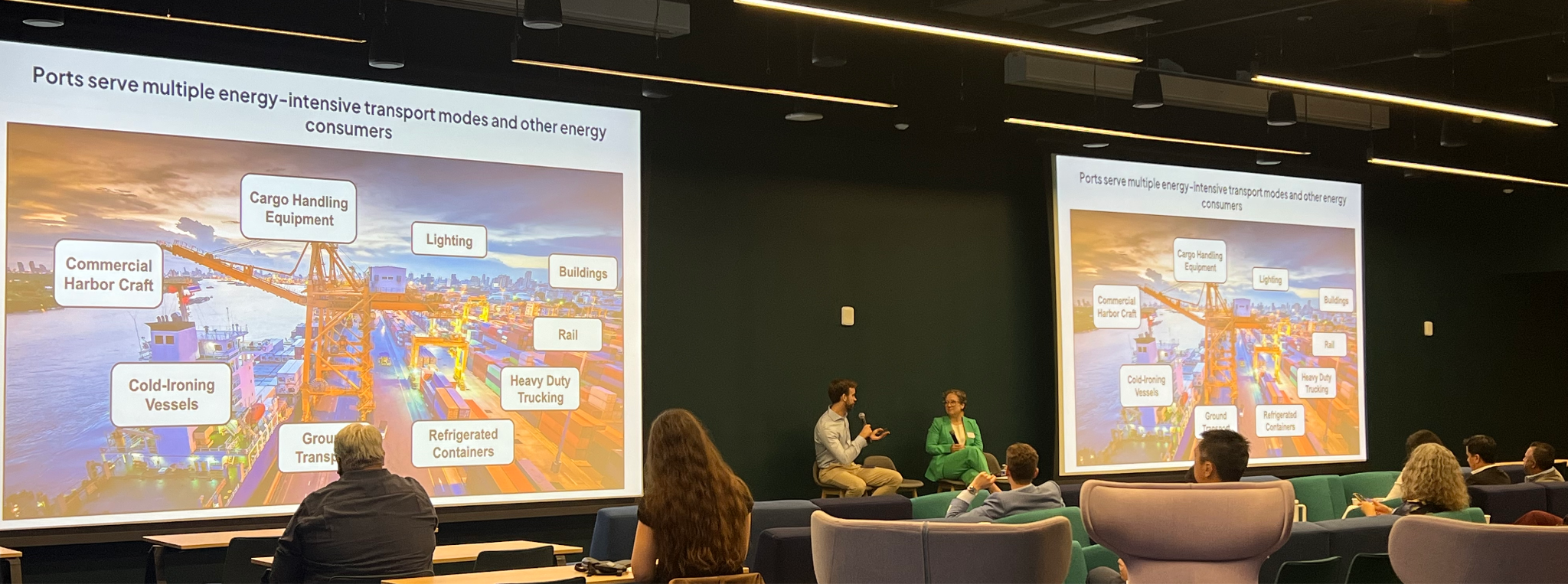
Where the Goods Move, the Country Follows: Freight, Ports, and California’s Climate Playbook, a fireside moderated by David Hume from the Liquid Grid, with Christine Casey, PhD, Deputy Secretary for Freight Policy at CalSTA.
Building the Workforce, Supply Chains & Deployment Lanes for Electrification, a panel with Orville Thomas, CEO of CalEPIC, and Kara Demirjian Huss from DCCM, on what it actually takes to build the new-economy flywheel: deployed projects, trained technicians, local suppliers from innovation to deployment to workforce.

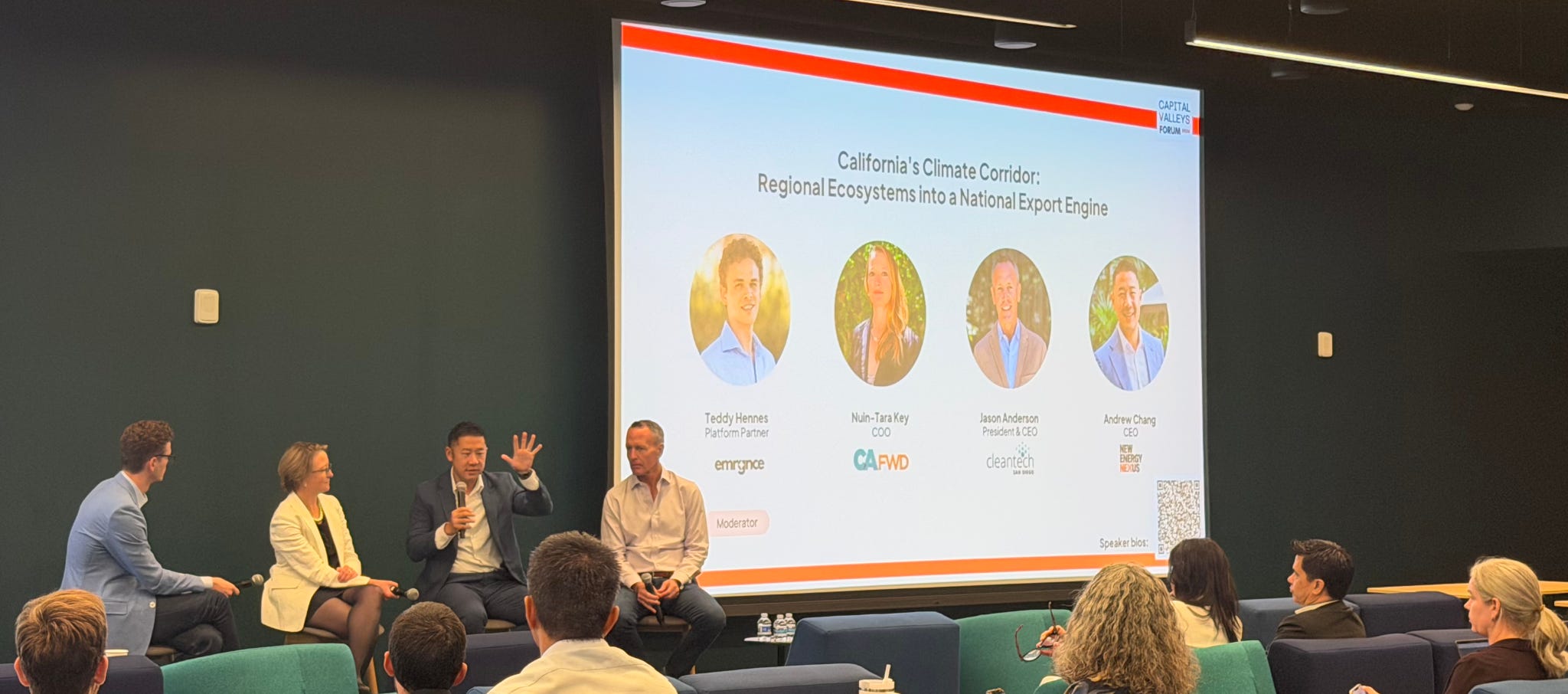
California’s Climate Corridor: Regional Ecosystems into a National Export Engine, a panel with Jason Anderson, President & CEO of Cleantech San Diego; Nuin-Tara Key, COO of California Forward; Andrew Chang, CEO of New Energy Nexus; and Teddy Hennes, Partner and Head of Platform at emrgnce / Cool Climate Collective, on how to connect California’s distributed innovation advantage, from San Diego’s 925 cleantech establishments, the Central Valley’s agri-tech corridors, the Bay Area’s venture-backed innovators into a unified export engine that scales beyond state borders without leaving the prosperity behind.
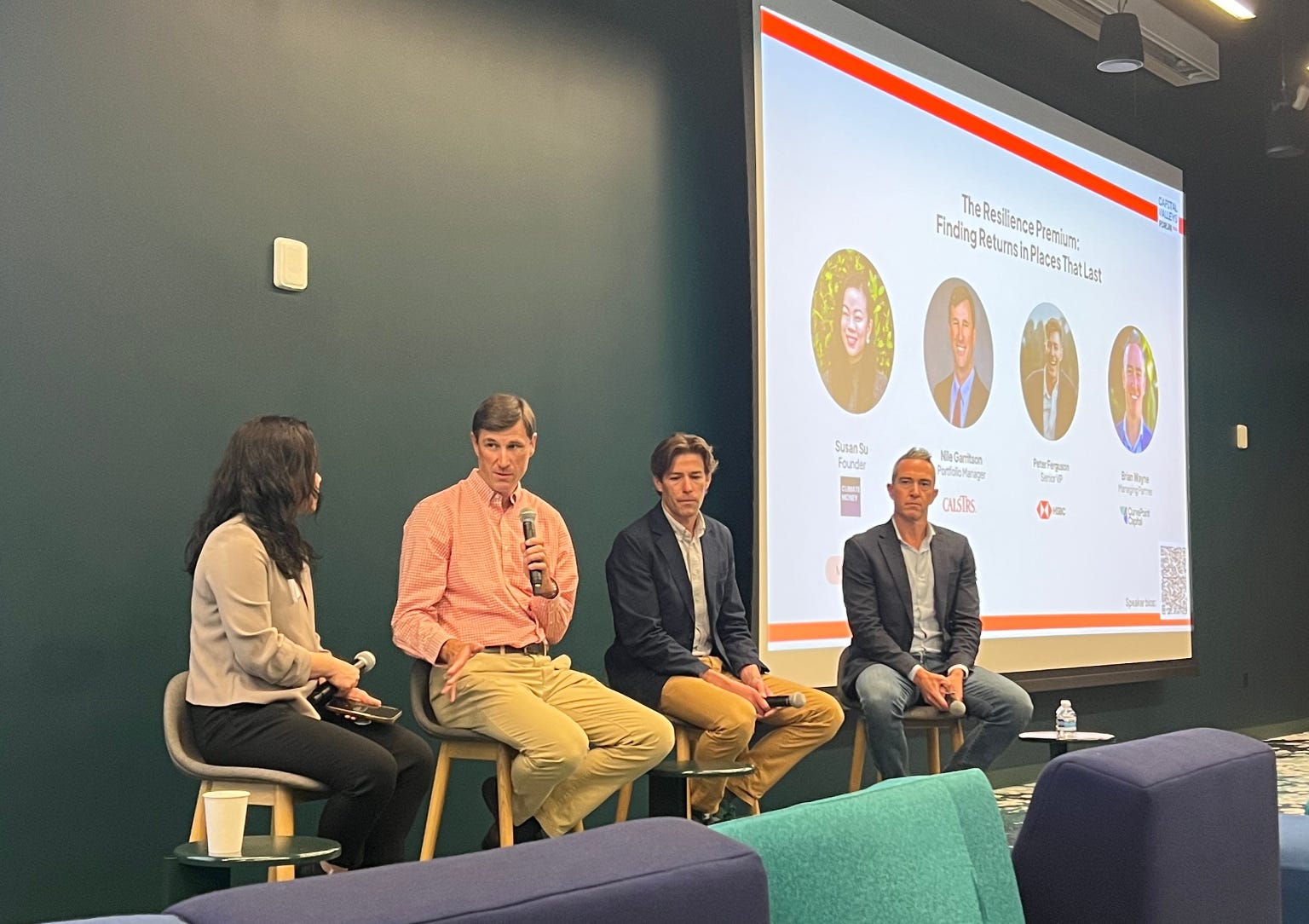
The Resilience Premium: Finding Returns in Places That Last, a panel with Nile Garritson, CFA, Portfolio Manager at CalSTRS; Peter Ferguson, HSBC’s lead for VC-backed energy transition and climate tech in Northern California; Brian Wayne from CurvePoint Capital; and Susan Su from Climate Money, on how debt & equity markets price resilience via various financing vehicles and how sponsors unlock cheaper, longer-term capital by underwriting the resilience layer.
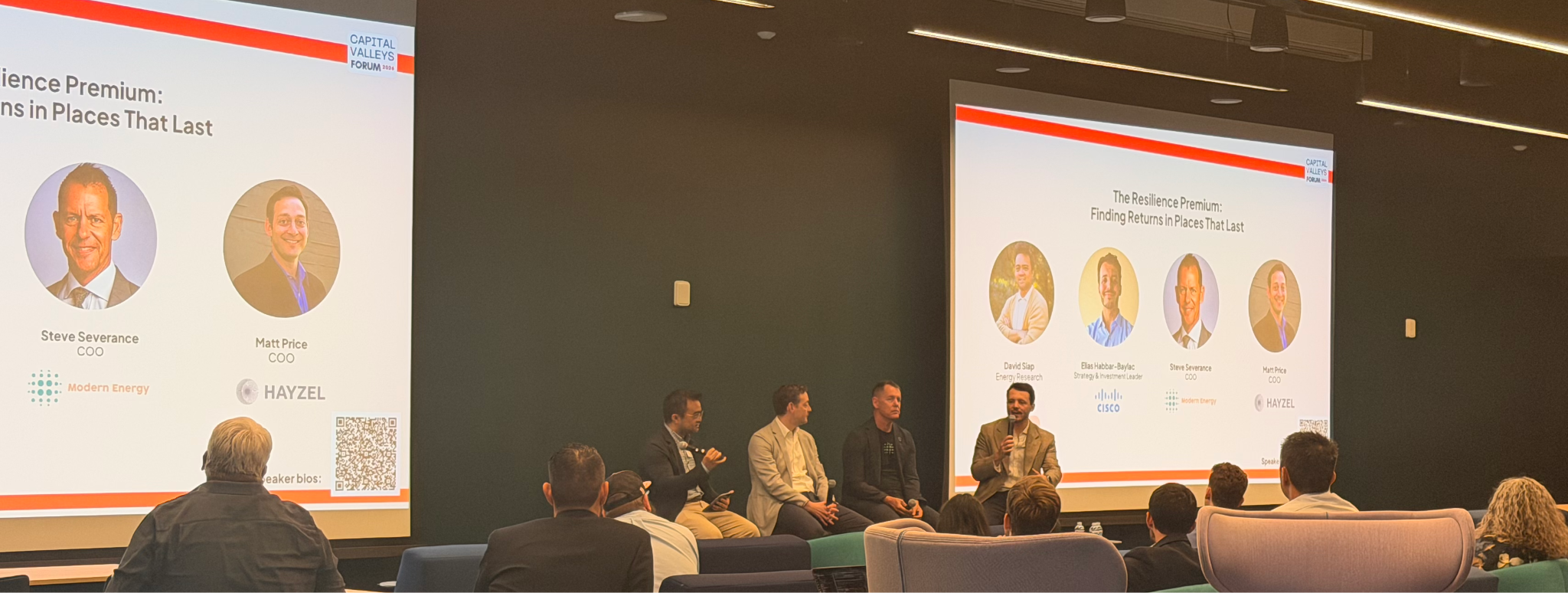
Powering AI Without Breaking the Grid, a panel moderated by David Siap, energy subject-matter expert at CREO Syndicate, with Elias Habbar-Baylac, who leads Strategic Energy and Sustainability Investments and Business Development in Cisco’s Chief Sustainability Office; Matt Price, Founder of Hayzel; and Steve Severance, Co-founder of Modern Energy, on whether AI can be scaled without scaling its footprint and what an honest accounting of inference and training data-center intensity looks like beyond the headline PUE and WUE ratios.
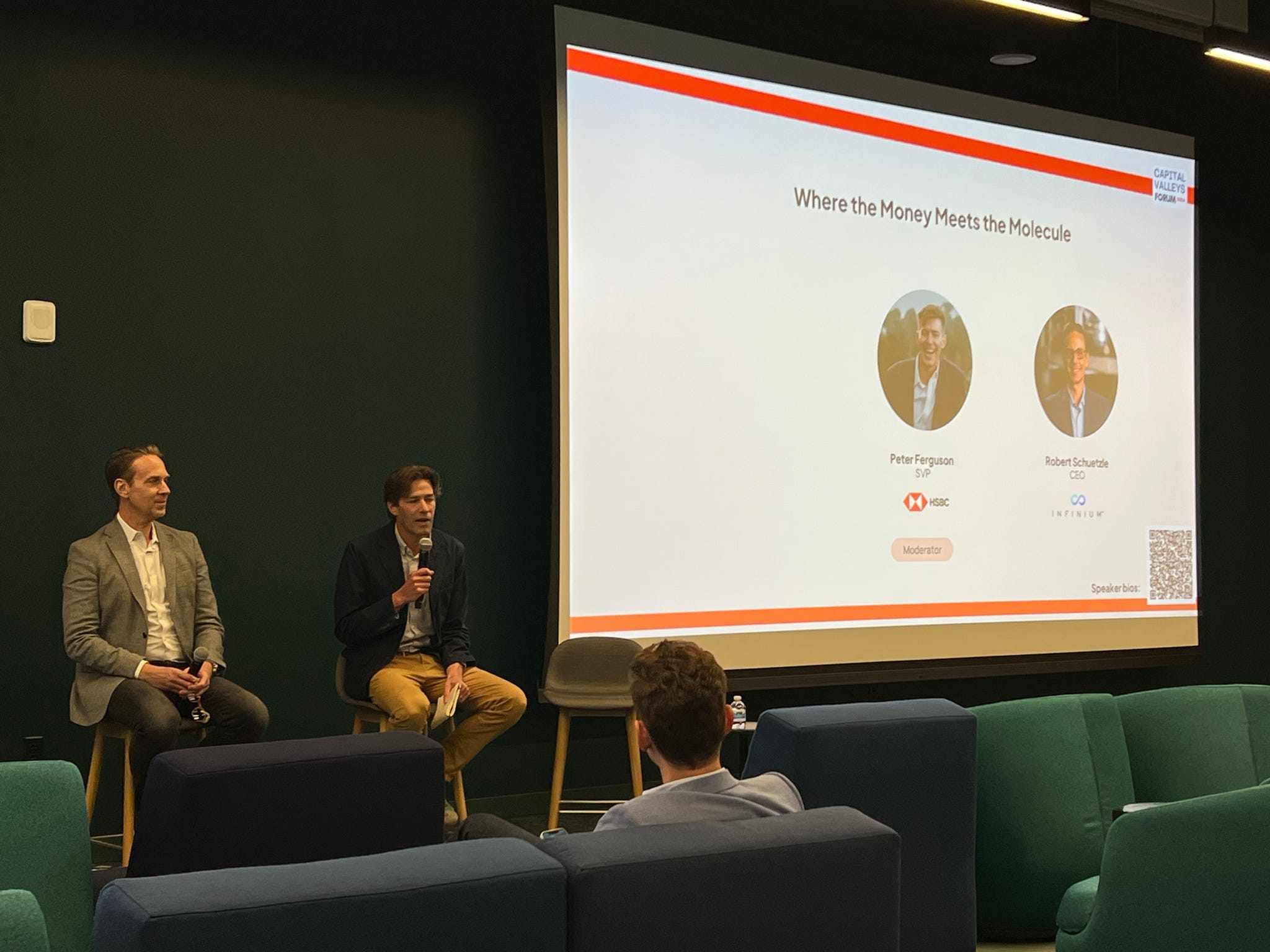
Where the Money Meets the Molecule, a fireside with Robert Schuetzle from Infinium and Peter Ferguson from HSBC, on how a Sacramento-grown company and a global bank turned waste CO₂ and clean electrons into bankable molecules… for aviation, shipping, trucking, and, this year, the immersion fluids cooling the AI data-centre build-out.
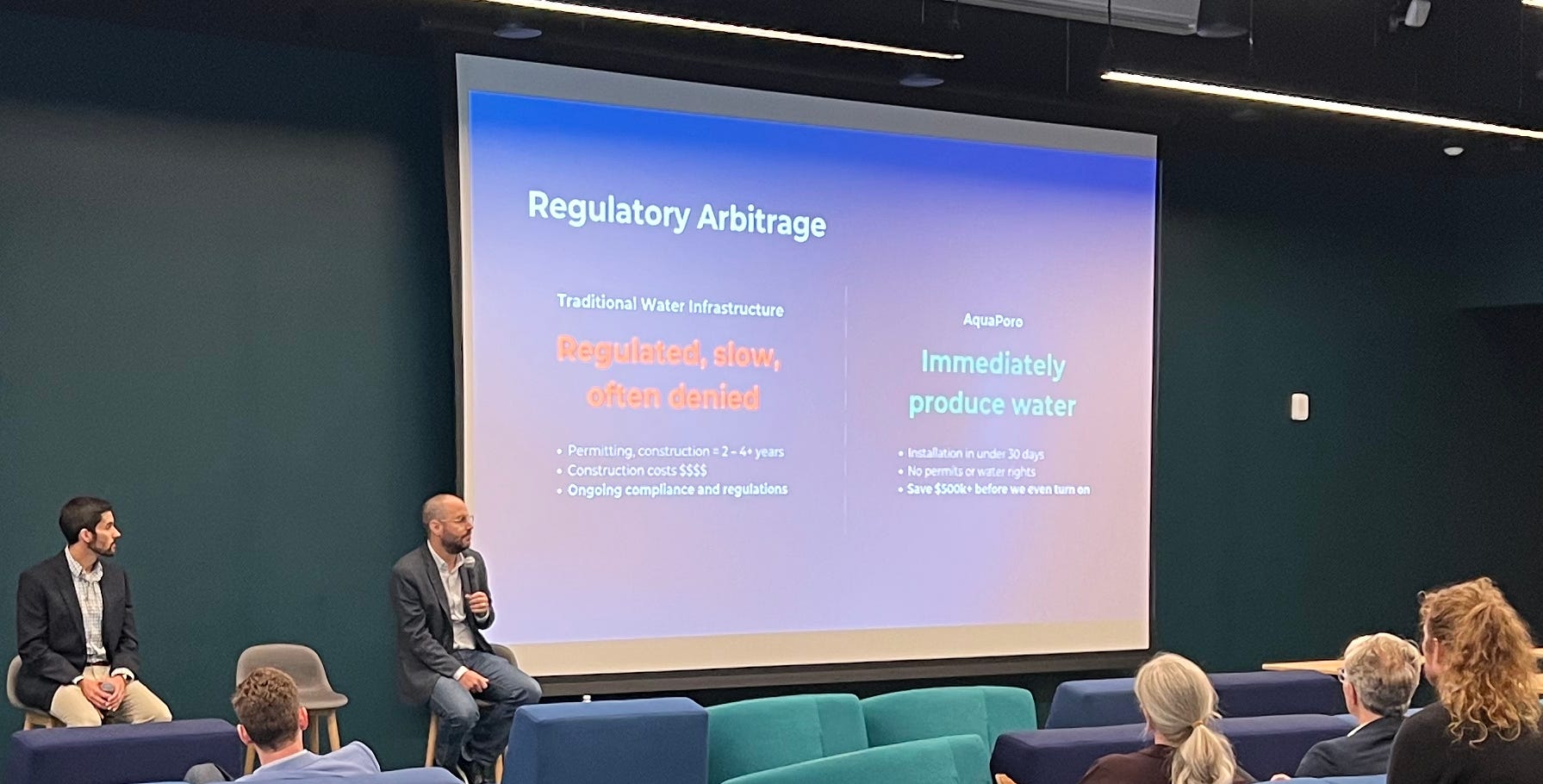
The End of Stationarity: What Scales in Water?, a fireside with Garrett Rapp, Senior Engineer at West Yost, and Kyle Cordova from AquaPoro, walked us through what it actually takes for water solutions to scale when the hydrologic patterns the infrastructure was built for no longer exist.
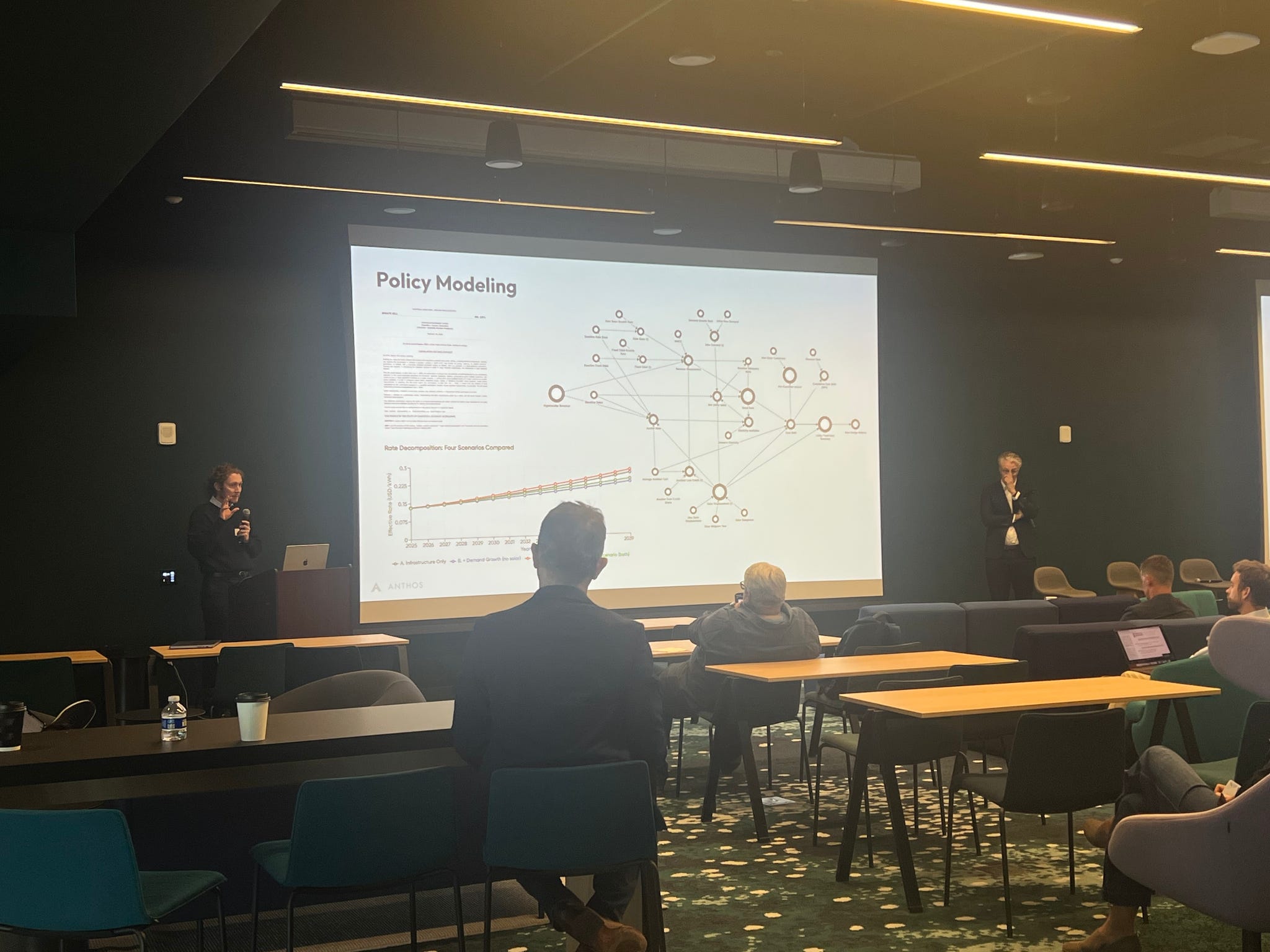
A policy x data-oriented highlight for me was when we had our friends at Anthos showcasing what the future of dynamic modeling can look like when we can interrogate multi-model causal interactions and variables in a world where spreadsheets alone can’t map the complexity.
Voices from the Room
A few of the day’s participants have since published their own reflections, each from a different vantage on the stack and each is worth reading.
Orville Thomas, CEO of CalEPIC and moderator on Building the Workforce, Supply Chains & Deployment Lanes for Electrification, has written about a week of climate conversations, on the road and at home in Sacramento, and what they amount to for the on-the-ground work of building the region’s clean-economy flywheel: the technicians, the suppliers, the deployment lanes that turn the climate transition from a federal-policy talking point into a working regional economy.
👉Read it here.
David Siap, who moderated Powering AI Without Breaking the Grid and leads the energy research agenda at CREO Syndicate, the leading network of private family offices investing into sustainable solutions, has written about the five weeks he spent in the field between California’s compute, energy, and capital nodes, in the lead-up to the Forum. His piece is one of the more honest accounts of what the AI-energy build-out actually looks like from a deployment lens, rather than a deck.
👉Read it here.
Teddy Hennes, our Platform Partner at emrgnce, moderated California’s Climate Corridor: Regional Ecosystems into a National Export Engine, has written about California’s early-stage startup scene from the California-Forward perspective — what holds the state’s distributed climate ecosystems back from compounding into a unified export engine, and what the next decade of platform-building has to do about it.
👉Read it here.
Devin Young, who with his co-founder DJ Passey delivered When Your Model Breaks and demo, shared his take.
👉Read it here.