


Listen to the AI Narrated commentary overview of the post:
Victor Hugo wrote that nothing is more powerful than an idea whose time has come. What he didn’t write, but history has shown repeatedly, is that the idea rarely announces its arrival. It doesn’t come with a press release, but often comes with a crisis.
The pattern is consistent enough to be a law. The Great Smog of London in December 1952 killed an estimated 12,000 people in five days. The science of air pollution had existed for decades. Activists had been raising alarms for years. None of it moved policy, but the smog did. The Clean Air Act was passed by British Parliament four years later. The idea’s time had come, not because the argument got better or the underlying facts changed but because the cost of the old arrangement became undeniable.
The 1973 OPEC oil embargo is the more directly relevant precedent. The U.S. had understood its oil dependence for years. Energy economists had been publishing papers. Politicians had commissioned reports. When the embargo hit and gas lines stretched around city blocks, something shifted, not in the analysis, but in whose problem it was. The Department of Energy was created. Corporate Average Fuel Economy (CAFE) standards were enacted by the U.S. Congress in 1975 via the Energy Policy and Conservation Act, once again largely in response to the 1973 OPEC oil embargo. The first modern solar installations got federal backing. Energy efficiency ceased to be an environmentalist preference and became a national security imperative.
The idea was the same before and after the embargo. What changed was the world’s willingness to act on it.
I’ve been thinking about this pattern this past week while at SF Climate Week, partially also continuing a stream of thought from my prior week in DC. Because we are living, right now, in one of those inflection moments and the evidence suggests that most markets haven’t priced it yet.

The pattern is visible in two places at once. In developed markets, data centers are forcing energy procurement to move at the speed of compute. In emerging markets, fossil volatility is turning renewables from a climate preference into fiscal defense. Different markets, same mechanism: when energy becomes the bottleneck, speed beats ideology.
Climate as Resilience: Last Year’s Language
If you attended climate conferences over the past year, you heard a particular phrase repeated like a mantra: climate as resilience. It was the reframe designed to make climate action legible to finance… to shift the conversation from moral obligation to risk management, from idealism to fiduciary duty.
It was the right argument. And for much of the audience, it still hasn’t been enough. Because resilience is abstract until the thing you’re supposed to be resilient against actually arrives.
That’s what’s different now. The geopolitical and energy disruptions of the past year: the commodity volatility, the supply chain fragmentation, the tanker route risk, the re-weaponization of energy as a geopolitical instrument, have turned the resilience argument from a conference slide into a live market condition.
Climate action is no longer a forward-looking hedge against possible disruption. It is the response to present disruption. The revelation is happening. It is just still making its way through markets, still being absorbed by capital allocators, still being translated into the regulatory and financing frameworks that will shape the next thirty years.
That lag, between the revelation and the repricing, is where the opportunity lives.
Samuel Insull and the Utilization Thesis
Before we get to the frontier, it’s worth pausing on the mechanism. Because the same economic logic that unlocked electricity for the masses is the one that will determine whether the energy transition reaches everyone or stalls at the edge of affordability.
In the 1890s, Samuel Insull inherited a chaotic, expensive, and deeply skeptical electricity market. Thomas Edison had built direct current systems that were brilliant but difficult to scale economically, each neighborhood needed its own generator, costs were astronomical, and electricity was a luxury for the wealthy. The public remained unconvinced.
Insull’s insight wasn’t technical, but purely economic. He recognized that the cost of electricity was almost entirely fixed, from the plant, the wires, the infrastructure and that every additional unit of consumption spread that fixed cost across a larger base. Utilization was the variable that determined whether electricity was a luxury or a utility.
So he went to work on utilization. He offered cheap off-peak rates to industrial customers who could shift load to overnight hours. He built the interconnected grid specifically to average out demand peaks across geographies. He pushed relentlessly into residential markets not because it was profitable immediately but because density of consumption was the mechanism through which electricity became affordable for everyone.
By 1920, Chicago had some of the cheapest electricity in the world. Once again, not because the technology got dramatically better, but because Insull understood that the path from expensive and exclusive to cheap and universal ran through maximum utilization of existing infrastructure.
This is the ACE framework, Average Cost Economics, applied to a network. And it is still the most under-appreciated dynamic in energy transition today.
Prosperity isn’t a byproduct of cheap energy, it’s inseparable from it. Insull did more than just wire Chicago, he had engineered the material conditions for a middle class.
The Data Center Version
There’s a hierarchy that nobody in the energy industry says out loud but everybody operates by.
At a session hosted by Google, HSBC and Sightline Climate, Kim Zou finally said it: speed, speed, speed — then cost — then climate.
That’s the procurement stack for hyperscale data centers. A truly honest take to the current demand requirements. When you’re trying to bring a gigawatt of compute capacity online, energy availability is an existential constraint. Climate is a preference. The industry’s credibility gap, the distance between what it says in sustainability reports and what it actually optimizes for, lives in that sentence.
But here is what Insull would recognize immediately: that priority stack isn’t a values statement. It’s a phase. The early electricity industry also prioritized availability over everything else. You couldn’t sell efficiency to customers who didn’t yet have power. Once availability was solved, the economics of utilization took over and efficiency became the profit motive, not just the preference.
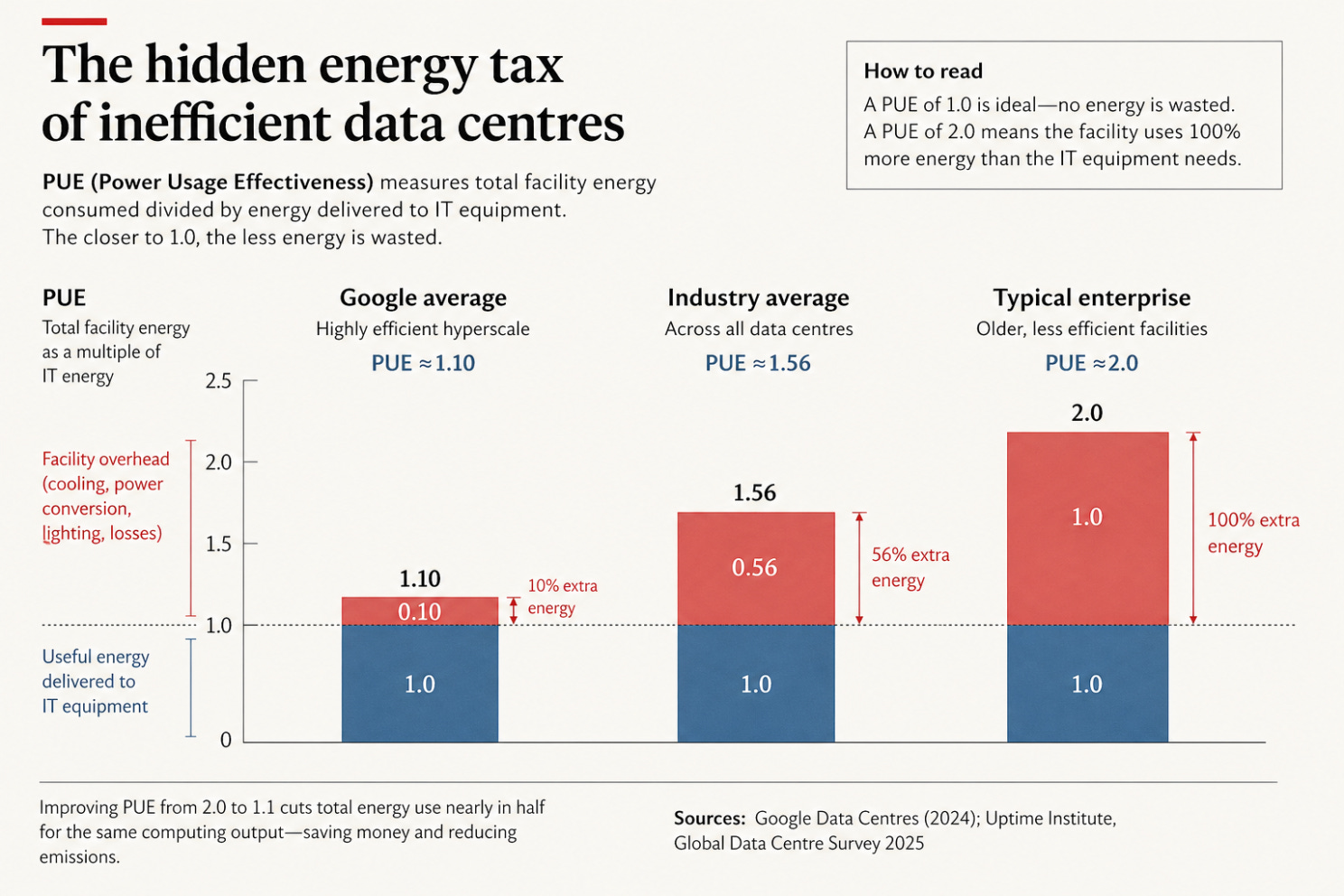
The hyperscale operators, whether Google, Meta, Microsoft or Amazon, are all publishing PUE (Power Usage Effectiveness) metrics and making serious commitments to clean power. But the underlying logic is the same as Insull’s. The three variables that determine the climate profile of your compute are: the cleanliness of your power source, on-premise versus cloud trade-offs, and how efficiently your actual workloads run. All three are utilization problems in disguise.
PUE is a ratio: total energy consumed by the facility divided by the energy delivered to IT equipment. Google’s average hovers around 1.10. Most enterprise data centers run between 1.5 and 2.0. That gap is wasted energy and wasted spend… the same gap Insull spent his career closing in the power grid.
The emerging frontier is self-powered data centers: facilities that own their energy supply chain rather than purchasing from a utility. Pair that with demand response assets and you’re looking at the architecture of a grid that behaves more like Insull’s integrated system than the fragmented utility model of the 20th century.
The phrase I heard: BYONCE, “Bring Your Own New Clean Energy”, sounds like a joke, but it captures the posture perfectly. It presents a structural shift in how large energy users relate to the grid. The implication is that speed, cost and climate stop being a priority stack and start being a simultaneous optimization problem. When your clean energy is co-located, dispatchable and yours, you don’t have to choose.
Forced Transitions
But the data center story, important as it is, wasn’t my main highlight of SF Climate Week.
It was when, our emrgnce ecosystem and Reciprocal, convened a room of friends for our Emerging Markets: The Next Climate Frontier event.
We opened with a provocation we called Forced Transitions: the argument that geopolitical shocks don’t merely disrupt energy markets, they accelerate adoption curves in economies with the least legacy infrastructure to protect.
The question on the table: as oil and gas volatility reshapes global capital flows, what role do emerging markets play? Are they recipients of climate finance & typecast as philanthropic playgrounds or are they the next proving grounds?
The answer the room kept arriving at: proving grounds. By a wide margin.
The Leapfrog Dividend
There’s a pattern in technology adoption that development economists call leapfrogging, the phenomenon by which countries that missed an earlier infrastructure wave skip it entirely and adopt the successor technology faster than incumbents encumbered by the old one.
The canonical example is mobile telephony. Sub-Saharan Africa never built landline infrastructure at scale. When mobile networks arrived, there was nothing to cannibalize, no installed base to protect, no regulatory regime built around legacy systems. The continent went from low telephone penetration to near-universal mobile access in under a decade. M-Pesa, the mobile money platform built on top of that infrastructure, emerged in Kenya in 2007 and processed more transactions than Western Union within five years.
Once again, this pattern is structural.
Incumbency is a liability when the technology generation turns.
We are at a technology generation turn in energy. The successor technology: distributed solar, storage, smart grid, demand response and the software layer that coordinates all of it, does not require the legacy grid architecture that incumbent utilities were built to protect. In many cases, legacy infrastructure actively impedes deployment.
Emerging economies, in this light, are not behind. They are unencumbered. And unencumbered, in a transition, is an asymmetric advantage.
The 1973 embargo is instructive again here. Japan, almost entirely import-dependent for oil, responded faster and more systematically than any other developed economy, cutting energy intensity per unit of GDP by nearly 40% over the following decade. The country most exposed had the most to gain from moving first and the fewest vested interests defending the old arrangement. Constraint, again, as catalyst.
Crisis-as-a-Catalyst
What I named in my talk as “Crisis-as-a-Catalyst” is the mechanism by which the leapfrog dynamic converts from latent opportunity to active imperative.
Oil and gas volatility is not abstract. When energy prices spike, the countries most exposed are net importers and most of the world’s emerging economies are net importers. Risk premiums, tanker route disruptions, OPEC+ production decisions: these are not geopolitical abstractions to a grid operator in West Africa or Southeast Asia. They are budget crises. They are the conditions under which governments that have resisted energy transition on cost grounds suddenly find the cost calculus has inverted.
This is precisely what happened in Europe following 2022. Germany had spent a decade hedging on energy transition, protected by cheap Russian gas and resistant to the speed that the moment required. The disruption of that supply didn’t just accelerate the renewable buildout, it restructured the entire political economy of energy transition on the continent. REPowerEU mobilized capital and political will in months that had been unavailable for years. The idea was the same, the crisis made it feasible and timely.
Now that dynamic is playing out across emerging markets… more slowly, less visibly, but with larger long-term consequences. Energy sovereignty is the frame that unlocks the investment thesis. A country that builds domestic renewable capacity isn’t making a climate bet. It’s making a national security bet. The climate co-benefit is real but secondary to the decision-maker.
Climate finance has struggled for years with the gap between the cost of capital in developed markets and the risk perceptions of emerging ones. The spread is real but often overstated and the narrative around it gets the causality backwards. The question isn’t: how do we reduce perceived risk enough to attract capital? The question is: what conditions make the investment inevitable regardless of climate preference?
Energy sovereignty answers that question. And the geopolitical conditions that create that imperative are not easing, but rather deepening. The revelation is not complete. It is arriving and the data is there if you start plugging in the right causal relationships, which is what I set out to explore.
Slide from my Emerging Markets presentation on Crisis-as-a-Catalyst
The Causal Model: What the Numbers Actually Say
The vulnerability of fossil-dependent emerging markets is not a hypothesis. It is a measurable, compounding mechanism and we mapped it.
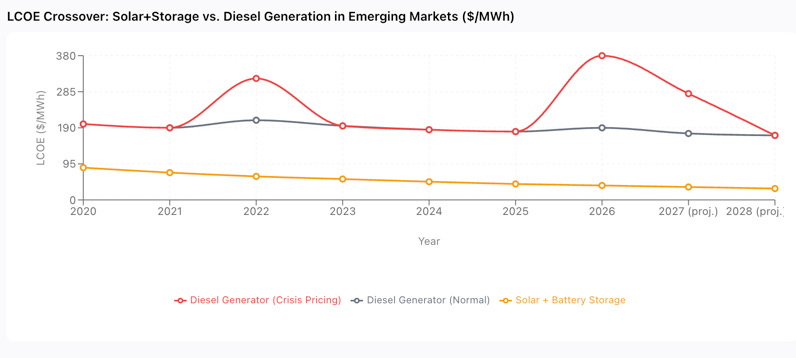
The entry point is LCOE: the levelized cost of energy. Utility-scale solar is now regularly benchmarked in the high-$30s to low-$40s per MWh in leading markets, while solar-plus-storage remains higher and depends heavily on storage duration, financing costs, grid conditions and local irradiance.
The long-term cost curve for solar continues to move downward, even if annual costs can stall or rise with interest rates, tariffs, interconnection delays or supply-chain shifts.
Diesel generation, by contrast, is structurally exposed to every crisis that touches the Strait of Hormuz, global fuel markets, shipping costs, insurance and dollar liquidity.
In many import-dependent or off-grid settings, diesel already runs several times more expensive than utility-scale solar. During acute crisis episodes, that gap can widen dramatically. The crossover has already happened in the places where fuel logistics and FX exposure matter most. Every new crisis makes the gap harder to ignore, because each shock strengthens the case for deploying the cheaper, less geopolitically exposed alternative.
But the LCOE crossover is only the beginning. The more important mechanism is fiscal transmission, the way an energy shock drains state capacity through four simultaneous pathways.
Let’s take Egypt as the case study:
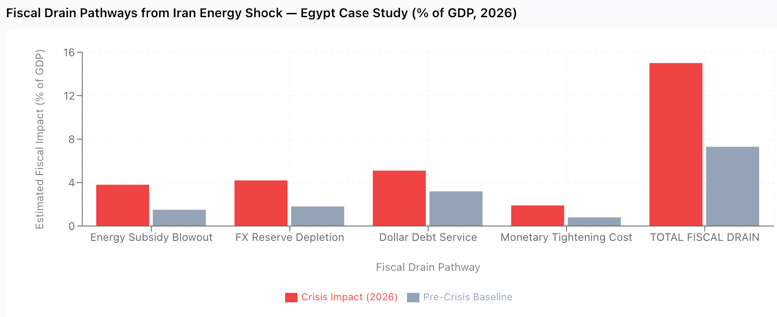
When energy prices spike, subsidies expand (political cost of letting prices through to consumers), FX reserves drain from higher import bills, dollar debt service rises as the currency weakens against that import pressure, and monetary tightening to fight imported inflation further squeezes fiscal space. The total fiscal drain roughly doubles from baseline during a crisis episode. Every gigawatt of solar deployed reduces the subsidy burden and the FX reserve bleed simultaneously. This is not at all an environmental investment, it is a fiscal defense.
Pakistan makes this concrete.
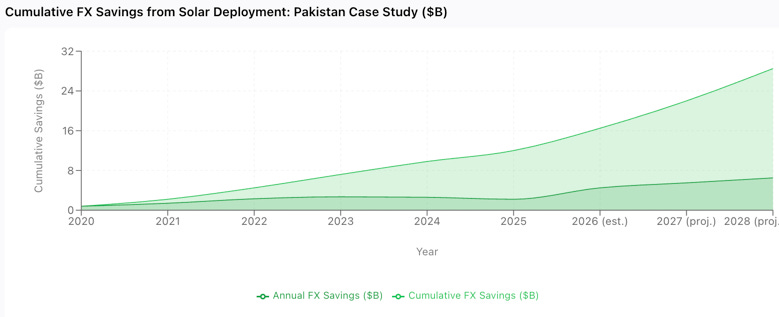
Pakistan’s solar boom has been driven less by climate policy than by affordability pressure. Households and businesses are not waiting for a perfect transition plan; they are arbitraging against an expensive, unreliable, fossil-dependent system.
Recent estimates suggest Pakistan’s rapid solar adoption has already avoided roughly $12 billion in fossil-fuel import costs. In a crisis scenario where fuel costs spike, that avoided exposure becomes even more valuable. The same solar panels do not just produce cheaper electrons; they become a hedge against FX depletion, imported inflation, and geopolitical volatility.
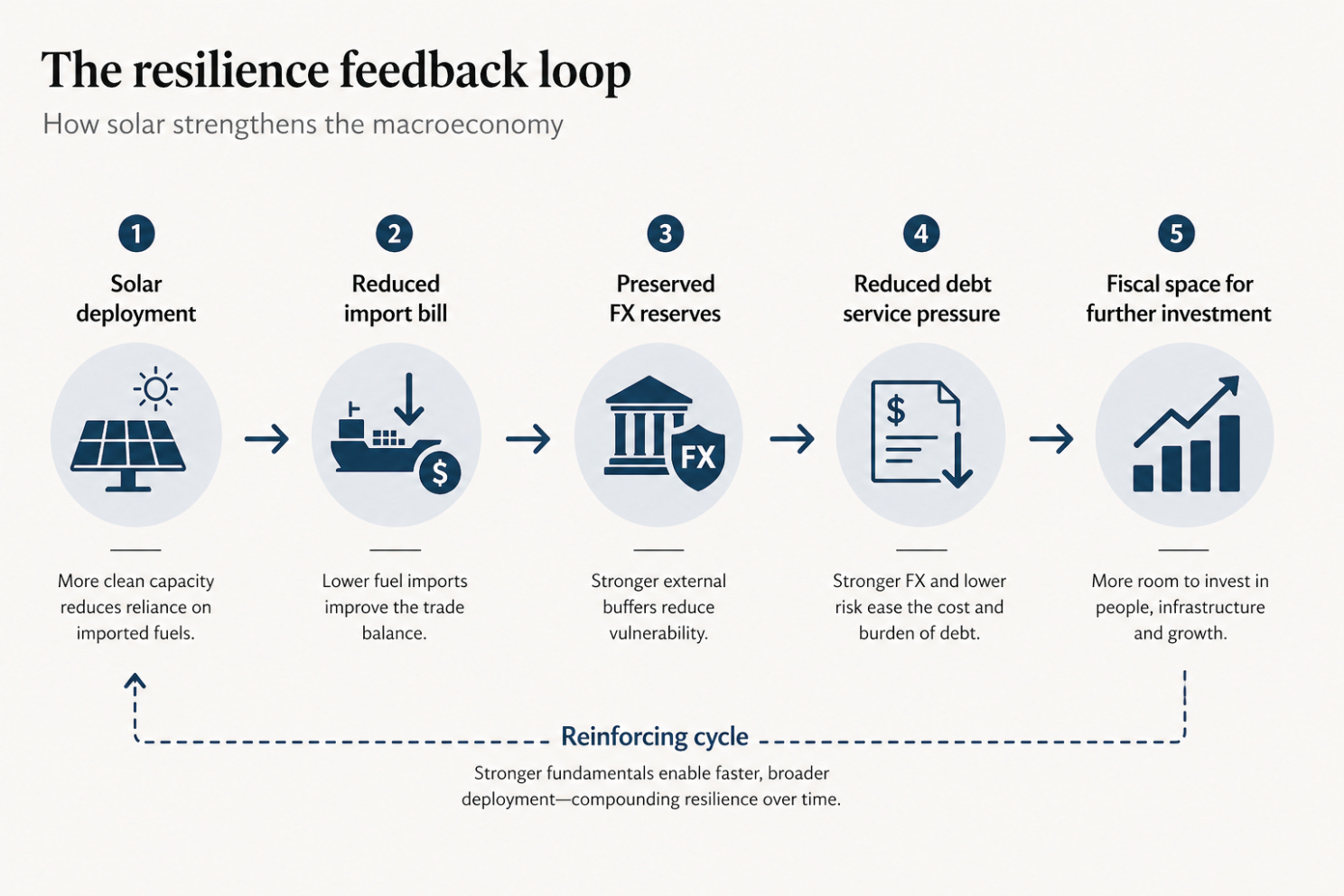
The structural argument runs deeper than cost. Transit risk, insurance disruption, refinery concentration, dollar exposure, subsidy drain, and price volatility hit fossil fuels directly and quickly.
Solar-plus-storage has vulnerabilities too. Chinese module concentration, critical minerals, grid integration and financing costs but these are slower-moving deployment and supply-chain risks, but they are not instant cascade risks.
Once again, this is not a climate argument, it is a national security argument expressed in the language of supply chain risk management. The countries that recognize that soonest will move fastest. The capital that understands the causal model, not just the LCOE crossover, but the full fiscal transmission chain, will be positioned at the right moments in the right markets.
The map of the ten most exposed emerging market states tells the rest of the story.
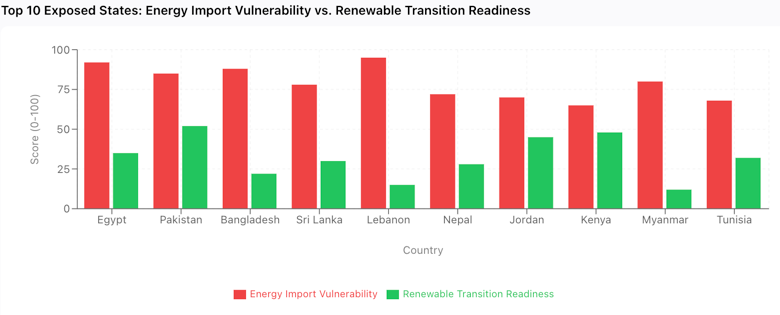
Bangladesh, Lebanon, Jordan, Kenya, Tunisia, Nepal and Egypt each sit at a different point between fossil vulnerability and transition readiness. The gap between those two scores is the opportunity space: in gigawatts deployed, import bills avoided, FX reserves preserved and fiscal headroom restored.
It is the political economy of governments that can no longer afford the alternative.
Second and Third Order Effects
The first order effect is obvious: faster clean energy deployment in markets that represent the majority of future energy demand growth.
The second order is more interesting: the companies and technologies that win in emerging markets are building for constraint, not abundance. They are optimizing for intermittency, limited grid infrastructure, mobile payment rails, distributed ownership models and communities (and construction sites) that have never had reliable power at all. That is a more rigorous design requirement.
My belief is that the technologies and business models that emerge from those constraints will flow back into developed markets, just as mobile money infrastructure pioneered in Kenya became the template for fintech innovation globally, just as the fuel efficiency innovations catalyzed by the 1973 embargo eventually raised global standards across the industry. The edge innovates under pressure. The center adopts when it’s convenient.
The third order is the one worth building toward: a global energy system where the geography of production and the geography of consumption are realigned. For a century, energy has been produced where hydrocarbons exist and consumed everywhere else. That asymmetry underwrote the geopolitical order of the 20th century… the petrostates, the tanker routes, the military presences, the currency arrangements, all of it downstream of the geology of oil.
The transition to renewables decouples production from geology. Solar irradiance, wind corridors, tidal and geothermal energy… these are distributed unevenly but vastly more evenly than oil reserves. The countries that have been energy-dependent for a century are, in many cases, among the best-positioned for renewable production.
That is a reordering of geopolitical power. The full implications are not yet priced into markets. They are not yet reflected in foreign policy. They are not yet articulated in the capital allocation frameworks of most institutional investors. But they are directional. And they are inexorable.
The Capital Implication
Volatility is a filter. The capital and operators that find their way into these markets through this cycle will define the next decade of climate infrastructure.
Insull’s lesson applies here too. He didn’t wait for demand to materialize organically. He created the conditions for it… through pricing, through interconnection, through relentless focus on utilization as the variable that made the economics work. The result was a network that created its own demand by making electricity too cheap and too available to ignore. Prosperity followed infrastructure. Infrastructure was a choice made in advance of the demand it generated.
That is the bet on offer in emerging markets today. The infrastructure that gets built now: the grid architecture, the ownership models, the digital layer, the regulatory frameworks, will determine what’s possible at scale for the next thirty years. The window between revelation and repricing is where patient, catalytic capital earns its return. This is not done by picking winners in established verticals, instead done by shaping the systems those verticals will operate within.
The fastest path to the energy transition isn’t the obvious one.
It runs through the places nobody’s watching… through constraints, through forced transitions, through the unencumbered edge, through the slow-moving recognition of an idea whose time, unmistakably, has come.
This piece originally appeared on Mehrad’s LinkedIn, a reflection of ideas from SF Climate Week 2026 & the prior week in DC