


I spent most of New York Climate Week in rooms with corporate executives, investors, public-sector leaders, bankers, infrastructure operators and people whose titles contained some combination of resilience, transition, strategic, future and global. The World Economic Forum’s Sustainable Development Impact Meetings ran from September 21 to 24 alongside the 81st General Assembly, close to a thousand people circling the same problem: plenty of technologies now work and far fewer of them are getting bought, financed or permitted at the pace our current moment demands.
On one of those afternoons I presented our Co-VC framework to a WEF Advisory Board. Then I spent the rest of the week collecting evidence for it, mostly in the form of institutions explaining, politely and at length, why they could not yet say yes to things that already work.
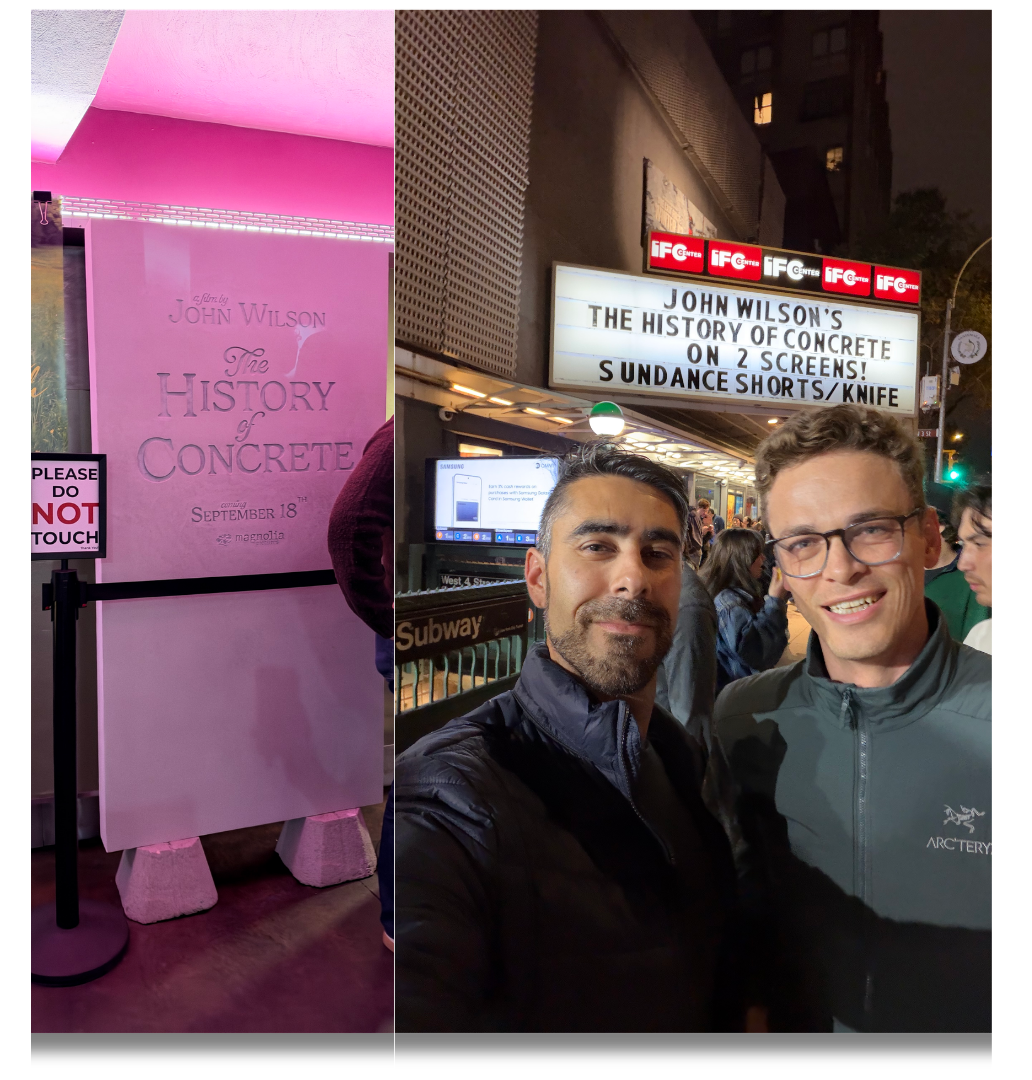
Teddy Hennes and I closed the week at an opening weekend screening of John Wilson’s The History of Concrete, which turned out to be the most on-topic hour and forty minutes of the week. I had spent several days talking about foresight, financial resilience, standards, regulation and the strange machinery required to get a new technology into the physical world. Wilson covered the same ground through sidewalks, with better jokes.
It also prompted a retrospective I had not planned on…
Ten years of concrete
In 2015, some of my earliest interactions with the team that would become Dubai Future Foundation gave me a first look at government using foresight as an operating system rather than as theater: run the scenarios, build the counterfactuals, expose institutions to a technology before it becomes unavoidable, and shorten the distance between this might happen and what would we do if it did.
Then came the Office of the Future. In May 2016 Dubai inaugurated what it called the world’s first 3D-printed office, a 250-square-metre structure printed in seventeen days and installed in two, which became the Foundation’s temporary home. It was a wonderfully literal object from the future. You could touch it, walk inside it, hold a meeting in it. And the institutional system around it still had to work out what it was.
That distinction has stayed with me. The building was clearly finished, yet the rules for it were not. Nobody at the municipality had a permit category for a printed structure, no insurer had a policy for one and no structural code told you how thick a printed wall had to be.
A new technology can be standing in front of you, fully built and still not exist as far as the system is concerned.
Most of the cost of getting something new into the world is spent in that gap…between the thing being real and the thing being recognized.
A few years later the UAE formalized RegLab, a regulatory sandbox launched in January 2019 under a federal law whose name I still find perfect. It lets the Cabinet grant temporary licences to projects that either conflict with existing legislation or operate where none has been written. A legal category for things that do not yet have one. I would not draw a straight causal line from one building to an entire regulatory institution, but from where I sat they were two expressions of the same problem. The future can arrive before the rulebook does.
Ten years on, I was back in a WEF session discussing low-carbon concrete and the conversation had moved from whether we could print it to whether we could buy enough of the low-carbon version to pull an industry forward. The Forum’s First Movers Coalition now brings 101 companies and 14 government partners together around collective purchasing commitments, worth more than $19 billion of demand by 2030, across shipping, steel, aviation, trucking, aluminum, carbon removal and cement and concrete. Cement joined at COP27 in 2022, when a group of construction, engineering and real-estate firms committed to buying at least 10% near-zero cement and concrete a year by the end of the decade. The Forum’s framing at the time: concrete is the second most consumed product on Earth after drinking water.
So a decade after watching a new form of concrete run into an institutional problem, I was watching institutions deliberately rearrange themselves around new forms of concrete. Somewhere between those two moments my understanding of climate investing changed. The hardest part of new concrete is everything around the concrete: the buyer, the standard, the insurer, the regulator, the contract, the debt, the procurement code and the person who signs their name beneath: yes, we will put this inside an asset expected to stand for forty years.
That was the week’s recurring theme. The scarce input in every room was coordination and we have spent a decade misdiagnosing its absence as a shortage of technology or a shortage of money.
We may have misnamed the Valley of Death
Climate tech loves the Valley of Death. It usually describes the financing gap between a promising technology and commercial scale and there is truth in that. But after enough conversations I started to suspect we have confused the symptom with the disease.
Imagine a technology that works. Physically, demonstrably works. Now try to deploy it…
The equity investor wants customer validation.
The customer wants insurance.
The insurer wants operating history.
The lender wants predictable cash flows.
The developer wants standards.
The regulator wants a classification.
The infrastructure owner wants someone else to carry integration risk.
Procurement would like three years of data.
Everyone would be delighted to participate immediately after everyone else has.
A perfectly rational Mexican standoff.
We call the resulting gap a financing problem because eventually, someone runs out of money. It is more accurately a coordination problem with a financing consequence.
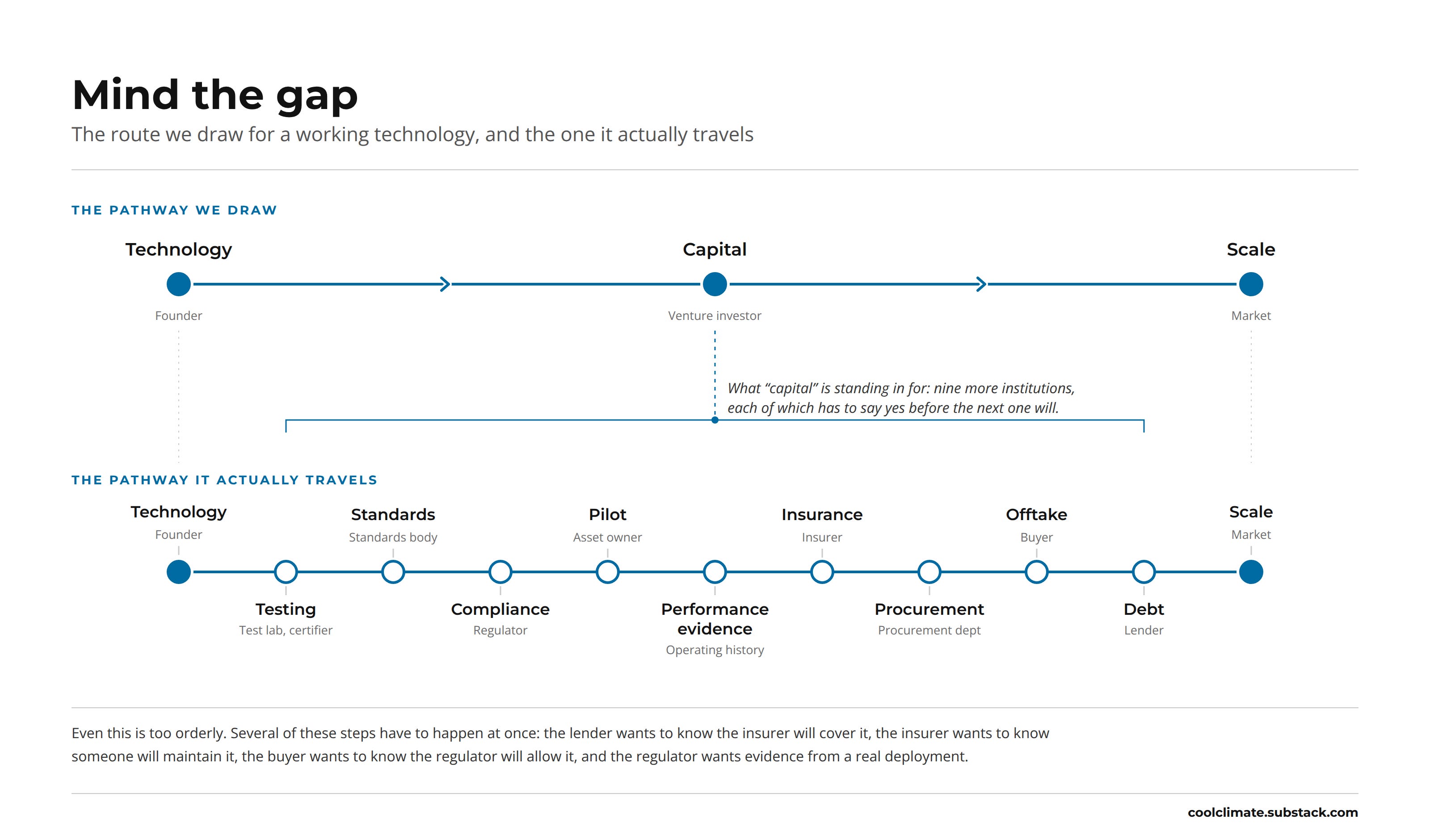
This is why so many climate technologies sit in pilot purgatory. They are waiting for six institutions to become comfortable at approximately the same time and that is a very different investment problem from waiting for a breakthrough.
The Forum’s own wrap-up of SDIM put it almost exactly this way: solutions that are commercially compelling in one market remain constrained by financing costs, infrastructure or policy in another…
“As environmental pressures mount, sustainability is increasingly central to competitiveness, resilience, security and well-being. But progress remains uneven: solutions that are commercially compelling in one market can remain constrained by financing costs, infrastructure or policy in another, and the costs and benefits of the transition are not always shared evenly,” said Sebastian Buckup, Managing Director, World Economic Forum. “In a more fragmented world, the task is to connect capital, technology and markets so that solutions can scale and deliver for people. SDIM showed why practical cooperation around these real-economy challenges remains an urgent priority.”
A pilot is a financial instrument in a hard hat
One question I heard during the week lodged itself in my head: what line does innovation sit on in your balance sheet?
Most companies say they want innovation, yet far fewer have a clean accounting answer for where it actually lives. A pilot ends up somewhere between R&D, sustainability, business development, procurement and corporate philanthropy… and that ambiguity matters because we have also given the word pilot a connotation almost designed to prevent adoption. A pilot is a thing we try and things we try are allowed to fail. Healthy in a lab. Less healthy in a procurement cycle.
If no one has defined what success leads to next, a pilot can succeed technically and vanish institutionally. The technology performs, everyone applauds, there is a photograph, LinkedIn receives the news and the pilot failts to commercialize the technology and just becomes another ‘whatever happened to that breakthrough I read on a headline years ago?’.
So my core belief is that the design question has to begin before deployment.
If this works, what changes? Does procurement unlock? Does the insurer revise a risk assumption? Does the lender move the cost of capital? Does a standard get written? Does another asset owner join? Does the pilot produce evidence a second customer can rely on? What is the pilot buying besides data?
Pilots are financial instruments disguised as engineering experiments. Designed well and they can convert one kind of uncertainty into another kind of certainty: technical uncertainty into performance evidence, performance evidence into underwriting confidence, underwriting confidence into cheaper capital, cheaper capital into easier procurement, procurement into volume, volume into falling cost. And then someone announces the technology has suddenly become commercially viable. Nothing was sudden. A chain of institutions learned how to say yes.
This is roughly the argument of a piece I co-authored for the WEF ahead of SDIM, on three shifts in financial design that get hard tech out of pilot purgatory: underwrite the decision rather than the demo; treat working assets as shared lab infrastructure; and structure the capital so the industry wins, not only the company.
In the write-up, I refer to our ongoing work with lomarlabs in the maritime space and our Madrid engagement with Dark Matter Labs as examples of the model. The phrase I keep returning to from it is terms of adoption. Most pilots negotiate the terms of the experiment, but almost none negotiate the terms of what happens if the experiment works.
First equity is a switchboard
We tend to think of early equity as the capital willing to tolerate risk before safer capital arrives. Venture takes the risk, the company matures, debt appears later. But the more useful role of first equity is to organize risk rather than simply hold it.
There are many different risks hiding inside the sentence this project is risky: technology, construction, demand, regulatory, catastrophe, integration, commodity, counterparty, political, performance.
These are different things and venture equity is almost certainly the most expensive institution to hold all of them at once. The job is to route each one, progressively, toward the party best equipped to price it.
Technology risk may belong with venture. Construction risk with project finance. Catastrophe risk with insurers. Demand risk shrinks under offtakes or advance market commitments. Policy risk can be partially absorbed by guarantees or public institutions. Performance risk migrates toward warranties, certification and testing. Integration risk can end up with the asset owner who understands its own equipment better than anyone else.
De-risking means putting each risk in the hands of someone who knows what to do with it. That makes early equity less a shock absorber and more a switchboard, and it changes what a climate investor should be doing after the check clears. The question moves from how much runway did we buy to which pieces of risk can now move somewhere cheaper. That may be the more important clock.
Pulling the debt market forward
One of the more interesting conversations I had was with a financial institution developing standards that would make new categories of project easier to underwrite. That sounds dry, but I believe it may be one of the most important climate technologies nobody puts in a pitch deck.
Standards perform a kind of financial alchemy. They turn unknown into comparable, comparable into modelable, modelable into underwritable, underwritable into financeable, and financeable, eventually, into boring. Boring is spectacular, it’s the gold standard of what broader financial markets want.
One of the great milestones for any climate technology will be the day no one calls it climate technology and an associate at a regional bank selects it from a dropdown menu.
We treat standards as compliance infrastructure. They are also capital-formation infrastructure.
Every time a lender can evaluate the fiftieth project with roughly the framework it used for the forty-ninth, transaction costs fall, capital relaxes, the market deepens and debt arrives earlier. Which suggests an inversion of the usual venture model. Rather than funding the company until it is ready for debt, ask what would have to be true for debt to be ready for the company. Strengthen the pre-seed and seed layer, yes, and at the same time pull the debt and project-finance markets forward: lenders into the learning loop earlier, insurers earlier, regulators earlier, infrastructure owners earlier. The company should not have to become a different species before those institutions are willing to learn its name.
Resilience has escaped the sustainability department
The other shift I felt all week was in the language around resilience. For years it sounded like a climate word… it now sounds like a CFO word, or a national-security word, or a procurement word, or simply the thing you discuss three years after discovering that the supply chain you optimized down to eleven minutes contains several oceans and one geopolitical rival.
The industrial ideal for a long time was Just-in-Time (JIT). Inventory is expensive, redundancy is inefficient, idle capacity is waste. Until the thing you removed turns out to have been your margin of survival.
I heard EXIM’s Project Vault discussed more than once. Announced in February, it establishes a U.S. Strategic Critical Minerals Reserve backed by an EXIM direct loan of up to $10 billion alongside roughly $2 billion of private capital, holding some sixty minerals in secure facilities across the country so that manufacturers keep access to raw materials through a disruption. The early participants read like an industrial who’s-who, Boeing, GE Vernova, Clarios, Western Digital, and in May EXIM named it Deal of the Year. It is, quite literally, a financialized shock absorber.
This is what interests me about the moment. We spent decades optimizing systems for efficiency; volatility is now forcing us to assign economic value to optionality.
Optionality looks like:
A second supplier.
Stored inventory.
Distributed generation.
Domestic processing.
Waste that can become feedstock.
Extra transmission.
Cooling capacity.
Water storage.
An alternative shipping route.
A material that can be sourced locally.
All of these look wasteful in the universe where nothing goes wrong and that universe has recently experienced some availability issues.
So the question shifts from what is the cheapest possible system to what is the cheapest system that keeps functioning across several plausible futures. That is a profoundly different optimization, and it maps directly onto how I have been thinking about investment through what we call Three Futures. The aim is to find positions that remain useful across several causally independent futures rather than to guess the one that arrives.
Resilience is the physical economy discovering the same principle: you pay for optionality before you know which option you will need.
When waste becomes ore
A thought followed naturally. A strong economy increasingly means one that can supply more of its critical needs under disruption. That can mean domestic mining. It can also mean noticing that yesterday’s waste is tomorrow’s strategic reserve: steel scrap, industrial by-products, construction waste, waste heat, wastewater, retired batteries, agricultural residues. The framing changes once you stop calling these things waste and start calling them domestically available feedstocks.
Circularity has been sold as an environmental virtue. Resource security may turn it into industrial strategy. The country that learns to recover valuable inputs from what it already has becomes marginally less dependent on whatever is happening at a port, border, mine, canal or ministry somewhere else.
Which raises a question I wrote down for investors: what is the floor price of the material? The floor, rather than the exciting upside case.
At what price does recovery, substitution or local processing become structurally viable? At what price does waste become ore?
At what price does a circular supply chain stop being sustainability theater and start being the rational economic response? Somewhere inside those thresholds are entire industries.
Maritime, where all the hard problems form a group chat
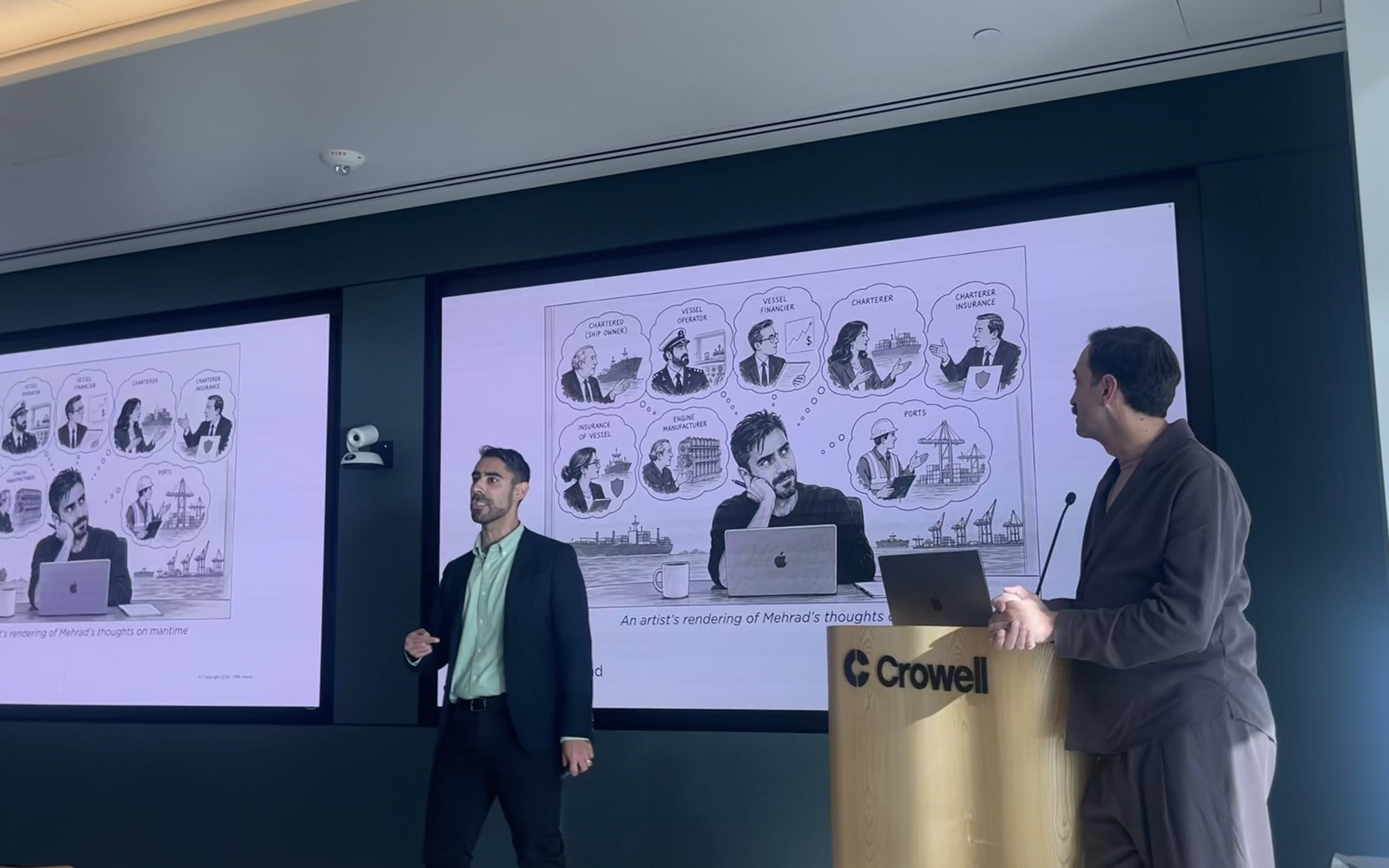
I also spent a lot of the week thinking about shipping. The more I study maritime, the more it looks less like an industry than a highly regulated multiplayer game designed by several committees that were not allowed to speak to one another.
Consider a vessel. There is an owner, possibly a different operator, a charterer, cargo owners, a lender, hull insurance, cargo insurance, a classification society, engine manufacturers, fuel suppliers, ports, port authorities, flag states, coastal states, regulators, freight forwarders, shipyards, maintenance providers, and a captain who would appreciate everyone deciding what fuel the ship runs on before departure.
Now insert a new technology: a fuel, a battery, a carbon-capture system, a hull coating, a propulsion unit, an autonomous system. What looked like a technical sale becomes a constitutional convention.
I have started describing maritime to myself as compliance and logistics in one industry. Those are already two of the hardest external functions for a startup. Maritime combines them and adds saltwater.
For any given voyage you are coordinating power, cargo, space, buyer, asset, insurance, finance, regulation and physical infrastructure, which makes a ship a surprisingly good miniature of the broader industrial economy. You can invent the technology. But if the port cannot handle it, the insurer will not cover it, the charterer will not pay for it, the operator cannot integrate it and the financier cannot price the vessel’s residual value after installation, you have not invented a product. You have invented a very interesting object.
This is why we have been building Fifth Wave around deployment infrastructure rather than scouting maritime technologies and hoping the market sorts itself out. The product is only one node in the system that decides whether the product exists commercially and maritime makes that visible faster than almost any other sector.
Three classes of bottleneck
This is becoming a broader part of our Co-VC framework. There are roughly three kinds of bottleneck a hard-tech company runs into.
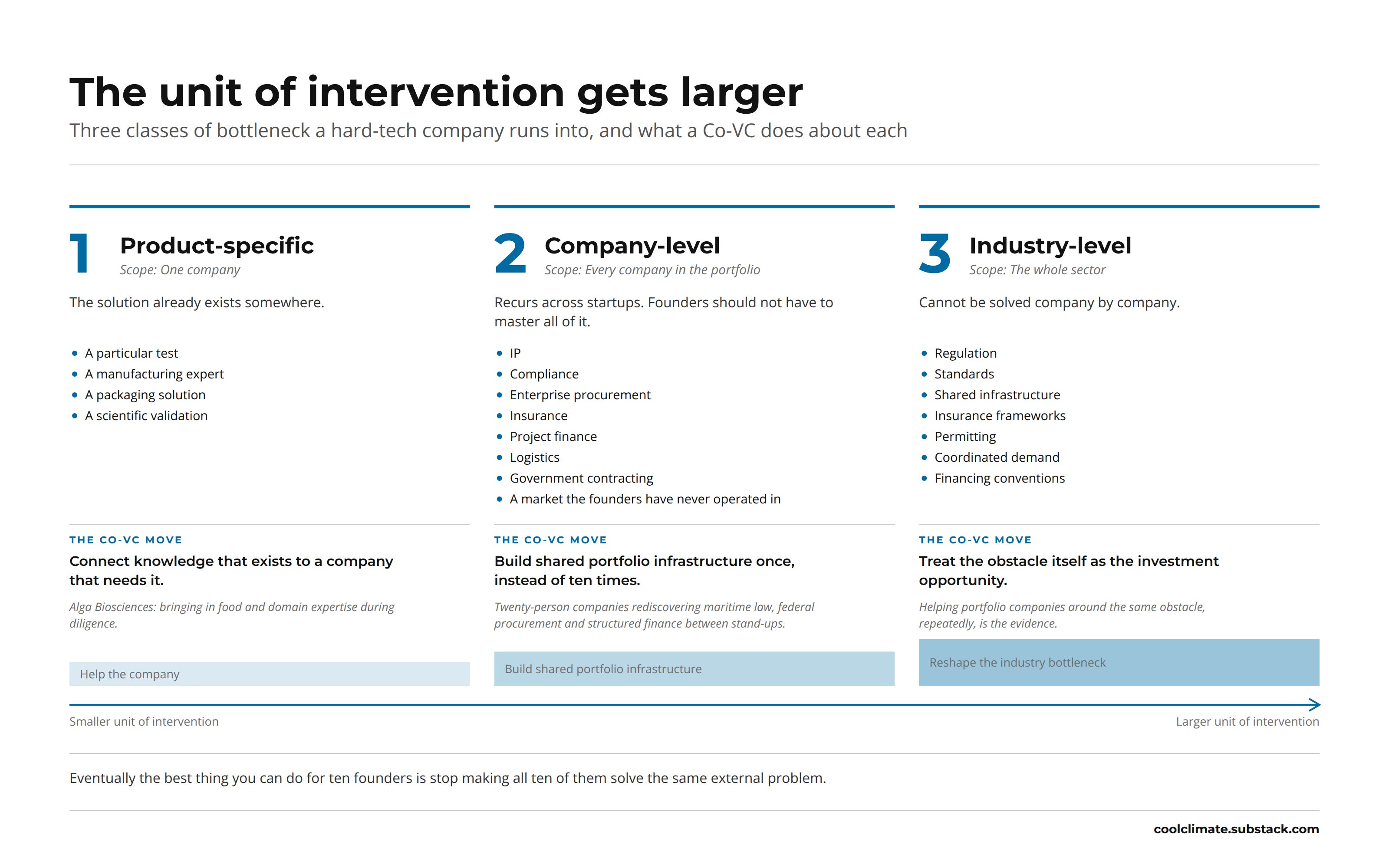
The first is product-specific. The company needs a particular test, a manufacturing expert, a packaging solution, a scientific validation. Hard, but the solution exists somewhere. When we diligenced Alga Biosciences, part of our work was bringing in food and packaging expertise; we were connecting knowledge that existed to a company that needed it, with no new institution required.
The second is company-level, and it recurs across startups: IP, compliance, entering a market the founders have never operated in, enterprise procurement, insurance, project finance, logistics, government contracting. Founders should not have to become world-class at all of these. Yet the ecosystem behaves as though every twenty-person company should independently rediscover maritime law, federal procurement and structured finance between product stand-ups.
The third is industry-level: regulation, standards, shared infrastructure, insurance frameworks, permitting, coordinated demand, financing conventions. These cannot be solved company by company. At some point, repeatedly helping portfolio companies around the same obstacle becomes evidence that the obstacle itself is the investment opportunity.
That is the evolution I see for Co-VC: help the company, then build shared portfolio infrastructure, then reshape the industry bottleneck. The unit of intervention gets larger. It was the spine of what I presented to the WEF Advisory Board and the useful part of the session had little to do with the slides I presented. It was watching leaders from various industry backgrounds recognize the same shape from inside their own sector. No one disagreed that it was a coordination problem, but often there was disagreement about whose job it was to coordinate. Which is, of course, the coordination problem.
The unit of intervention grows for a simple reason. Eventually the best thing you can do for ten founders is stop making all ten of them solve the same external problem.
Collusion, but for the planet
Another line from my notes: corporate collusion, but for the planet. I would not present it to antitrust counsel without context, but there is something real underneath. Companies compete fiercely on products, customers, pricing and share. They can still share precompetitive bottlenecks: standards, safety, charging infrastructure, data formats, supply-chain traceability, testing facilities, demand for a new material.
The First Movers Coalition is interesting precisely because it works on the demand side. Instead of asking suppliers to build something cleaner and hoping customers arrive, buyers collectively signal that if you can produce to a defined threshold, a market is waiting. Five years ahead of its 2030 target date, the coalition’s members have already signed more than 130 offtake agreements and investments.
The mechanism matters more to me than the branding: an individual buyer becomes aggregated demand, aggregated demand becomes a credible market signal, the signal makes production capacity financeable, capacity increases supply, supply lowers cost, and low-carbon cement becomes ordinary procurement.
Demand itself becomes infrastructure. Sustainability alignment occasionally produces the peculiar situation in which competitors realize they are all constrained by the same missing market. They still want to beat each other, it’s just they would simply prefer to do it in a world where the low-carbon cement exists.
Six questions
A memorable dilgience framework that was shared in one of the chatham house rooms, was around four simple questions: who uses, who chooses, who profits, who pays?
I would add two more: who carries the risk, and who grants permission?
In climate infrastructure the remarkable thing is how often those six questions have six different answers...
The party benefiting from resilience may not be the one paying for it. The party choosing the technology may not operate it. The institution holding the asset may not capture the public benefit. A city benefits from flood protection on private property. A building owner pays for cooling that mostly protects tenants. An employer protects workers during a shift with no say over whether they can recover overnight in a cool home. A cargo owner wants lower-emission shipping while the vessel owner carries the retrofit risk. A startup creates the technology while an insurer decides whether anyone is allowed to deploy it.
The questions followed me to a different room the next day. At our Fifth Wave executive roundtable, the head of government of a small island state addressed a table of maritime executives and he was courteous about it, which made it land harder. Shipping, he observed, has a remarkable ability to absorb a disrupted world. When trade lanes shift or bunker prices spike, the industry reprices the voyage and passes the bill down the chain. His country sits at the end of that chain. It imports nearly all of its fuel and most of its food, so this year's two regional wars arrived in his economy as a single line item: higher freight on top of higher energy on top of higher grain, compounding into the kind of inflation that no domestic policy can offset. A government can win every argument it chooses to have at home and still be undone by a surcharge set in a port it has never seen.
This is where rational systems produce irrational outcomes.
Everyone benefits, but benefit, agency, cost and risk sit on different balance sheets. Every resilience conversation eventually becomes a conversation about who is splitting the check.
Heat as an operating condition
That became especially clear around extreme heat. We frame heat as a public-health problem, correctly, but the framing is incomplete. Heat is increasingly an operating-condition problem. Humans have thermal operating limits. So do data centers, robots, transformers, buildings, crops and transport infrastructure.
The ILO put a figure on the human version some years ago and it has aged in the wrong direction. Assuming only 1.5°C of warming, it projected that 2.2% of all working hours worldwide would be lost to heat by 2030, the equivalent of 80 million full-time jobs and roughly $2.4 trillion a year, with agriculture and construction taking most of the hit. The report called that a conservative estimate.
One session ranged from occupational heat exposure and kidney health to the workplace rules governing summer labor. Another described researchers putting elite athletes through controlled extreme-heat environments to understand performance at the physiological edge. Then someone raised a point that only sounds obvious after you hear it…
We spend a lot of time asking whether workers are protected from heat at work. What happens when the shift ends? Does the person go home to air conditioning? Can their body cool overnight? What does heat resilience mean if we provide eight hours of thermal protection followed by sixteen of exposure?
It reminded me of the Apple TV show, Severance… it’s not like our work body physiology, is disconnect from the same human body that has to recover during our ‘home time’. If conditions are becoming structurally hostile, resilience cannot end at the company gate.
Heat may be the first climate risk that forces us to design biological and technological infrastructure at the same time. A city cooling strategy is labor productivity, grid resilience, building design, data-center efficiency, urban planning, machine reliability, insurance, real estate and public space in one line item. In that moment the common enemy is temperature, and adaptation becomes the work of keeping civilization inside its operating specifications.
The invisible giant web
A concept I shared this week, from our Fifth Wave presentation was what I have been calling the Invisible Giant Web: the underlying sensory network of the physical economy. Ocean temperatures, port congestion, commodity movements, weather, insurance claims, satellite imagery, grid stress, shipping routes, crop yields, migration, conflict, industrial production, disease, freight rates, reservoir levels, search behavior, corporate purchasing. Individually, each is data, that can be seen from those of us with enough connections to the maritime industry. Together, the signals form a system that behaves like a nervous system that can feel the early vibrations of war, climate stress, supply-chain disruption, food shortage, infrastructure failure, political instability.
Feeling them early is different from predicting them with certainty, and the distinction matters. Foresight is the systematic detection of weak signals, dependencies and plausible causal pathways before they become consensus, rather than fortune-telling with nicer charts. The bridge I think is still missing runs between that intelligence and financial architecture. If you can see a risk emerging earlier, what exactly do you do with it? Change procurement, add inventory, move an asset, write a different insurance contract, finance another supplier, add cooling capacity, buy an option, change a building standard, fund a startup?
The value of foresight is the number of useful moves you have available before everyone else realizes they need one.
Foresight without finance is a PowerPoint
This may be the thing I came home thinking about most. I have spent much of the last decade orbiting foresight in one form or another. Dubai was one entry point and venture became another. Climate made the relationship literal, because the time horizons are strange: we routinely build assets expected to survive thirty, fifty or a hundred years using financial models calibrated on a much narrower window of history. Our physical asset lives in the future, but the spreadsheet mostly lives in the past.
So when we talk about foresight, I increasingly want the next sentence to be: what changes on the balance sheet? Otherwise we are producing very sophisticated weather reports.
If you believe a supply-chain disruption is plausible, does your inventory strategy change?
If you believe heat exposure will intensify, does your building design change?
If you believe regulation is coming, does your financing change?
If three independent futures create demand for the same capability, should the cost of capital reflect that optionality?
That is where foresight becomes financially useful: as decision design under uncertainty.
Shock absorbers, built before the pothole
This is why EXIM’s Project Vault caught my attention. Conceptually it is a financial structure built around an anticipated disruption, a shock absorber installed before the pothole. This pattern generalizes… strategic reserves, capacity markets, advance market commitments, minimum-price mechanisms, insurance pools, government guarantees, contracts for difference, blended finance, first-loss capital, offtake agreements.
All are ways of asking the same question: how do we make a socially or economically valuable future investable before ordinary markets are comfortable underwriting it?
There is enormous creativity still available here. Climate investing has spent a lot of energy inventing technologies.
The next phase requires equal creativity inventing the financial objects that let those technologies exist at scale. The climate financial product may prove as consequential as the climate technology. Less photogenic, admittedly. But you cannot depreciate a photograph.
Coordination is infrastructure
I kept arriving at the same conclusion from different directions. Concrete, shipping, heat, critical minerals, insurance, standards, pilots, procurement, debt: all of it collapsed toward one problem.
The first era of climate technology asked can we invent it?
The second asked can we make it cheaper?
The question now is can the system around it absorb it?
As in… can it be permitted, insured, financed, purchased, integrated into the asset? Can somebody be held responsible for it? Does the regulator have a category, the lender a model, procurement a code? Does anyone own the crack?
Technology moves extraordinarily quickly and institutions generally cannot, and the widening gap between those two speeds may be one of the defining investment opportunities of the next decade.
Once enough useful technologies exist, coordination itself becomes infrastructure, in the hard, economic sense of the word: the standards that let banks lend, the contracts that let buyers commit, the pilots that produce transferable evidence, the regulation that gives a technology somewhere legal to exist, the insurance products that let an asset owner say yes, the coalitions that aggregate demand, the intelligence systems that reveal risk early enough to act, and the capital structures that move each risk toward the institution best equipped to hold it.
This is the layer I find myself drawn toward. The next phase of climate investing may be less about financing the future than about financing the machinery that lets the future arrive.
When I walked out of John Wilson’s film I kept thinking about old technologies that quietly outperform their improved descendants, about infrastructure as an underrated form of resilience, about all the things we rely on precisely because we never think about them, and about what happens when nobody is quite sure who owns the thing everyone depends on.
A few notes followed me back to the hotel. The Romans got a couple of thousand years out of some of their concrete, and it turns out this was no accident: in 2023 a team at MIT worked out that the small white lumps of lime long dismissed as sloppy mixing were reservoirs of calcium that let the material heal its own cracks. The Pantheon’s dome has been quietly repairing itself since the year 128, whilst we cover our furniture in plastic to make it outlast our bridges.
Durability rarely wins the procurement process and yet will always wins over time. When everyone shares infrastructure, it becomes remarkably easy for no one to own the crack; the Romans, apparently, solved that by making the concrete own it.
Perhaps that is the hidden lesson. The future rarely arrives as a single breakthrough. It arrives as an awkward object that does not quite fit the spreadsheet, the insurance policy, the procurement category or the building code, and the rest of society has to reorganize around it. Sometimes that takes decades, but sometimes a coalition of aligned partners can deliberately pulls the institutions forward.
Foresight, it turns out, is often remembering what already worked and writing the rules before the concrete sets.