


Listen to the AI Narrated commentary overview of the post:
Earlier this month, I was in Washington DC attending what I can only describe as a five-day production of The Greatness of American Capitalism, staged at Semafor World Economy.
With an ensemble cast with 400+ Fortune 500 CEOs, cabinet secretaries, central bankers and finance ministers. From headline takes, it clearly was the ‘the Davos in DC’, but as the week unfolded, it proved to truly be a ‘festival of news’ as Ben Smith, Editor-in-Chief of Semafor, put it.
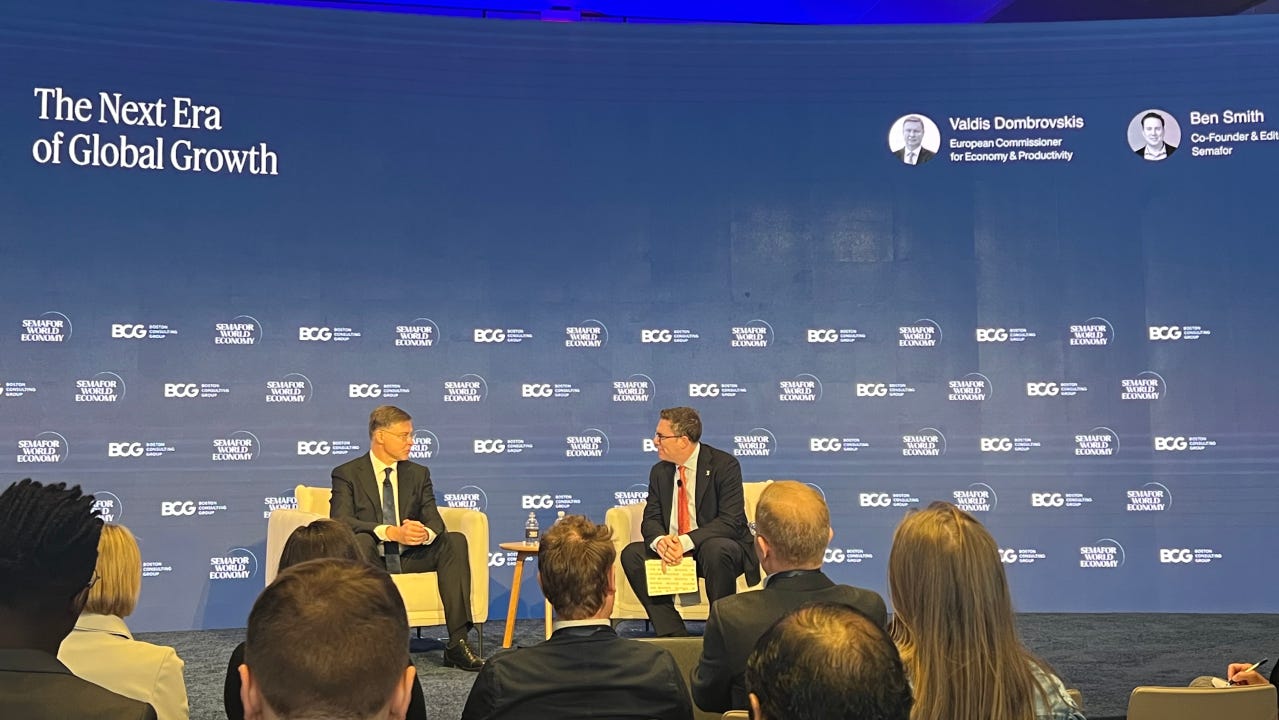
One could feel the invisible hand of Adam Smith himself guiding every panel and discussion. American optimism descended over the proceedings like a benediction, the kind of communion only IMF Spring Meetings week can summon in this city.
The American Dream, the American Ideal and the American Balance Sheet, all converging on the 3 main stages.
The themes were timely as ever: risk, resilience and the redemptive power of innovation. Speakers across every track, from Cabinet to boardroom, arrived at the same revelation: the future is uncertain, but human ingenuity will meet it.
There are always, at gatherings of this caliber, ideas whose time has come. This year’s quartet was clear: GLP-1s, energy growth, interwoven geopolitics, AI, and most movingly, the emerging consensus that in an agentic commerce world, consumer experiences will matter more than ever. One’s agent, it was gently clarified, cannot experience consumerism on one’s behalf. That pleasure, mercifully, remains ours to perform.
A few of my observations from the week worth holding onto:
Digging is the ultimate resilience
The most memorable aphorism of the week came during a discussion on energy security. Dig for tunnels, dig for geothermal, dig for resources, dig deeper than your adversary can reach. The principle generalizes: capital, like geology, rewards depth. The strategic assets of the next decade: energy, compute, minerals, sovereign capacity, will all reward whoever was willing to dig earliest and deepest. Surface-level positioning is increasingly cheap; depth is the moat.
Energy resilience is becoming a political premium
Refineries and terminals were struck somewhere offstage in the recent regional escalation; flow was disrupted, infrastructure is repricing, capacity will take years to rebuild.
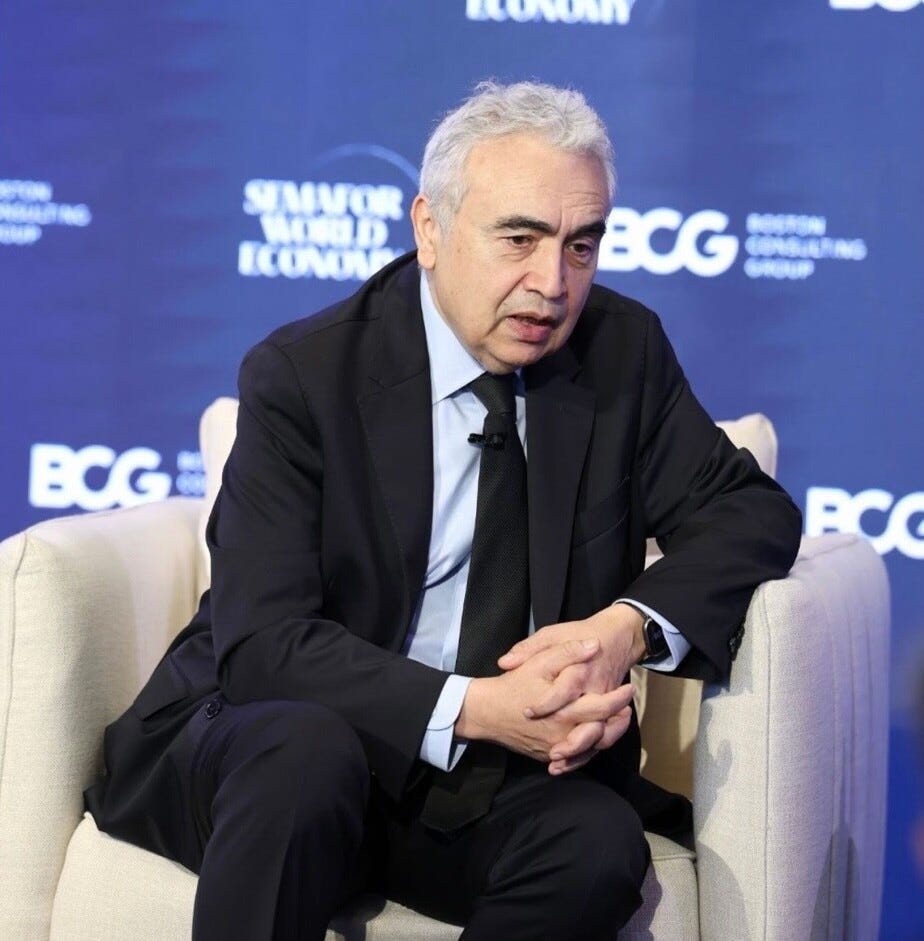
Dr. Fatih Birol, the IEA’s executive director, captured it on stage with an unusually direct line: [the Iran war] will redraw the global energy map in real terms. It is an apt description of what is already underway. The conversation has rightly shifted from infrastructure to flow, but the deeper point is that energy resilience is no longer just an economic variable. It has become a political one, particularly in emerging markets. A leader who can credibly own, not merely subscribe to, their nation’s energy supply now commands a premium of trust from their citizenry.
Predictability and sovereignty are being repriced.
A thought on frontier models: East and West
One thread I found myself exploring on my own, prompted by the week’s AI conversations, was why the frontier looks the way it does between the two leading model ecosystems. The standard answers: compute, data volume, capital... felt incomplete. What kept surfacing for me was epistemological density.
The English-language corpus carries centuries of adversarial reasoning baked in: legal argumentation, scientific peer review, Socratic philosophy, financial analysis under fire. The chain-of-thought that makes frontier models good at hard reasoning is, in some real sense, downstream of that tradition. Where corpora are structured differently, or where state filtering systematically removes precisely the domains in which high-stakes reasoning lives… law, finance, dissent, science under pressure, the gap may be architectural rather than something that closes with more tokens. A working hypothesis worth pressure-testing: the moat is in the library, not the GPU.
The bit-watt spread is the next refinery margin
Energy and AI were discussed on separate panels all week. The synthesis was within reach and never quite gripped: it almost never makes sense to curtail inference. A watt unspent clears at a few cents; a watt spent on tokens clears at orders of magnitude more.
Whoever owns the cheapest marginal watt closest to demand owns the bit-watt spread... the refinery margin of the digital economy. This is the thesis hiding inside the week’s two biggest themes, and it is where I expect the most consequential capital formation of the next cycle to concentrate.
A note on consumer markets:
PMI’s chief executive Jacek Olczak delivered the line of the week: cigarettes belong in a museum, alongside the rotary dial phone. A powerful sentiment, offered with the conviction of a man who has personally led his industry’s reinvention. I had the chance for a brief one-on-one with him after... what stayed with me was less the headline reinvention story and more the granularity of his thinking on the supply side.
He spoke about topsoil health, plant health, and the financial logic that connects them to the business, not as an ESG layer or a sustainability talking point, but as basic operating economics. It is genuinely refreshing to hear a Fortune 500 CEO at that altitude move fluently between soil biology and ROI on the same breath, and it left me with a more grounded read on what serious reinvention actually looks like from the inside.
Consumer markets provided the elegant interlude. Luxury, we were reminded, no longer means the $4,000 handbag. It means inclusive luxury: a $12 sock or a $300,000 watch, depending on how the guest arrives at the home. As Patrice Louvet of Ralph Lauren explained, Ralph Lauren does not sell clothes; he sells dreams. Ralph’s Coffee has become its own sub-brand.
Beyond the main stage... happenings across DC
The week was richer for what surrounded it. A lecture at George Washington University on foreign direct investment was a useful reset (thanks Karim for the invite), a reminder that the slower-moving architecture of global capital flows still does most of the actual work, even as the headlines chase faster signals.
Several World Bank Spring Meetings side events hosted by the Atlantic Council added the geopolitical layer that the main stage tends to abstract away. The conversations there moved more honestly between economic policy and security policy than the convening format usually allows.
And a few congressional fundraisers brought some of the most candid exchanges of the week, particularly on energy security and the geopolitics of supply. There is a different register of conversation that happens when the room is small and the cameras are off, and it tends to be where the actual operating assumptions of policy reveal themselves.
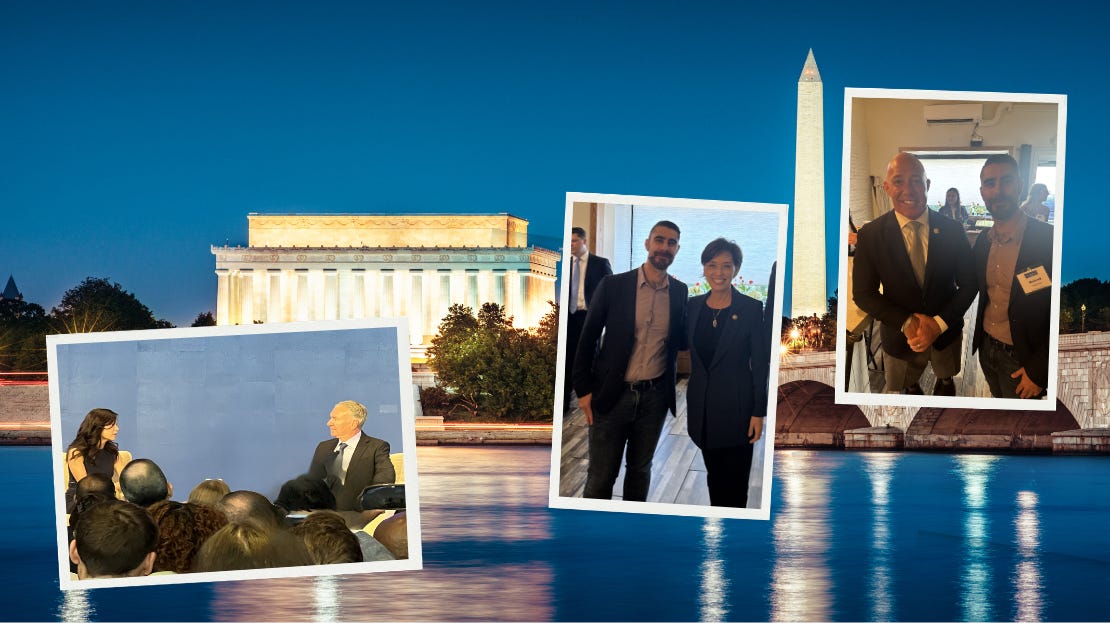
I will admit one of these conversations updated my thinking. Many have long been skeptical of the framing of Iran as an “imminent” threat at the surface... the rhetoric has been used too cynically, too often, and the surface case has rarely held up. But what was laid out, more eloquently than I had heard before, was the harder version of the argument: that the regime’s strike-hardening of its nuclear program was approaching a depth at which Western and regional strike capability would no longer reach it.
The window was not measured in years. It was measured in weeks to months. Combined with the regime’s recent strikes on GCC nations and infrastructure, a clear demonstration of how it behaves when it judges itself unaccountable, the case for action becomes harder to dismiss, even granting that some of the regime’s posture was provoked by earlier escalation. I left less certain than I arrived. That is what serious rooms & conversations are supposed to do.
The takeaway I walked out with...
If I had to compress the week into a single thought, it would be this: instability is a routing problem, not a containment one.
The assumption underneath much of the week’s optimism was that the developed world’s economic insulation is structural. It is not. It is conditional. Higher energy costs will hit oil-importing emerging economies first, and many lack the financial muscle to weather a sustained shock. What follows, currency stress, political turnover, migration pressure, supply disruption, security spillovers, does not stay local but re-routes. The developed economies absorb it in different forms, sometimes years later, and rarely in the shape they were modeling for.
In a tightly coupled global system, the parties closest to a shock who lack the capacity to absorb it become the parties who export it onward. The ones who thought distance was their hedge discover that distance was a routing assumption, not a barrier.
Resilience analysis that stops at one’s own borders is incomplete. The right question is not only can we weather this, but can the most exposed economy on the chain weather this, because if it cannot, the shock does not disappear. It merely changes form and manifests across the rest of our interconnected systems.
That, more than any single panel, was what the week left me with.
Every dissonance resolved, as great drama demands, in the same hopeful crescendo. Capital markets, efficient. CEOs, bullish on AI. Productivity, soon to be reimagined beyond its rearview-mirror measure of hours clocked, though no one specified by what, or measured by whom.
I left deeply impressed. It is rare to witness so many powerful people agree so fully on what the problems are, who the protagonists are and what paths the story can take.
Kudos to the brilliant Semafor editors who put it altogether through curation and conversation. Truly a “festival of news”.
This piece originally appeared on Mehrad’s LinkedIn.