


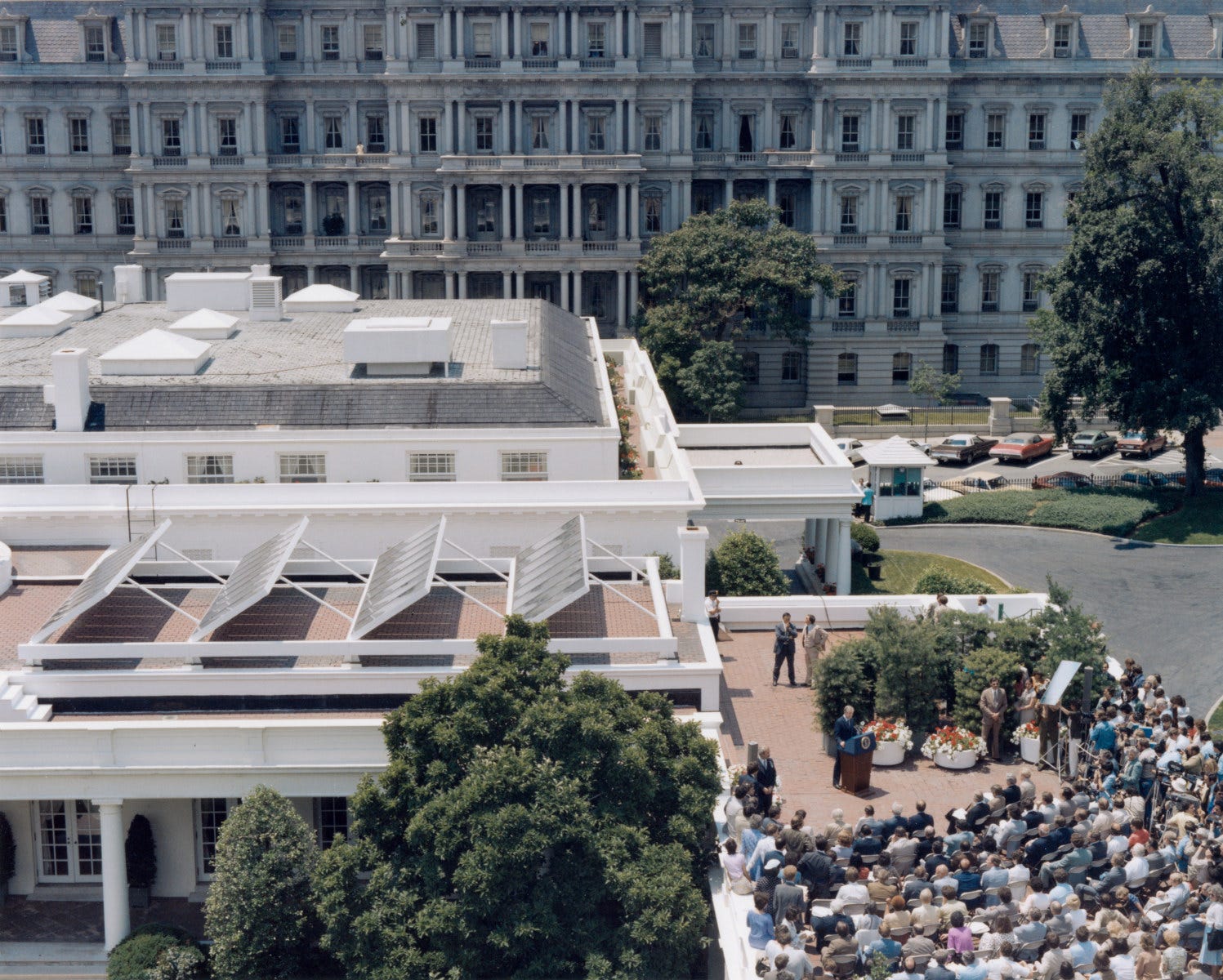
On the afternoon of June 20, 1979, a small delegation in suits and ties climbed onto the roof of the West Wing, reporters in tow, to inspect 32 solar panels tilted toward the sun.
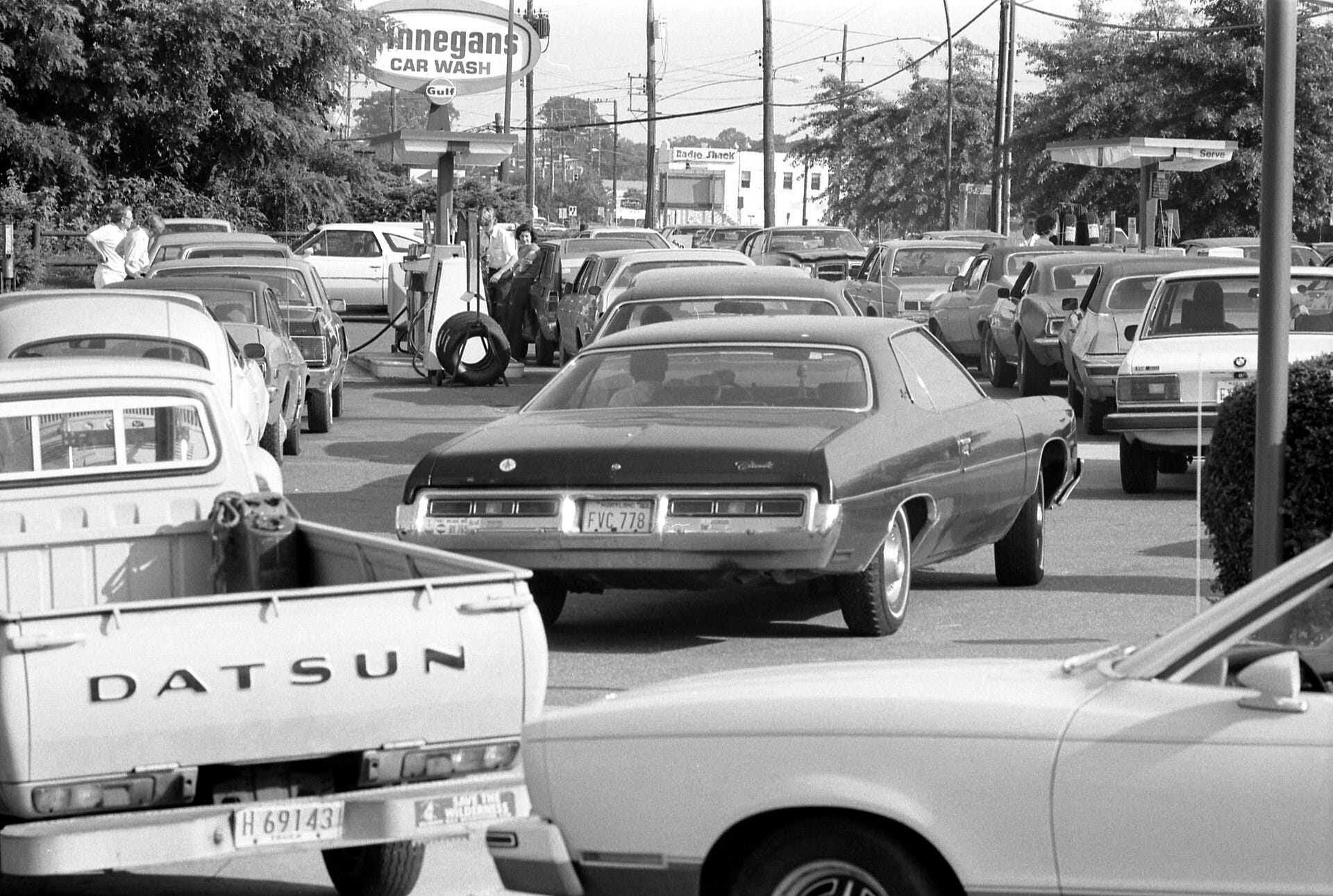
America was living through its second oil shock in six years. Gas lines wrapped around city blocks. Jimmy Carter had created a Department of Energy, pushed green tax credits through Congress and called the energy fight “the moral equivalent of war.”
The panels were his flag on the hill. An engineer named Fred Morse had spent years, going back to a request from the Nixon White House, working out how to put solar on the most photographed roof in the world without changing its silhouette. Parts of the panels ended up painted white. Absorption, traded for appearances.

Carter used the moment to set a target that sounded absurd at the time: 20% of America’s energy from the sun by the year 2000. Then he offered the country two futures for a humble water heater. It could become “a curiosity, a museum piece,” or a small part of one of the greatest and most exciting adventures ever undertaken by the American people.
Both futures came true. One after the other, but on two different continents.
What Happens to a Lifeboat When the Water Looks Calm?
By the mid-1980s, oil prices had collapsed and the crisis felt like history. The new administration gutted renewable R&D budgets and eliminated the tax breaks for wind and solar. The homeowner solar credits expired on December 31, 1985, and much of America’s young solar industry went dark.
In 1986, the White House roof needed resurfacing. The panels came down and never went back up. Fred Morse remembers protesting that the system still worked. Reagan’s chief of staff reportedly thought the equipment was just a joke. The panels went into a government warehouse in Franconia, Virginia and were forgotten.
Five years later, an administrator at Unity College in Maine pulled the seats out of an old school bus, drove down I-95 and brought the panels home. Sixteen of them heated the college’s cafeteria water until 2005.
Then the epilogue. In August 2010, one of Carter’s panels was handed to Huang Ming, chairman of Himin Solar, then the world’s largest maker of solar water heaters, for permanent display at the Solar Science and Technology Museum in Dezhou. Huang had helped write China’s 2005 renewable energy law, a policy that reads like an echo of Carter’s 1977 program.
Carter’s panel became a museum piece (in China). It also became part of the greatest industrial adventure of the century… run by someone else.
America built a lifeboat, took it off the roof the moment the water looked calm and left it in storage. Someone else picked it up.
Did Washington Just Do It Again?
In March, I argued that Trump had made the ultimate case for energy diversification: a war in the Gulf proved that energy dependency is a sovereignty problem, and that the nations with the option not to fight are the ones that built generation at home. This piece is its uncomfortable sequel. While the case was being made abroad, the lifeboat was being taken apart at home.
On July 4, 2025, the One Big Beautiful Bill Act became law. It stopped short of repealing the Inflation Reduction Act wholesale and went for the parts that touch buyers instead. The EV and residential efficiency credits ended within months. Wind and solar credits now close for projects that start construction after July 4, 2026 and come online after 2027. The $27 billion Greenhouse Gas Reduction Fund was repealed outright. What survived tells you everything: the 45X manufacturing credit, storage, geothermal, nuclear, carbon capture and credit transferability.
There was a comfortable theory about all this and my own model leaned on it. Most IRA projects, jobs and investment had landed in Republican districts, so Congress would never shutter factories in its own voters’ backyards.
The backyards went first. E2’s tracking shows that since the start of 2025, Republican-held districts attracted more than $21 billion in new clean energy investment and lost more than $49 billion to cancellations and downsizing. General Motors redirected a $4.3 billion plan to build electric pickups at its Orion plant in Michigan toward V8 gasoline engines. A lifeboat yard, retooled to build more of the ship.
Washington kept the credit for building lifeboats and cancelled the passengers’ tickets.
What Happens When the Iceberg Actually Arrives?
On the last day of February, the United States and Israel launched coordinated strikes on Iran. Iran answered by closing the Strait of Hormuz, the chokepoint for roughly a fifth of the world’s oil.
On March 11, President Trump authorized a 172-million-barrel release from the Strategic Petroleum Reserve, the US share of a 400-million-barrel IEA collective action and the largest in the agency’s history. It was the right call as that is what the reserve is for.
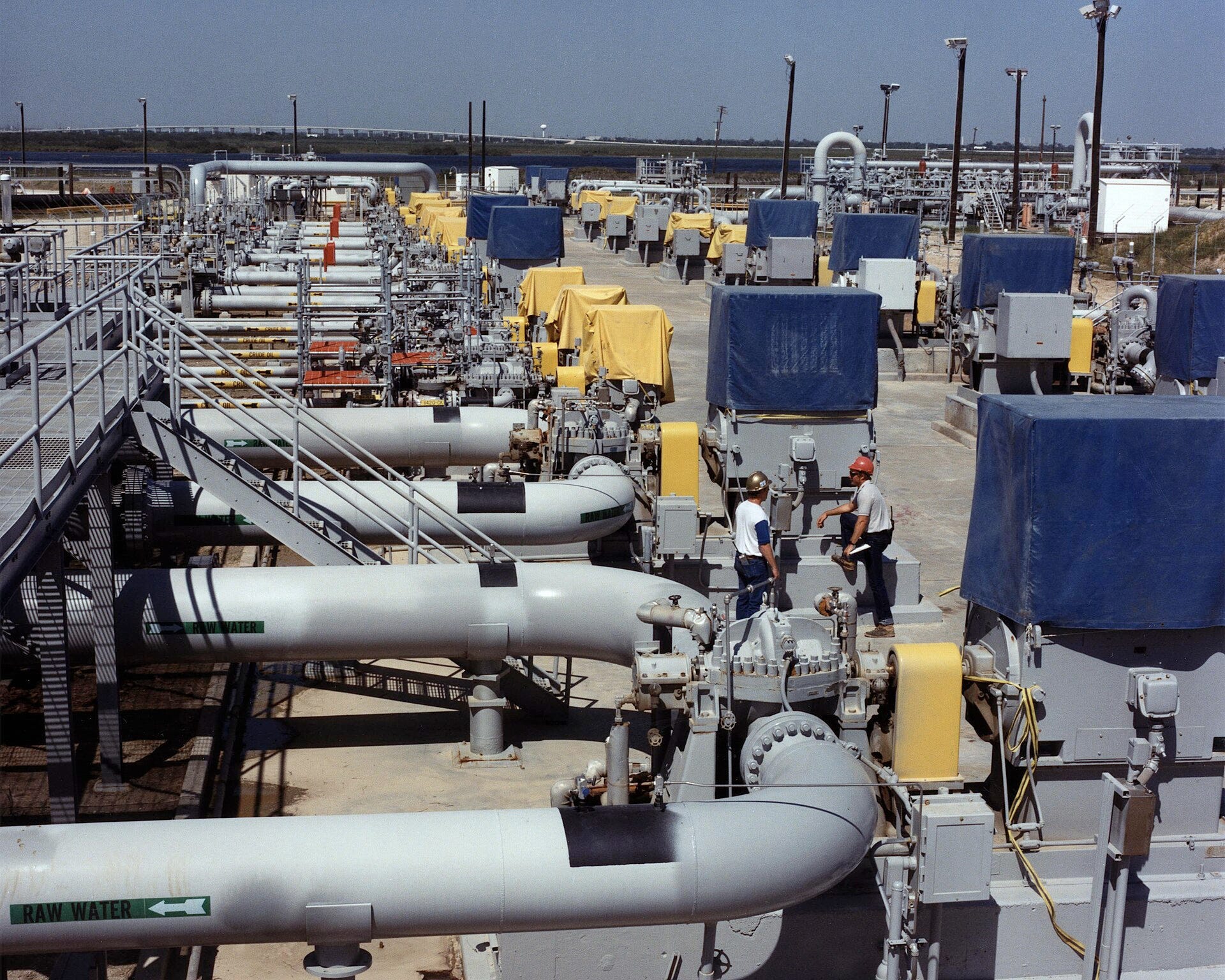
Now look at what’s left. In the week ending September 18, the SPR held 284.6 million barrels, about 40% of its authorized capacity and its lowest level since October 1982. The emergency stockpile built in answer to the Carter-era shocks is back roughly where it stood while his panels were still on the roof. And it is one of the few levers Washington has left to ease prices at the pump.
A reserve is a life jacket. It keeps you afloat for a fixed number of days but a lifeboat is what gets you somewhere.
In 2026, America reached for the life jacket because it had spent the previous eighteen months taking the lifeboat apart.
Who Has an Immune System Against Oil Shocks?
During the early days of Hormuz crisis, I built a simple model of what I call demand hysteresis: whether a price shock leaves a permanent dent in oil demand or just a temporary dip.
The model I built scores each region on three conditions that determine whether a demand shock produces permanent change or just a temporary dip…
Three conditions decide it:
1) How long the shock lasts
2) Whether alternatives sit at cost parity
3) and… whether policy holds the switch in place once prices fall.
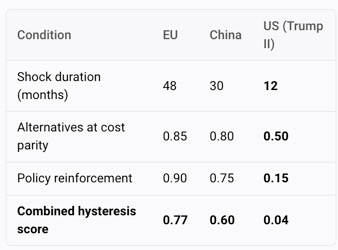
As per the model, the US hysteresis score under Trump II is 0.04… nearly zero. The EU’s is 0.77. That means when the next price shock hits, Europe will permanently shed oil demand because its people have bought EVs, installed heat pumps and have binding laws preventing reversion. The US, with weak policy and slow capital turnover, will bounce right back to oil dependency when prices fall.
The EU is building an immune system against oil shocks. The US under Trump is choosing to stay exposed.
I vibe modeled that as a crude forecast. 2026 has turned it into an experiment.
The results are emerging... in China, EVs took nearly 63% of retail car sales in May, and the country cut its net crude imports by 30% year on year in the second quarter.
In Europe, EVs are now close to 30% of new car sales. In the first quarter, EV sales jumped about 80% in Asia-Pacific outside China and 75% in Latin America. South Africa’s EV sales more than quintupled in the first half, and Laos banned gasoline car imports for the rest of 2026. EVs hit record highs in 50 countries in the second quarter alone.
And the United States? EV sales fell roughly 28% year on year in the first quarter, and EVs were 5.8% of new car sales in the second quarter. Americans bought record numbers of hybrids and used EVs, so the appetite is real.
The new-car lifeboats were thinning out: Acura, Chevrolet, Dodge, Honda, Hyundai, Kia, Nissan and others discontinued or scaled back EV models after the credit ended and tariffs rose.
Yale Climate Connections summed it up in a headline: the war supercharged EV sales everywhere except the US.
When the shock came, the rest of the world reached for the lifeboat. America reached for the reserve.
The model predicted America would snap back to oil once prices eased. 2026 suggests something darker: much of the country never got far enough off oil to snap back at all.
California is the exception that proves the rule. With its own policy scaffolding still standing, EVs reached 16.6% of new car sales there in the second quarter, nearly triple the national rate, with a state instant rebate on the way. Where a government kept building the boat, people climbed in.
Can “Drill, Baby, Drill” Outrun Geology?
The other side deserves its strongest case. The US is producing around 13.7 million barrels a day, within touching distance of its all-time record and doing it with fewer rigs than a year ago. Shale’s efficiency gains are real and compounding. That output is a big reason 2026 has been an expensive crisis for Americans instead of a 1979-style crisis of empty pumps. Energy dominance is genuine leverage.
Now look at the machine producing it. An average shale well loses about 74% of its output in its first year, and 83–85% of new wells simply offset that decline, which means drilling more than 15,000 wells a year just to stand still.
In the IEA evidence my model draws on, the shale patch’s reserve replacement ratio has collapsed from the four-figure multiples of the 2000s to roughly a third, and the agency has questioned how long shale can remain the swing producer.
Then watch what the industry did when the price signal finally arrived. After nearly a month of oil above $90, rig counts declined; drillers told the Dallas Fed they had little confidence the prices would hold. By summer, the Permian was still running 36 rigs below year-ago levels despite $105 crude. Public shale companies answer to shareholders who want dividends and buybacks and no slogan from Washington changes that math.
Drill, baby, drill runs the treadmill faster. Politics can change the incline. Geology sets the belt speed.
Does Peak Oil Care Who’s President?
Zoom out from Washington and the shape of the problem gets sharper.
The world’s legacy oil fields decline at around 5% a year, per the IEA. Conventional discoveries replace only a fraction of what we burn. And the oil we do find costs more energy to get. A 2021 study in Applied Energy by Delannoy and colleagues estimated that producing oil already consumes about 15.5% of its gross energy, and that by 2050 the share could approach half. Call it the net-energy cliff: a barrel is still a barrel, but less and less of it is left over for the rest of the economy.
On the demand side, China alone accounted for 77% of global oil demand growth in 2023, and the IEA expects India to become the largest source of rising energy demand through 2040.
Geology set the course toward peak oil decades ago. The only variable Washington truly controls is the lifeboat.
So Who Builds the Lifeboats Now?
In the first half of 2026, EVs made up about 45% of China’s car exports. Those are the cars arriving in Vientiane, Johannesburg and Bogota. The adventure Carter described on the West Wing roof is running at full speed, out of factories a few hours’ drive from the museum where his panel now sits in China.
The deeper race is about capital turnover. Evidence from the 2009 demand shock suggests that when reductions get embedded in capital decisions, they persist for sixteen to seventeen years. Every EV sold, every heat pump installed, every rooftop array mounted is a long-duration vote against the next shock. Every one left unsold is a long-duration vote for it.
For those of us who deploy capital, the federal retreat settles one question and opens another. Washington has answered whether it will build the lifeboat, for now.
The current active question is who else can build the lifeboat’s hull in time: states like California, utilities, fleet operators, ports, municipalities and private capital willing to underwrite resilience before the next closure of a strait nobody in Washington controls.
The lifeboat has become a distributed build.
Which Future Did We Choose?
In 1979, a president stood on a roof and offered America two futures for a solar water heater: a museum piece or one small part of the greatest adventure the country would ever undertake.
We got both. In that order. On different continents.
Washington has now taken the lifeboat off the roof twice. Both times, the water looked calm right up until it wasn’t…
If this one landed, you might also enjoy the piece it follows: Trump’s Ultimate Case for Energy Diversification (And Yes, Renewables).