


On the morning of December 7, 1941, 183 aircraft of the Imperial Japanese Navy struck Pearl Harbor. Ask most Americans why, and you’ll get well trodden commentary on aggression, militarism, a “sneak attack.” What you’ll rarely hear is another, under-appreciated truth: Japan attacked the United States over oil.
In 1941, Japan imported over 80% of its petroleum from the United States. When Roosevelt froze Japanese assets and embargoed oil exports that July, in response to Japan’s occupation of French Indochina, he didn’t just impose a sanction. He severed a lifeline. Japan’s navy had 18 months of fuel reserves and its army had 12. The country faced a binary: withdraw from its empire and negotiate, or go to war to secure the oil fields of the Dutch East Indies before the reserves ran dry.
They chose war. Not out of madness, but out of math.
This is the pattern that almost never gets named in energy policy debates: oil dependency doesn’t just create economic vulnerability, it creates the conditions for conflict. The resource you can’t generate at home becomes the chokepoint someone else controls. And when that chokepoint tightens, the options collapse to diplomacy or force. Pearl Harbor wasn’t an aberration. It was the logical endpoint of a nation whose industrial economy was tethered to a supply chain it didn’t own.
What Does Sovereignty Look Like From the Other Side?
This isn’t an observation from the armchair or the doomscroll. I spent the better part of a decade in Dubai, building companies and navigating the innovation ecosystem of a city that, like much of the Gulf, was built on the momentum of hydrocarbon wealth, but has been quietly, methodically, constructing a post-oil identity for longer than most Western observers realize.
The UAE is often caricatured in Western media: hyperwealth, artificial islands, performative sustainability. But underneath the spectacle is something more interesting: a sovereign state that understood, earlier than most, that oil isn’t just a commodity. It’s a dependency. And dependency, for a small nation flanked by larger, more volatile neighbors, is an existential risk.
Living there, you feel the geometry of it in ways that don’t register from Washington or London. The Strait of Hormuz is not an abstraction, it’s the waterway you fly over, the bottleneck your neighbors’ economies flow through, the reason the conversation at every geo-political policy talk eventually turned to Iran. You learn quickly that the Gulf states don’t think about energy the way Western commentators do, as a climate issue or an economic input. They think about it the way small countries flanked by large, unpredictable neighbors think about anything that determines whether they survive: as a question of sovereignty, full stop.
And the uncomfortable truth that rarely surfaces in Western analysis is this: everyone in the region knows that a wider war with Iran has been a plausible scenario for decades. The question was never if the Strait could close, it was when, and whether you’d built the architecture to endure it. The UAE’s answer has been to build that architecture, methodically, for over a decade.
The Mohammed bin Rashid Solar Park, one of the world’s largest single-site solar installation wasn’t just a PR exercise. The UAE’s investments in nuclear energy (Barakah), green hydrogen, and long-duration storage are the actions of a government that looked at the same map Japan’s war planners studied in 1941 and drew a different conclusion: the way out of dependency isn’t more supply, it’s by diversification -- including a different kind of generation entirely
What the UAE recognized, and what this week has made viscerally clear to every energy-importing nation watching the Strait of Hormuz close, ports take missile fire, and flight paths reroute across an entire region, is that energy security isn’t a trade policy. It’s a sovereignty architecture. And the only architecture that holds when chokepoints fail is the one you build at home.
What Happens When Nations No Longer Need Each Other’s Oil?
Now step back from the Gulf. Widen the lens.
The deeper structural argument isn’t about any single region or any single conflict. It’s about what happens to the global order when the energy dependency graph starts to rewire.
For most of the 20th century, geopolitical alliances were, at root, energy alliances.
The US-Saudi relationship wasn’t built on shared values… it was built on shared supply.
Europe’s relationship with Russia wasn’t a partnership… it was a pipeline.
Japan’s post-war alignment with the West was, in significant part, the price of guaranteed energy imports. The architecture of international relations has been load-bearing on a simple premise: nations that can’t generate their own power must align with nations that can supply it.
Renewables break that premise.
Not immediately, not completely, but structurally. When a nation can generate baseload electricity from the sun hitting its own soil, from the wind crossing its own coastline, from nuclear plants on its own territory and when batteries can store that energy at grid scale, the compulsion to maintain alliances of necessity begins to weaken. What replaces it isn’t isolationism. It’s choice. Nations that no longer depend on supply chains running through contested straits or adversarial territories can begin to form alliances based on something other than who controls the oil.
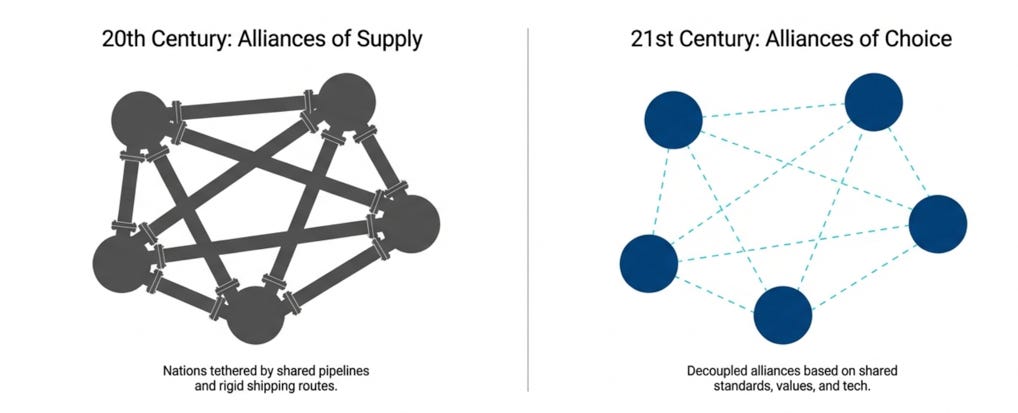
This is the geopolitical shift that almost nobody in the energy transition conversation talks about: renewables don’t just decarbonize the grid, they disincentivize the reasons nations go to war. Supply chains will always matter. Resources will always shape alliances. But energy has occupied a unique position in that architecture, the one input so fundamental that its absence doesn’t just create economic pain, it creates existential crisis. As energy dependencies give way to domestic generation, that singular leverage begins to erode.
Deeper into the 21st century, alliances will increasingly be strengthened and weakened by different measures: shared governance frameworks, technology standards, cultural alignment, institutional trust. Not because supply chains stop mattering, but because the one supply chain that could start a world war gradually loses that power.
The implications are profound and uncomfortable for incumbents on every side. For petrostates, it means the commodity that buys alliances loses leverage. For importers, it means the relationships maintained out of energy desperation become optional. For the US itself, long the guarantor of Middle Eastern energy flows, it means the strategic rationale for forward-deployed naval power in the Gulf begins to erode when the nations it protects can power themselves.
Why Isn’t China Going to War Over This?
For decades, the specter of a war with Iran carried an unspoken assumption: it wouldn’t stay contained. Russia and China would back Tehran. The Strait would close. Oil would spike. Alliances would activate. The great powers would be drawn in, and the world would spiral toward something no one could control. This was the implicit logic behind every argument for restraint in the Gulf… not that Iran couldn’t be struck, but that striking Iran meant risking the kind of cascading escalation that pulls everyone in. A wider war. Maybe the wider war.
That isn’t what happened.
Russia, bogged down in Ukraine, diplomatically isolated, and hemorrhaging economic capacity, is in no position to open a second front of confrontation with the West. And China, the actor whose response matters most, has done something that would have been unthinkable a decade ago: it chose the Gulf corridor over its own oil supplier.
Consider what’s just happened through Beijing’s eyes. In the span of three months, the United States has intervened in Venezuela, seizing its president and redirecting its oil exports and launched strikes on Iran that have, among other consequences, effectively closed the Strait of Hormuz.
China imported roughly 11.6 million barrels of crude per day in 2025. Of that, roughly a fifth came from sanctioned sources, primarily Iran, Venezuela, and relabeled barrels transiting through Malaysia and Indonesia. Iran alone accounted for roughly 13% of China’s seaborne crude imports. Venezuela added another 4-5%. These weren’t strategic partnerships built on shared ideology. They were arbitrage plays, discounted barrels from pariah states, purchased at $8-10 below Brent through shadow fleets, forged documentation and ship-to-ship transfers in international waters.
Both supply lines are now under severe, simultaneous pressure. Venezuela’s crude is being redirected to the United States under “authorized channels.” Iran’s export infrastructure, Kharg Island, the Strait itself, is in the crosshairs of an active military campaign. China’s independent refiners, the “teapot” refineries of Shandong province that depend on these discounted barrels to survive, face a margin crisis with no quick fix.
This should be Beijing’s nightmare. And five years ago, it would have been.
But here’s the distinction that changes everything: for China in 2025, the loss of Iranian and Venezuelan crude is not an existential question. And that single fact, that it is not existential, is what makes rational cost-benefit analysis possible at all.
This matters more than it might seem. When energy is existential, you don’t get to weigh costs and benefits. Japan in 1941 didn’t evaluate Pearl Harbor the way you’d evaluate a strategic trade-off. They were in survival mode, the amygdala of the state, not the prefrontal cortex. The options collapsed to fight or die. When energy is not existential, the entire decision-making apparatus shifts. The question moves from “how do we survive?” to “what’s the smartest play?” And that shift is what makes all the cascading calculations that follow even possible.
What moved the needle? Two decades of methodical investment on two fronts.
The first is energy. China invested over $625 billion in clean energy in 2024 alone. It hit its official 2030 wind-and-solar capacity target six years early — in 2024. Electric and hybrid vehicles reached 51% market penetration in China by March 2025. The country’s demand for transport fuels: gasoline, diesel, jet fuel, has plateaued.
Growth in oil demand has shifted almost entirely to petrochemical feedstocks, not combustion. The renewable transition and battery buildout have done something that no amount of diplomatic maneuvering or shadow-fleet logistics could do: they’ve turned an existential supply risk into a manageable cost pressure.
The second is geopolitics, and the lesson was written in real time across Ukraine.
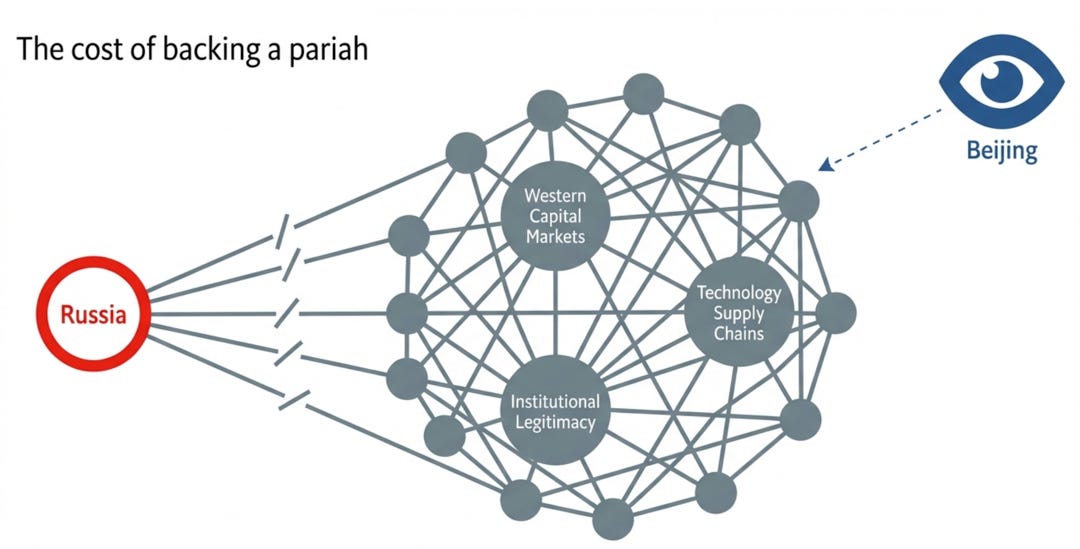
For two years, the world watched what happens when a major power backs a pariah state past the point of return. Russia’s invasion of Ukraine didn’t just trigger sanctions, it triggered a wholesale rewiring of European energy infrastructure, a deepening of NATO, and the effective isolation of Moscow from Western capital markets, technology supply chains, and institutional legitimacy. China watched all of this. And it learned.
The question Beijing faces with Iran isn’t whether it sympathizes with Tehran’s position. It’s whether signaling support for another bad actor on the global stage, one now absorbing direct American military strikes is worth putting the rest of China’s economic architecture at risk.
The trade relationships, the technology access, the capital flows, the Belt and Road partnerships that depend on at least nominal alignment with international norms. And those Belt and Road partnerships cut particularly close: the UAE, Saudi Arabia, Oman, the very nations on the other side of Iran’s aggression, are critical nodes in China’s infrastructure corridor strategy, a pattern, incidentally, as old as China itself; the Zhidao road and Lingqu Canal of 212 BCE were the Qin Dynasty’s version of the same play: “civil works” that were really high-frequency logistics lanes for troops and grain across hostile terrain. Beijing doesn’t sacrifice civilizational corridor infrastructure for a discount on crude. Backing Tehran doesn’t just risk Western sanctions. It risks alienating the Gulf states that China needs for everything other than oil.
And as of this past week, we can see the math playing out in real time. Bloomberg reports that Beijing is actively pressuring Iranian officials to keep the Strait of Hormuz open, urging Tehran not to attack oil and LNG tankers transiting the waterway, and specifically not to disrupt Qatari gas exports, which account for roughly 30% of China’s LNG imports. China buys 90% of Iran’s oil. It is Tehran’s most important economic lifeline. And yet, when forced to choose between protecting its Iranian supplier and protecting its broader Gulf corridor… the Qatari gas, the Saudi and Emirati trade relationships, the infrastructure partnerships, Beijing chose the corridor without hesitation. That’s not diplomatic ambiguity. That’s the cost-benefit analysis of a nation that no longer depends on any single supplier for survival.
Two decades ago, cheap Iranian crude might have been worth all of it. Today, after years of reducing the existential weight of oil in its energy mix, the math doesn’t pencil.
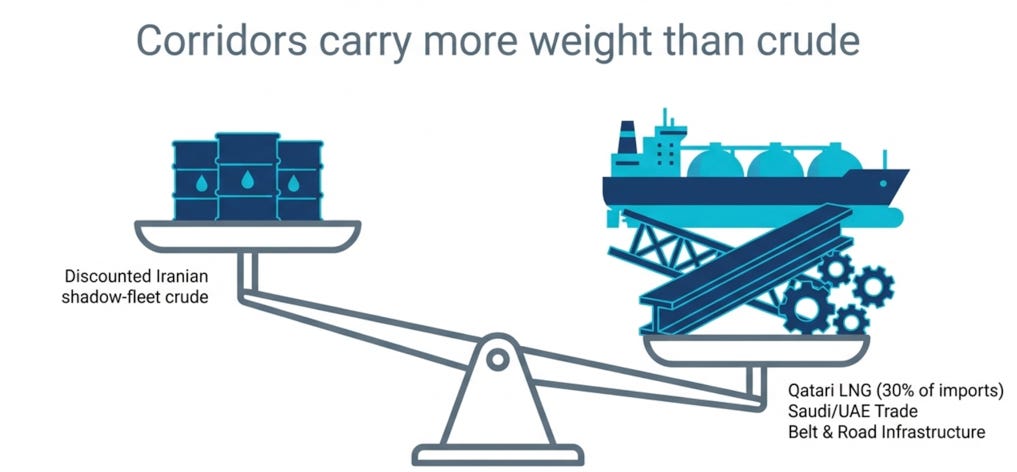
This is the compounding logic that single-variable analysis misses. China is not yet free of oil dependency. But it is no longer structurally vulnerable to oil dependency in the way Japan was in 1941, or in the way it itself would have been even a decade ago. And because the energy question is no longer existential, every other strategic consideration gets to register — the Ukraine precedent, the Belt and Road dependencies, the cost of global isolation. None of those factors would have mattered if China still faced a survival-level energy crisis. All of them matter now, precisely because it doesn’t.
The loss of Iranian and Venezuelan discount barrels hurts China’s teapot refiners. It does not threaten China’s grid, its transportation network, or its industrial base. And defending those barrels would threaten something far more valuable than the discount itself. That compound distinction, between inconvenience and existential threat on one axis, between cheap oil and global standing on the other — is the strategic dividend of the energy transition. And it’s the reason China’s response to this week will be economic displeasure, not military escalation.
What If the Best Defense Technology Doesn’t Look Like a Weapon?
Sit with that for a moment. Because the implication is staggering.
The single most important reason that this week’s events are unlikely to cascade into a global war is that the nation with the most to lose from the disruption, the world’s largest oil importer, has spent twenty years building the energy infrastructure that makes restraint the rational choice. Renewables didn’t just give China cheaper electrons. They gave China the option not to fight. And in a world where the conditions for great-power conflict are accumulating on every front, the existence of that option may be the most consequential strategic fact of the decade.
This is the argument that neither the climate community nor the defense establishment has fully articulated, though the foundations are there. I’ve written before about why our definition of “defense tech” is dangerously narrow… confined to missiles, drones, and cyber, when the real vulnerabilities are systemic: ecological, biological, infrastructural. The same logic applies here, but with an even sharper edge. A solar farm doesn’t look like a defense asset. A battery factory doesn’t feel like a strategic deterrent.
But if the function of defense is to prevent the conditions under which war becomes rational, then the energy transition is the most effective defense infrastructure ever built, not because it wins wars, but because it removes the compulsion to start them.
Under rational decision-making parameters and the entire architecture of nuclear deterrence, game theory, and international relations rests on this assumption: renewables fundamentally alter the escalation calculus. They raise the threshold at which disruption becomes existential.
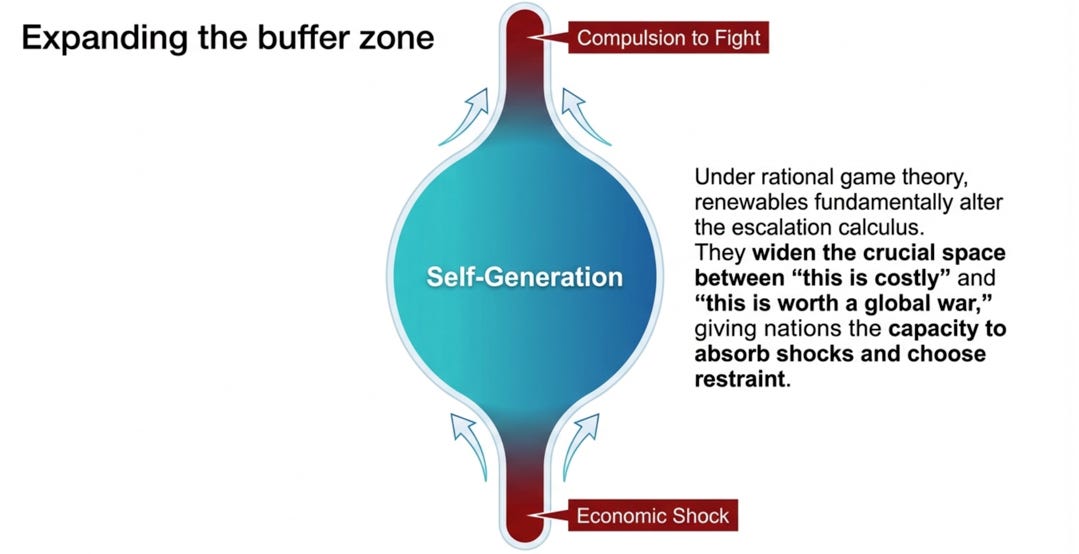
They widen the space between “this is costly” and “this is worth fighting over.” They give nations the room to absorb shocks, weigh options, and choose restraint. That is not a climate benefit. That is a deterrence benefit. And in deterrence terms, a technology that prevents the conditions for war is more valuable than a technology that prevails in one.
What Does the Cost of the Current System Actually Look Like?
None of this should be read as abstraction. The war unfolding right now is producing consequences that are immediate, visceral, and compounding.
Sunday morning, residents of Tehran woke to black skies. Israeli strikes hit four oil storage facilities overnight, and the resulting fires released toxic hydrocarbon compounds, sulfur, and nitrogen oxides into the air over a city of ten million people. Iran’s Red Crescent warned that the rainfall was highly acidic, capable of chemical burns to the skin and serious lung damage. Residents described oil-stained rain coating buildings, cars, and streets.
Meanwhile, the infrastructure that sustains basic human life is entering the target set. Bahrain accused Iran of striking a desalination plant on Sunday. Iran says the US hit one of theirs. In a region where entire populations depend on desalinated water to survive, the war is no longer just hitting military assets… it’s hitting the systems that keep cities alive.
The ripple effects extend far beyond the Gulf. Maritime traffic through the Strait has dropped to near zero. Maersk, Hapag-Lloyd and MSC have all suspended transits, rerouting around the Cape of Good Hope, adding two weeks and roughly a million dollars in fuel costs per voyage. Dubai and Doha airports shut down for days.
A significant share of Europe’s jet fuel supply normally transits Hormuz; those flows are now severed. Fertilizer shipments are disrupted ahead of Northern Hemisphere spring planting. The Middle East itself imports 85% of its food and military logistics are taking priority over perishable cargo.
And here’s where the structural argument meets the balance sheet: when jet fuel supply chains run through a war zone, the economics of sustainable aviation fuel invert overnight. SAF produced from local waste feedstocks: municipal solid waste, agricultural residue, forestry byproducts, is still more expensive on paper. But "cheaper" fuel that can't reach you isn't cheap… it's unavailable. And unavailable has no price — it has consequences: grounded fleets, cancelled routes, stranded passengers, and an industry burning cash while it waits for a strait to reopen.
“The premium you once paid for localized production turns out to be the discount you get on not being exposed to a chokepoint”
The same inversion applies across every sector watching this crisis: distributed energy over centralized imports, regional supply chains over global dependencies, domestic production capacity over just-in-time efficiency routed through contested straits.
The devastation isn’t a footnote to the energy transition argument. It is the argument. Every supply chain executive, airline CFO, and energy minister watching this week is learning the same lesson in real time: resilience isn’t a premium. It’s a prerequisite. And the systems that survive contact with reality are the ones you build at home.
Did a Fossil Fuel President Just Make the Best Case for Renewables?
That’s the irony nobody is naming.
An American president who has dismissed renewables, pulled out of climate agreements, and championed fossil fuel dominance has, through the unintended consequences of his own military actions, produced the most compelling strategic case for energy transition in a generation. The Strait of Hormuz closing isn’t an argument for more drilling. It’s an argument for never needing the Strait of Hormuz again.
Every nation watching this past week, in Asia, in Europe, in Africa, in South America, is recalculating the same equation Japan’s war planners faced in 1941. The math hasn’t changed. What’s changed is the menu of options. Since coal powered the industrial revolution, energy independence has been a geological lottery, you either had the reserves under your soil or you didn’t, and if you didn’t, you negotiated or you fought.
For the first time in industrial history, there is a scalable alternative that doesn’t require winning that lottery. Sun and wind aren’t deposits. They’re conditions. And nearly every nation on earth has them.
The counterargument is obvious: renewables create new dependencies — on lithium, cobalt, rare earths, on supply chains that today run disproportionately through China. But there’s a categorical difference between depending on a material you can mine in multiple geographies, stockpile, substitute, and recycle vs. depending on a fuel you combust once and must continuously re-import through a chokepoint someone else controls.
One is a manufacturing challenge. The other is a casus belli - the kind of dependency that starts wars.
Solar panels don’t get embargoed. Wind doesn’t flow through straits. Batteries don’t require shadow fleets. Nuclear reactors don’t care who controls Kharg Island.
The case for renewables isn’t just about carbon. It’s about sovereignty… and survival. This week made that legible.
Speaking of Legibility, you might also enjoy my prior write-up on The Cost of Legibility.