


Listen to the AI Narrated commentary overview of the post:
On the morning of March 9th, the Dow dropped 900 points before the opening bell had finished echoing. By the close, it had clawed back every point and finished up 239.
A 1,100-point intraday swing, one of the largest in market history, triggered not by a change in fundamentals, but by a single comment from the President suggesting the Iran conflict might be winding down. (Clearly not the case, as the past 2 weeks of escalations have shown).
Within 400 milliseconds of the first strike on February 28th, trading algorithms had already processed the news, adjusted risk models, and begun executing thousands of sell orders. By the time a human trader read the headline, equity futures had dropped 2% and oil had spiked 7%. The algorithms didn’t wait for analysis, context or a measured assessment of what the strike actually meant for global supply chains.
They saw war. They sold. Then they saw a tweet. They bought.
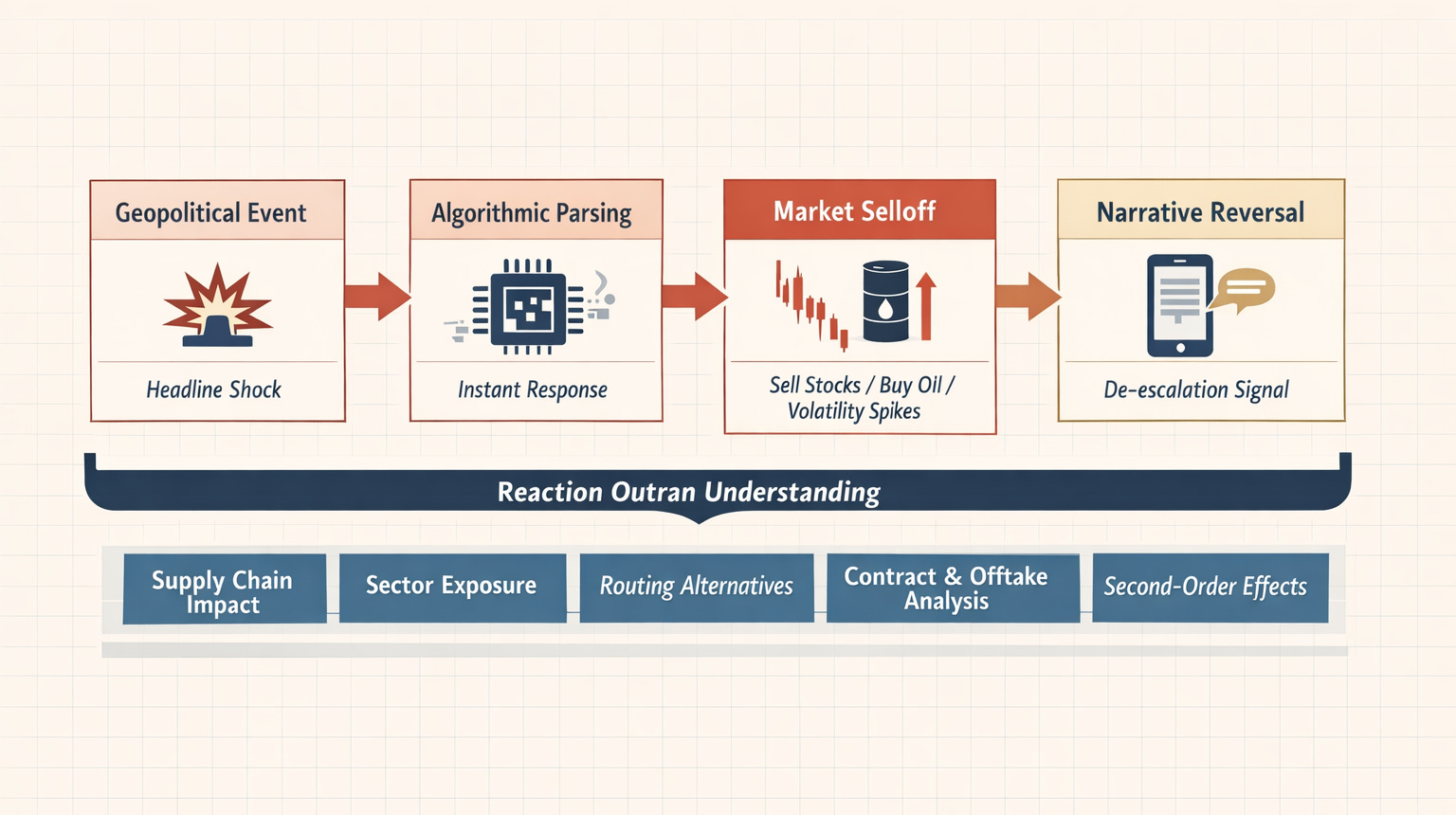
This is the information diet the modern market runs on… and it has the nutritional value of a gas station hot dog.
Overfed and Undernourished
The best analogy for what AI is doing to information comes from food science, I’ve heard some calling it: ultra-processed information.
The analogy is more precise than it sounds. Over the last century, we re-engineered the food system. We replaced nutrient-dense crops with synthetic fertilizers and products engineered for shelf life, palatability and scale. The result is a population swimming in calories and starving for minerals. People are overfed and undernourished simultaneously… in a way we are full, but not nourished. The body registers satiation while the cells quietly deteriorate.
AI is doing the same thing to information. It industrializes production; generating analysis that tastes like understanding, that has the texture and confidence of insight, but has been stripped of the contextual nutrients that would make it actually useful. We are swimming in takes. We are drowning in commentary.
We are mentally full, saturated with signal that turns out to be noise while remaining profoundly undernourished for lack of real, contextualized understanding.
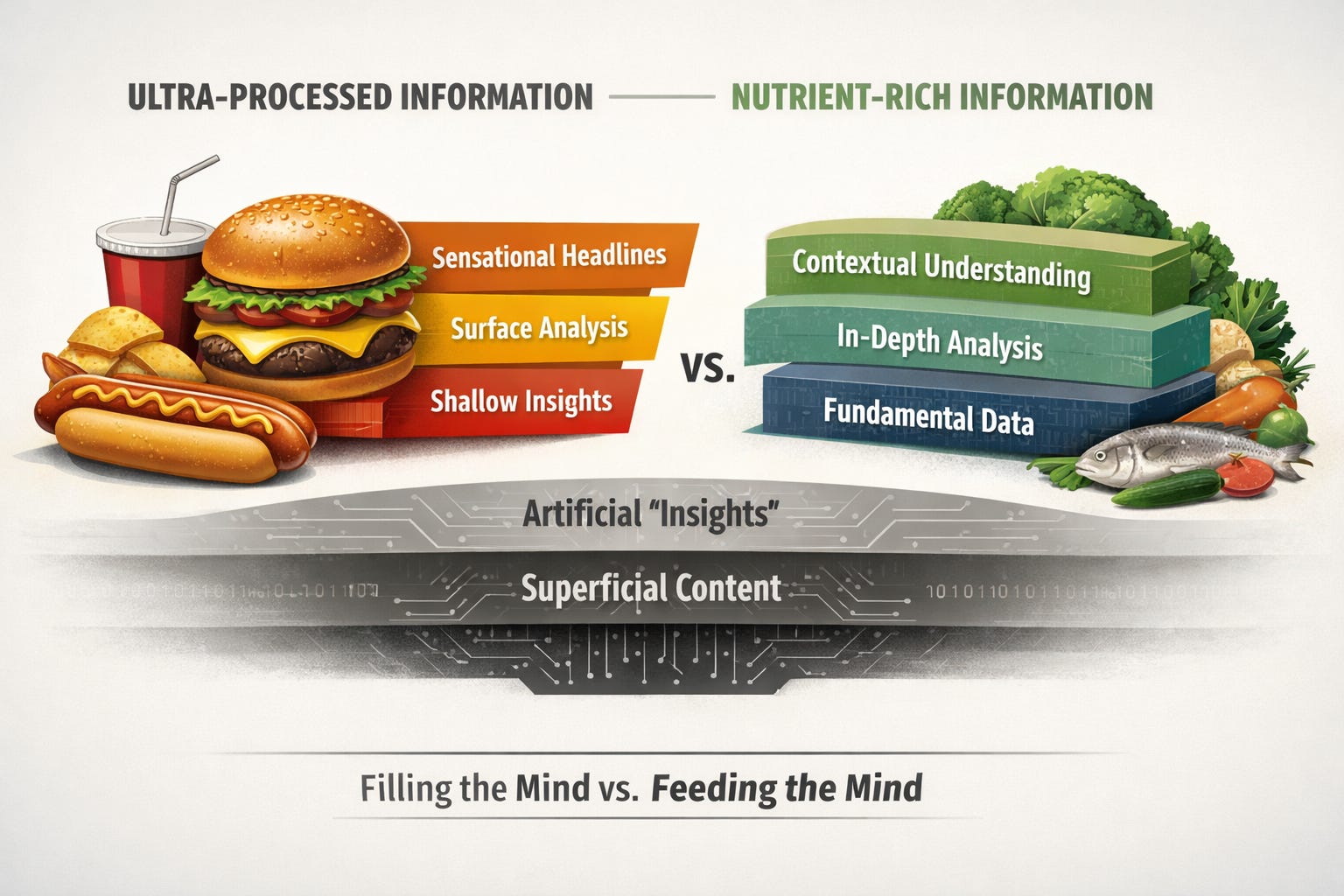
“War is bad for markets” is ultra-processed information take. It’s the equivalent of asking a base model LLM a generic question and getting a technically correct but contextually useless answer. Yes, wars create volatility. Yes, the Strait of Hormuz closure disrupted 20% of global seaborne oil. Yes, airlines got hit, defense stocks rallied. Every financial media outlet on earth ran some version of this story this week, and every version said roughly the same thing: uncertainty is bad, volatility is up, here are the sectors to watch.
That’s not analysis. That’s pattern-matching on headlines. And it’s the investing equivalent of what some in AI call “slop”… outputs that are fluent, confident and almost entirely devoid of the contextual depth that would make them actionable. A gas station hot dog of insight. It fills you up but fails to feed you.
The Dow’s Monday swing wasn’t a market processing information. It was a market reacting to the absence of information. It is filling the void with sentiment, momentum and algorithmic reflexes trained on historical patterns that may or may not apply to a situation with no precedent.
The View From a Room Full of Allocators
I spent part of SxSW with a gathering of allocators in Texas. The mood in that room was not panic. It wasn’t even particularly bearish. It was recalibration.
These are people who don’t trade on headlines. They trade on fundamentals: production data, reserve reports, offtake agreements, infrastructure capacity, unit economics. They have access to the underlying data about the businesses they invest in, not the algorithmically amplified sentiment about the sectors those businesses happen to occupy. And what they were seeing was not a uniform story of destruction. It was a landscape of differentiated opportunity hiding behind a generalized narrative of fear.
Here’s what I mean. “War in the Gulf is bad for energy” is the ultra-processed take. The textured take requires you to hold multiple variables simultaneously:
US LNG exporters are capacity-constrained and suddenly commanding premium pricing. European gas storage is only 30% full and Qatar, which supplies roughly 20% of global LNG, just shut down Ras Laffan, the world’s largest LNG export facility, after an Iranian drone strike. That gap has to be filled by someone. US producers with existing export terminal access just had their strategic position repriced overnight.
Domestic energy producers in the Permian are looking at a demand environment that structurally improved. Not just because oil went up… oil always goes up in a crisis and then comes back down. But because the reliability premium on non-Gulf supply just became tangible in a way that no amount of policy advocacy could have achieved. Buyers who previously optimized purely on price are now optimizing on price plus supply security. That’s a structural shift, not a trade.
Pipeline operators with non-Gulf routes… the East-West Pipeline, the Fujairah bypass, the potential Yanbu rerouting that Saudi Arabia is already negotiating with Pakistan, are becoming critical infrastructure overnight. These were second-tier assets a month ago. Now they’re the only arteries still flowing.
Battery storage, distributed energy, domestic manufacturing, anything that reduces a nation’s or a company’s exposure to a chokepoint, just had its strategic value repriced. Not by a policy paper, but by a war.
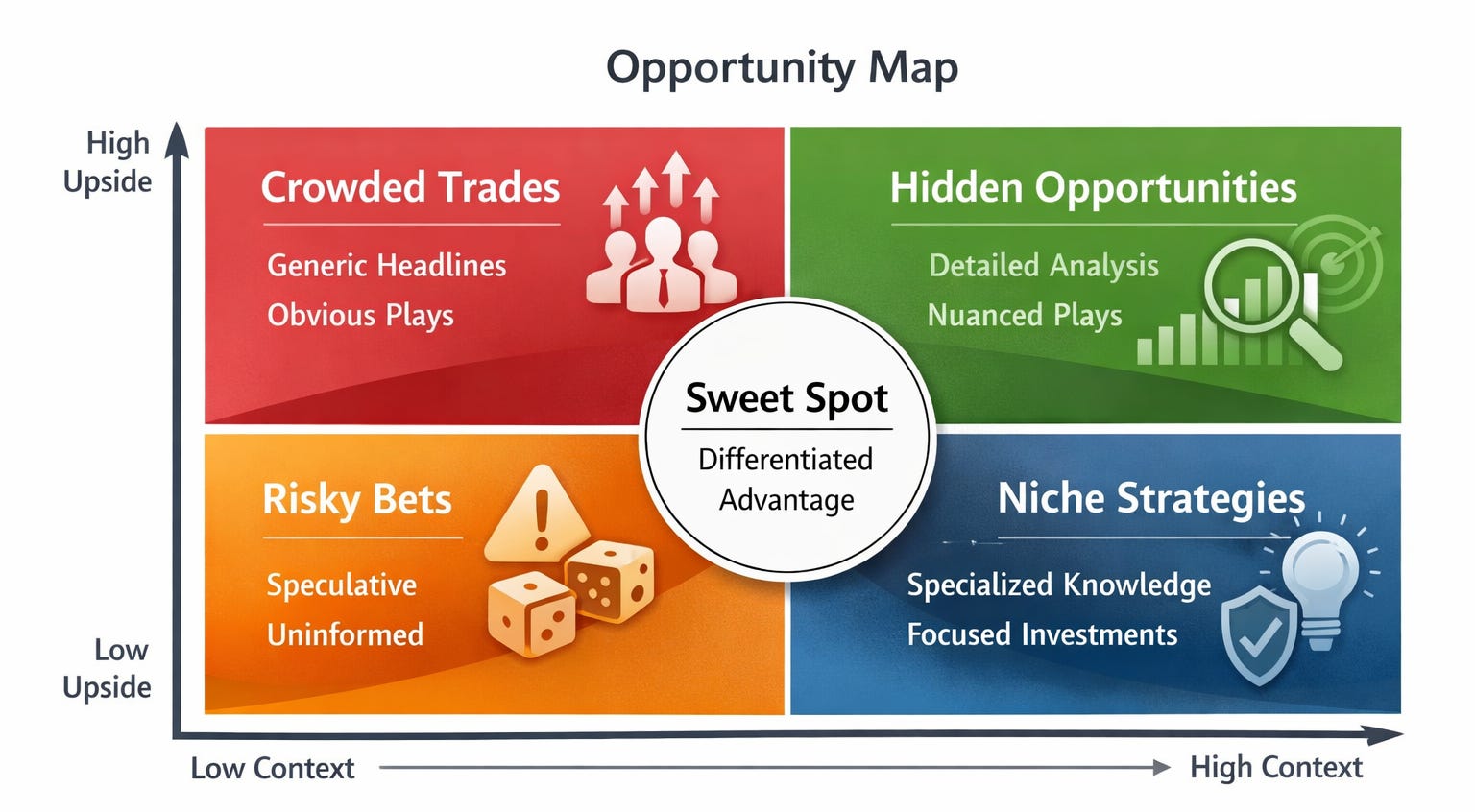
I recently wrote about how renewables function as sovereign defense infrastructure, the technology that prevents the conditions for conflict by eliminating energy dependency. The same logic applies at the portfolio level. The companies and technologies that reduce chokepoint exposure aren’t just “ESG plays” or “climate tech.” They’re resilience infrastructure and in the past month, resilience just got repriced from a nice-to-have to a prerequisite.
Context Windows: The Real Parallel Between AI and Investing
A large language model without context is just a pattern-matching engine. Ask it a generic question, you get a generic answer… fluent, plausible and potentially useless for your specific situation.
Give it a rich context window: your documents, your data, your specific constraints and the same model produces outputs that are genuinely useful because they’re grounded in your reality, not the averaged reality of its training data.
The public market, in its current form, operates like a zero-context LLM. It ingests headlines, processes sentiment, and produces outputs: buy/sell signals, sector rotations, price movements, based on pattern-matching against historical precedent. “War in Middle East means short airlines, long oil, buy gold.” It’s not wrong, exactly. It’s just operating without a context window.
The 1,100-point swing is what happens when a market runs on zero context. The algorithms that sold within 400 milliseconds of the Iran strike weren’t processing the specific implications of the Strait closure for Qatar’s LNG contracts, or for the Shandong teapot refineries, or for the relative competitive position of US shale versus Gulf crude.
They were matching a pattern: military conflict → risk off → sell.
Then when Trump suggested de-escalation: diplomatic signal → risk on → buy.
Lacking real substantive context and reacting on pure reflex.
Private markets operate fundamentally differently. When you’re underwriting a direct investment into a battery storage company, a domestic SAF producer, an infrastructure play with locked-in offtake agreements… you’re not trading on sentiment. You’re operating inside a rich context window. You have the unit economics. You have the contract structures. You have the capacity constraints. You can see that a specific company’s competitive position just drastically improved not because its technology got better, but because its competitor’s supply chain now runs through a war zone.
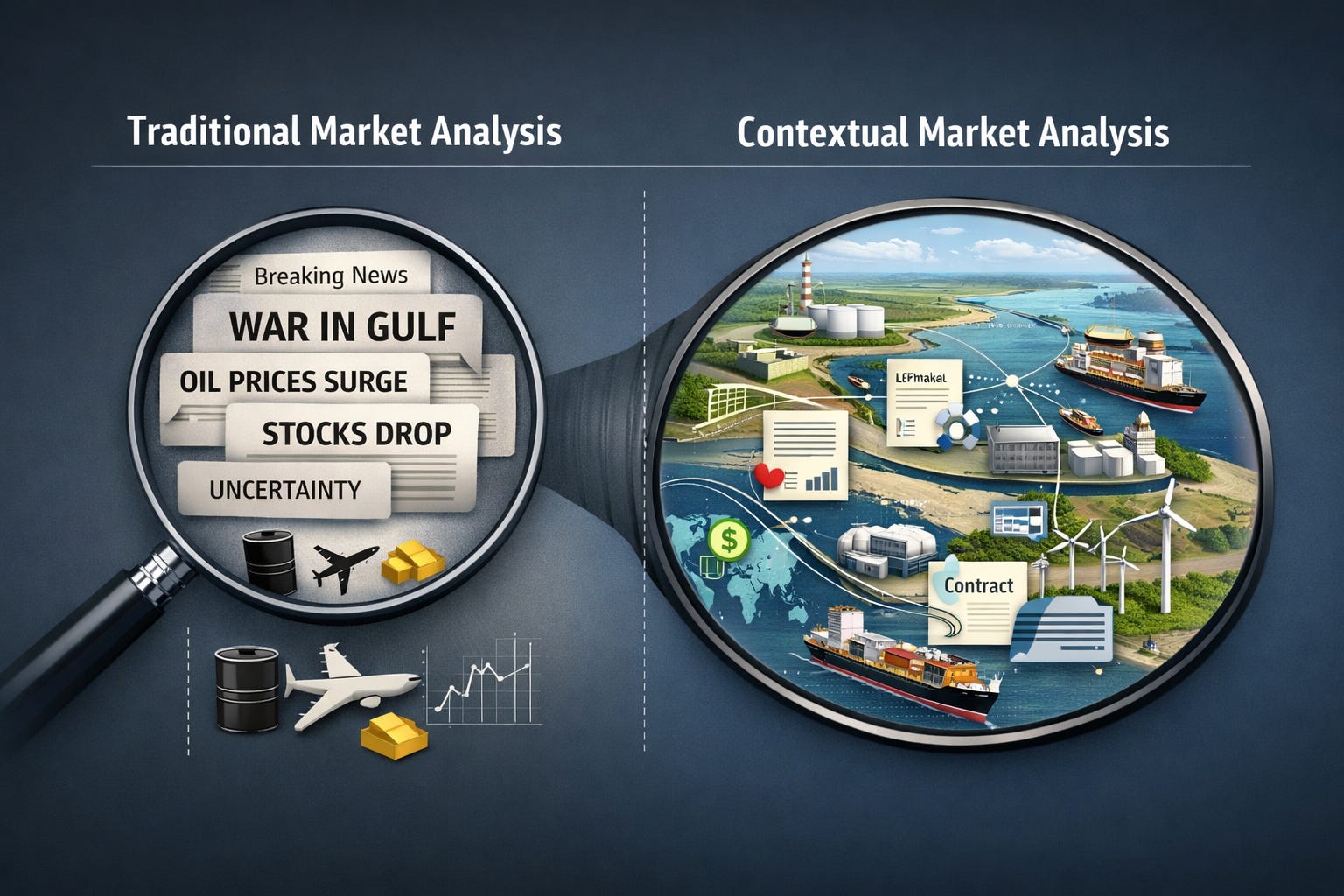
That distinction, between investing on generalized signal and investing on contextualized fundamentals, is the distinction between ultra-processed information and actual analysis. It’s the same distinction that separates useful AI output from slop.
The Opportunity That Generalized Takes Often Miss
Let me be specific about what I think the noise is obscuring.
✈️“War is bad for airlines” is the headline take.
The contextual take: airlines that locked in substantial domestic SAF offtake agreements or hedged fuel with non-Gulf-exposed positions are in a fundamentally different situation than those running unhedged on conventional jet fuel routed through Hormuz.
The war didn’t change the unit economics of sustainable aviation fuel. It changed the relative value of not being exposed to a chokepoint. That’s not a sentiment trade, it’s a structural repricing of supply chain architecture that the public market hasn’t yet differentiated.
🛢️“Oil prices go up in a war” is the headline take.
The contextual take: the insurance market for Gulf transit is in the early stages of a structural repricing that will outlast the conflict itself. Lloyd’s war risk premiums don’t snap back overnight. The companies and routes that can operate outside the risk zone, pipelines bypassing the Strait, terminals on the Red Sea or Atlantic coast, domestic production with no maritime exposure, aren’t just benefiting from a temporary spike. They’re benefiting from a permanent increase in the risk premium applied to their competitors.
🪖“Defense stocks rally” is the headline take.
The contextual take: the nature of this conflict, drones hitting desalination plants, missiles striking civilian infrastructure, cyber disruptions to port operations is accelerating demand not for traditional munitions but for distributed resilience systems: drone defense, grid hardening, critical infrastructure protection, maritime surveillance. The second-order defense opportunity looks nothing like the first-order headline.
But the example that best illustrates why context depth matters and why generalized takes are so expensive is what’s happening right now in shipping.
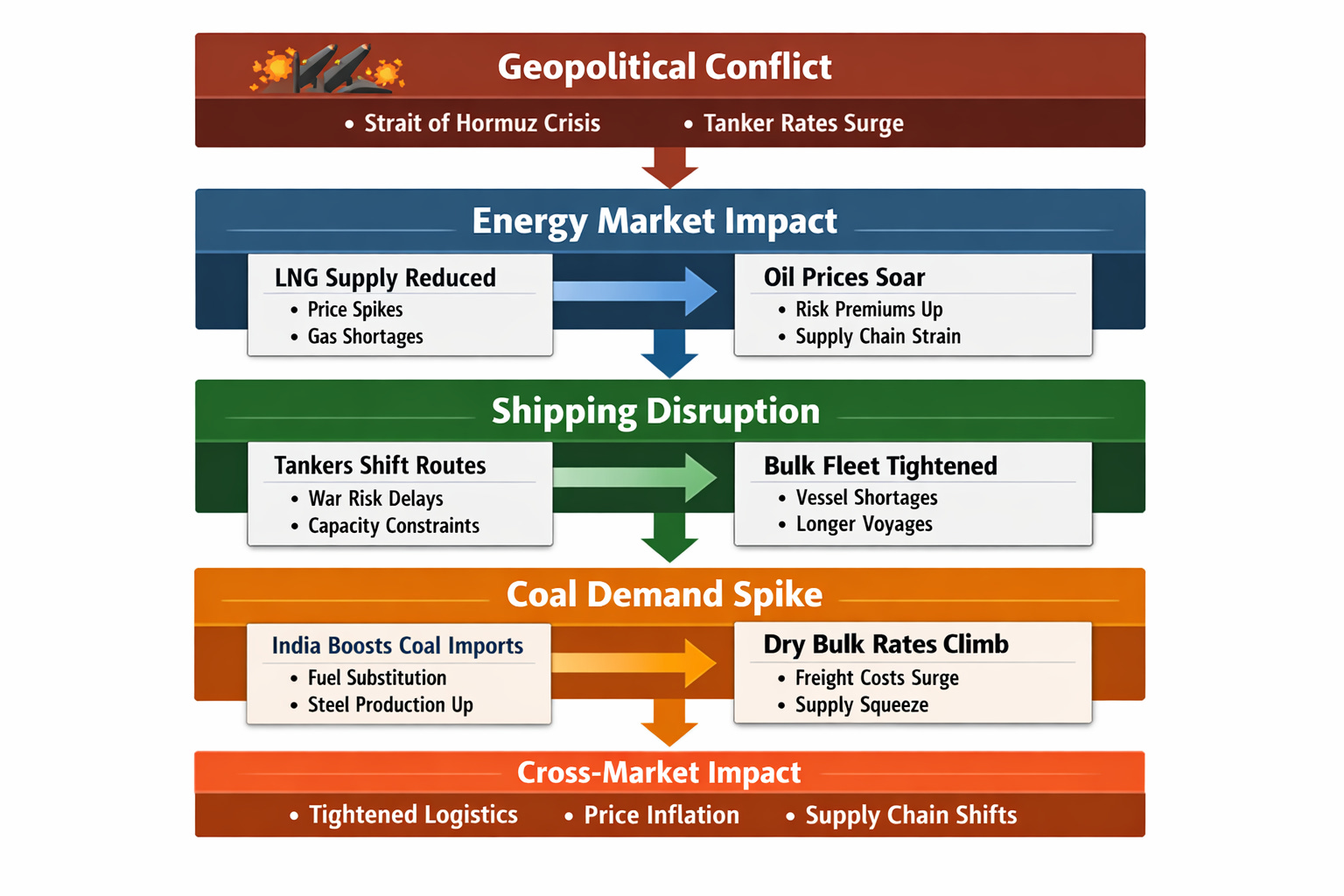
🚢“Tanker rates spike in a war” is the headline take. And it’s true, spectacularly so. VLCCs that were earning roughly $35,000 a day in Q3 2025 crossed $100,000 by late November. After the strikes on February 28th, Saudi shipper Bahri signed the DHT Jaguar at $208,000 a day. By early March, the benchmark Middle East Gulf-to-China route hit $423,736 a day, the highest ever recorded. Some fixtures reportedly approached $537,000 a day, with analysts projecting $800,000 in a full blockade scenario. A vessel that barely covered operating costs six months ago is now generating more daily revenue than most startups earn in a quarter.
That trade is now visible to everyone.
It’s the ultra-processed version: war ➡ tankers ➡ rates up ➡ buy shipping stocks.
Every financial media outlet has run the story.
Here’s the second-order trade that almost nobody is watching:
The Gulf crisis has simultaneously disrupted LNG markets, driving up gas prices across Asia right before summer demand season. Price-sensitive nations, India chief among them, are responding the way they always do when gas gets expensive: they burn more coal.
India’s maritime coal imports rose roughly 9% in February alone, to 19 million tonnes. Its 9% steel production expansion in 2026 is creating simultaneous metallurgical coal demand on top of the thermal substitution. That’s a double demand shock on bulk carriers.
Now here’s where it compounds. The extreme premiums in the tanker market are pulling vessel owners toward VLCC and product tanker routes, effectively removing tonnage from the dry bulk trade. Meanwhile, war-risk insurance withdrawals and Cape of Good Hope rerouting are adding weeks to voyage durations, shrinking effective fleet capacity across the board. One market participant described losing a bulk carrier to a competitor who paid 50% above typical rates to carry coal from Indonesia to India’s west coast, precisely because vessel owners were uncertain about Gulf routes.
So bulk carriers face a pincer: new coal demand pulling volumes up, while the tanker crisis pulls vessels toward higher-paying routes, tightening available supply. That’s a supply-demand squeeze in dry bulk that most people aren’t watching because it doesn’t show up in the headline “war is good for tankers.”
The investor who understood coal’s role here not as an energy thesis but as a shipping arbitrage, triggered by a geopolitical shock in an entirely different commodity class, cascading through fuel substitution patterns in a third market, that’s the pattern worth paying attention to. And it’s the kind of pattern that only surfaces when you have enough context depth to trace cause through consequence across three interconnected systems simultaneously.
Every one of these distinctions requires context that the public market’s zero-context processing can’t access. It requires knowing…
…which SAF producer has which feedstock agreement.
…which pipeline operator has which capacity.
…which defense company is positioned for which threat vector.
That’s not information you get from a headline. It’s information you get from being in the room or from having access to the underlying data to connect the dots.
And Now Double-Click on the Region Everyone Just Wrote Off
Here’s where the ultra-processed take might be at its most damaging….
“The Middle East is in turmoil. Avoid.” That’s the generalized signal. It’s the take that gets your capital allocation committee to nod along and move to the next agenda item. It’s also, for anyone who actually understands the structural mechanics of the Gulf economies, almost exactly wrong.
Start with the counterintuitive fact that experienced Gulf investors have understood for years: when regional tensions rise, oil prices rise with them. Saudi Arabia is one of the world’s largest oil exporters. Every time the price moves up, government revenues increase significantly and quickly. And those revenues do not sit in a drawer. They flow directly into the infrastructure programs, giga-projects, sector development budgets, and economic reforms that form the backbone of Vision 2030. The geopolitical premium that frightens investors in London or Frankfurt is, in structural economic terms, often the same force that accelerates government spending on the very projects those investors are considering.
The thing they fear is simultaneously the thing that funds what they want to participate in. That is counterintuitive, but it is empirically true.
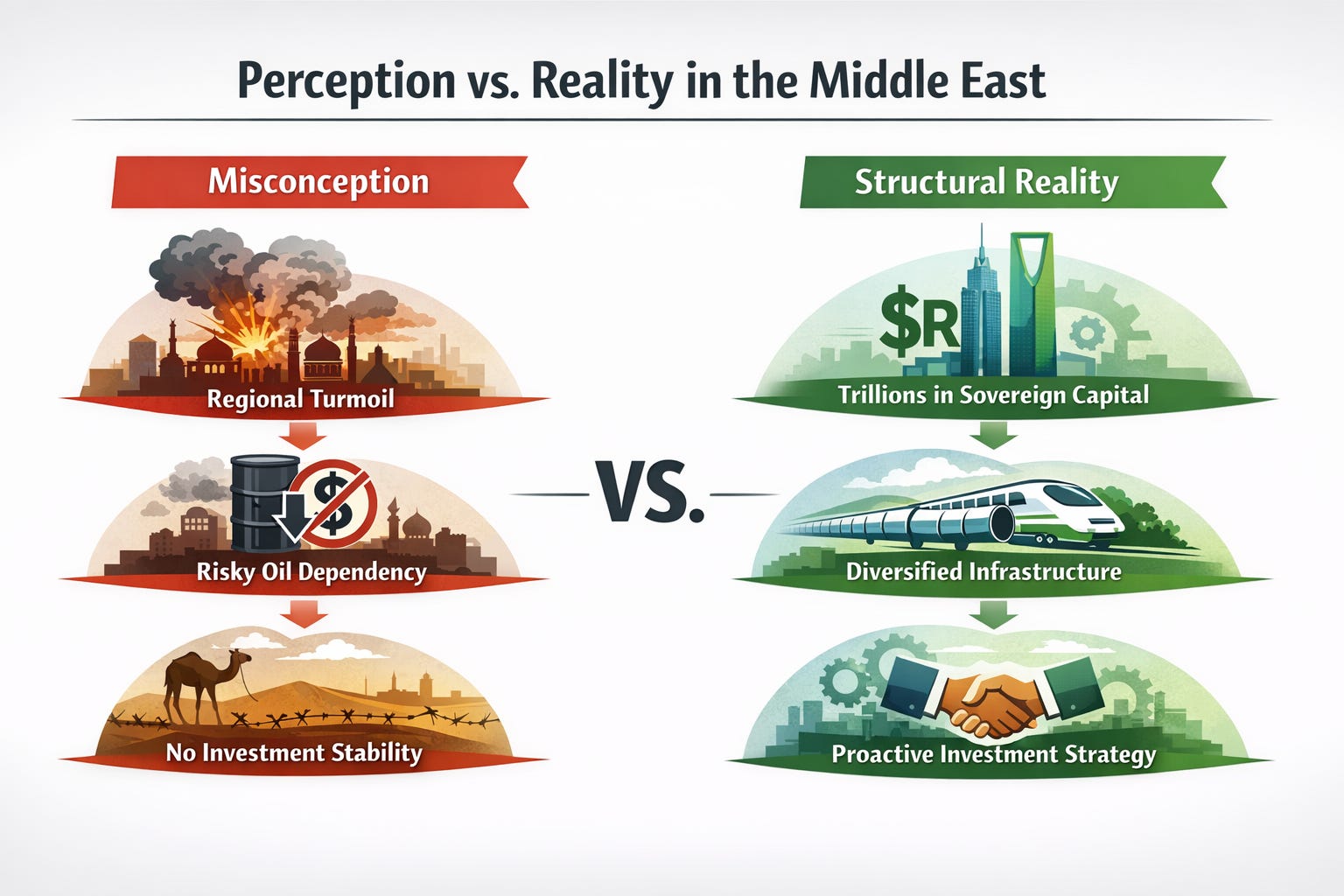
Then consider the sovereign wealth funds. Saudi Arabia and the wider GCC hold sovereign wealth valued in the trillions. These funds were built precisely to absorb external shocks, that is their design purpose, not a happy accident. This past week, the UAE re-affirmed $1.4 Trillions US Investments Plan Amid Iran Conflict.
When global markets tighten, when borrowing costs rise, when uncertainty spreads across other asset classes, these funds don’t retreat, they actually deploy. The capacity to inject liquidity, backstop major projects, stabilize banking systems, and sustain investment programs through periods of regional volatility is a structural feature of the Gulf economies. For foreign investors, this changes the risk calculation fundamentally, you’re investing alongside a government that has both the incentive and the balance sheet to keep building through the storm.
Now layer on the infrastructure reality that the generalized take completely ignores. The India-Middle East-Europe Economic Corridor, the Iraq Development Road, the expansion of non-Hormuz pipeline and port capacity — these aren’t speculative. They’re under construction. Saudi Arabia is already negotiating with Pakistan to reroute oil exports through Yanbu on the Red Sea coast. The UAE has the Fujairah pipeline bypass operational. The trade architecture of the region is being physically rewired to reduce Strait dependency, which is not just in response to this week’s crisis, but as a long-term strategic build that this crisis now accelerates.
The demand for foreign capital, foreign knowledge and foreign institutional partnership across the Gulf is not passive. It is explicit government policy, backed by regulatory reform, licensing incentives, sector-by-sector opening, and direct ministerial engagement with international operators. That appetite is genuine, substantial, and if anything, intensified by the current moment because the current moment makes the case for diversification and resilience infrastructure louder than any policy paper ever could.
The real risk in the Middle East isn’t the one everyone is talking about. The real risk is the one the global investment community has run for decades: waiting for certainty. Waiting for the political risk to resolve, the regulatory framework to be fully established, the market to be proven, the pioneers to have already succeeded. And by the time all of that is visible, the strategic positions are taken, the government partnerships are locked, and the early movers have captured the value that the latecomers spent years waiting to feel comfortable about.
“The Middle East is in turmoil” is the ultra-processed take.
The contextual take: a region with trillions in sovereign capital, accelerating diversification spend, infrastructure being built to bypass the exact chokepoints that just failed, and an explicit policy appetite for international partnership, is probably not the place you want to be leaving right now. It might be the place you want to be arriving (timing it right).
The Investing Version of “Context is Everything”
There’s a broader principle here that extends well beyond this week’s crisis.
We’re entering a period where the gap between generalized market intelligence and contextualized fundamental analysis is going to widen dramatically. AI is accelerating this in both directions simultaneously.
On one side, AI-powered algorithmic trading is making public markets faster, more reflexive, and more sentiment-driven, more prone to the kind of 400-millisecond pattern-matching that produces 1,100-point swings.
On the other side, AI applied to private market due diligence: parsing complex datasets, modeling scenario-specific outcomes, identifying structural shifts that headline analysis misses, is making fundamental analysis deeper and more accessible than ever.
But here’s what most people in both the AI and investing worlds haven’t fully internalized yet: LLMs gave us the language interface, the ability to interpret and generate human-readable analysis at scale (and speed). That was the breakthrough of the last three years. What they didn’t give us, and what the next frontier demands, is context depth. The ability to reason not just from language patterns but from localized knowledge, domain-specific data and real-time conditions that no training corpus contains.
Think about what that means in practice. Localized context: understanding that a specific pipeline operator in Oman has a specific capacity constraint that makes it a chokepoint beneficiary this week, not just that “pipeline stocks might go up.”
Domain context: knowing that Lloyd’s war risk repricing follows a specific actuarial pattern that persists 18-24 months after a conflict, not just that “insurance costs rise in wars.”
Real-time context: processing that Qatar’s Ras Laffan shutdown this morning creates a specific LNG supply gap that maps to a specific set of US export terminals with specific available capacity, not just that “LNG prices are volatile.”
None of that comes from generalized language models trained on the open internet. It comes from systems that can hold complexity, that can see the second and third-order consequences of a specific event cascading through a specific supply chain affecting a specific set of companies with specific contractual positions. That’s not pattern-matching. That’s something closer to structural foresight and the ability to trace cause through consequence across interconnected systems in real time.
Some of the work we're pursuing at Cool Climate Collective sits exactly at that intersection: building intelligence systems that don’t just summarize what happened, but model what happens next, across domains, with the kind of causal depth that generalized takes can’t touch. We all agree that the LLM gave us the interface, however I firmly believe that the context layer, which is: localized, domain-rich, temporally aware, is where the real value gets created. And it’s barely been built or even capitalized on (yet).
The investors who will outperform in this environment are the ones who understand which mode they’re operating in. If you’re in the public market reacting to headlines, you’re competing with algorithms that are faster than you and just as context-free. If you’re in private markets with access to underlying fundamentals and increasingly, with AI tools that can process those fundamentals at depth rather than at surface, you’re in a different game entirely. One where the noise that drives public market volatility is actually your edge, because it creates mispricings that only contextual analysis can identify.
“War is bad for markets” is what you get when you ask the market for a take without giving it any context. The answer isn’t wrong. It’s just useless for making actual decisions. The same crisis, processed through a rich context window, the specific companies, the specific supply chains, the specific structural shifts, produces a completely different output. Not “this is bad.” But “this is bad here, neutral here, and a generational opportunity here… and here’s why.”
Context isn’t just everything in AI, it’s everything in investing and both are still in the earliest stages of learning that lesson.
So where does this all lead us…?
I'll end with this note on an old parable, often attributed to a Chinese farmer. I've explored a version of this story before through a climate lens, but it lands differently this week. It goes like this…
The farmer’s horse runs away.
The neighbors say, “Such bad luck.” The farmer says, “We’ll see.”
The horse returns, bringing wild horses with it. “Such good luck!” We’ll see.
His son breaks his leg taming one. “Such bad luck!” We’ll see.
The army comes to conscript young men, but passes over the son because of his broken leg. “Such good luck!” We’ll see.
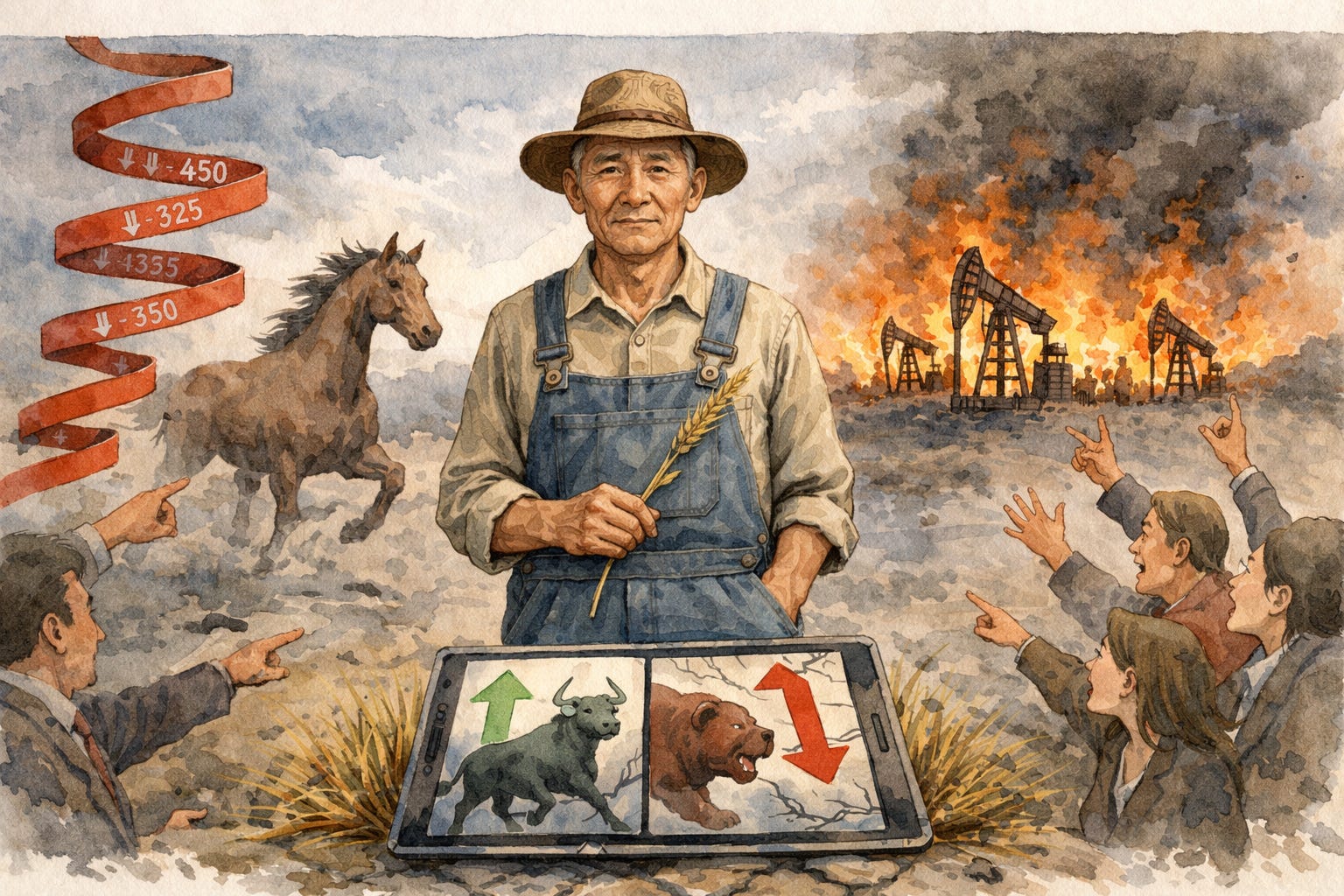
War is bad for markets. We’ll see.
War is good for energy. We’ll see.
The Strait closing is a disaster. We’ll see.
I might be an optimist trying to find the opportunity that lies before us, as they say, never waste a good crisis. But from the context window I have, there is something real to act on here. A longer-term structural shift toward the futures we actually want to inhabit… more sovereign, more resilient, more locally powered.
"The pessimist sees difficulty in every opportunity. The optimist sees the opportunity in every difficulty” - Winston Churchill
Maybe the farmer wasn’t being evasive after all. He was the only one in the village with a particular larger context window.
The farmer had context. Most of the market doesn’t.
The ultra-processed analogy is great Mehrad.
Wall Street more broadly has had a very simplistic approach to political risk as you pointed out in the market gyrations. And, one common assumption—Trump does not like to see the market fall and will end the war–keeps getting proven wrong.
Second and third order implications I am watching include the weapons procurement super cycle broadly, Saudi and UAE interest in European weapons systems, drones and UAV development, mil-tech, data center drone defense systems, urban drone defenses (think New York City). On the energy front: energy security in India, Japan, Korea, SE Asia—including investment in nuclear and renewables. Eventually there will be a swing in US renewables as well.
Great analysis Mehrad. The thesis for investing in climate resilience and adaptation solutions has taken on even more importance due to the Middle East conflict. It has previously been framed as a climate issue but the themes of energy independence, food security etc are critical for the multi polar world we are now living in. You highlighted it well 'more sovereign, more resilient, more locally powered.'