


Listen to the summary:
Follow-up companion piece: Our Deployable Window is Closing from Both Sides
While in New York last month, I heard a public official from a small island nation bring up an uncomfortable reality into a conversation about resilience. Their country imports much of its food and energy, neither dependency can be unwound quickly, and two regional wars were already showing how easily events thousands of miles away can interrupt the supplies an entire population depends on.
For most of the room, resilience was a strategic priority. For their country, it was an operating condition. One group was discussing how to prepare for a world that becomes less reliable; the other already lives in a world where reliability is negotiated daily, through other people’s ports, shipping routes, fuel supplies and geopolitical disagreements.
What stayed with me was the asymmetry of agency, more than the vulnerability itself. The people most exposed to a system’s failure often have the least say over the decisions that determine whether that system survives.
I keep running into this pattern in very different places: venture-backed companies trying to commercialize technologies that already work, cities struggling to finance infrastructure that pays for itself in avoided losses and multilateral institutions trying to coordinate action on risks whose consequences are clear but whose ownership remains politely undefined. The technologies & solutions change from case to case yet the underlying mechanism keeps reappearing.
This week I’m in Reykjavík for the inaugural Global Risk and Stabilization Summit, a gathering organized around some of the most consequential questions humanity can ask.
What happens if the Atlantic Meridional Overturning Circulation destabilizes?
What if Arctic sea ice loss accelerates?
What if major ecosystems reorganize, ice sheets enter sustained retreat or changes to Earth’s reflectivity reinforce warming?
Each question carries its own level of evidence, uncertainty and reversibility, and the summit brings together the people working to understand these risks, prepare for them and work out what responsible prevention might look like.
I have been thinking about a related question that sits somewhat outside the physical sciences…
What if civilization loses the capacity to prevent catastrophic outcomes before those outcomes themselves become unavoidable?
The first tipping point we cross may well be in our socio-economic systems before anything in the climate system gives way.
The Other Tipping Point
Climate science has given us an increasingly sophisticated understanding of nonlinear change. A warming ocean does not always respond in proportion to each additional increment of heat. Ice loss changes reflectivity, which can drive further warming. Drying soils can intensify heat, and ecosystems pushed through enough disturbance can reorganize into entirely different states, with consequences for carbon storage, rainfall and biodiversity.
The mechanics vary and only some thresholds behave like cliffs. Some changes are abrupt while others unfold over centuries; some can be reversed and others become effectively permanent on human timescales. The broader principle still holds: a system can accumulate pressure for a very long time before its behavior shifts in ways that are hard to undo.
Human institutions have their own version of this problem. Consider a coastal region under growing stress from repeated disasters. Insurance premiums rise first. Then insurers restrict coverage or pull out of parts of the market, property values come under pressure, and municipal tax revenue becomes less predictable just as infrastructure costs climb. Public borrowing gets more expensive, maintenance gets deferred, businesses reconsider expansion, families relocate and the political capacity to fund long-term resilience weakens. (I covered this financial cascading risk more extensively in a Feb 2025 write-up.)
Not every coastal region will follow this sequence, and policy can interrupt it at several points. That is exactly why the sequence matters. The physical shock and the institutional response form a feedback system whose loops reinforce one another. Climate damage erodes financial and institutional capacity; weaker institutions are less able to prevent or absorb the next round of damage; and each new shock lands on a system with less left to respond with.
This points to a distinction I think is underdeveloped in how we talk about catastrophic climate risk. There is the physical tipping point, where an Earth system enters a new state or a hard-to-reverse trajectory.
And there is the institutional tipping point, where the organizations responsible for responding have lost enough financial, political, industrial or social capacity that meaningful intervention becomes impossible, even while a technically viable option still exists.
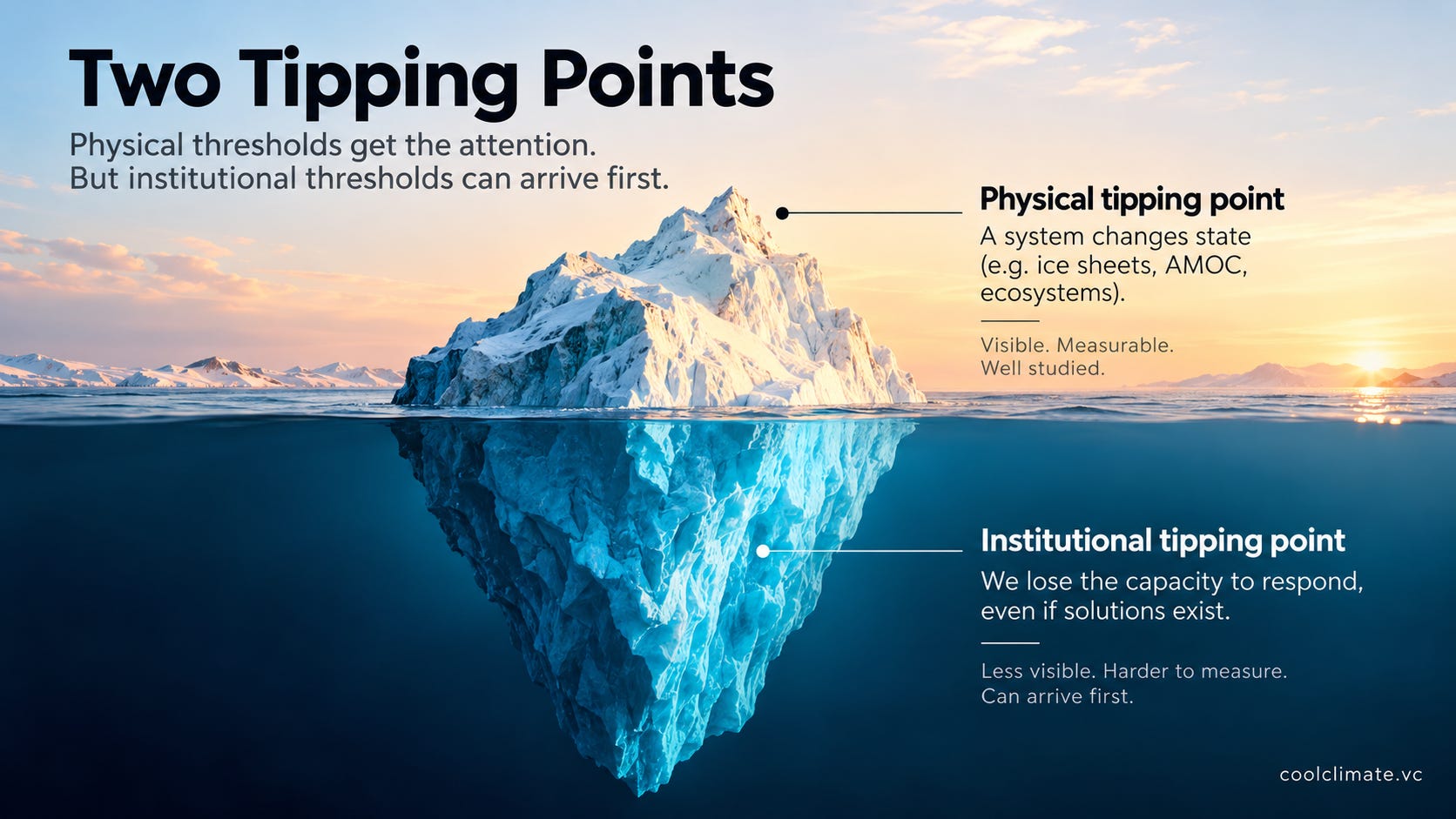
In some circumstances, the second threshold may arrive before the first. I hold that as a hypothesis to test, and its implications are substantial. We could spend decades sharpening our forecast of a dangerous physical threshold, only to discover that the window for organizing a credible response closed while we were still refining it. The climate clock & the institutional clock run on different schedules.
Then there is a third clock, the one I deal with for most of my working life: the time it takes to actually get something done.
Three Clocks, One Response Window
Climate venture has made me wary of the phrase “the technology is ready.” Many of the technologies we need already work. They produce water, store energy, cut emissions, recover materials, improve industrial efficiency, or perform some physical task better than the established alternative. Yet working technologies routinely spend years waiting to become deployable products, financeable projects or accepted industrial practice. The scientific breakthrough happened; the market never received the memo.
A company can demonstrate a technology and still have no viable procurement route, no acceptable liability structure, no standardized performance contract, no insurer prepared to carry the relevant risk, and no institution able to underwrite a first commercial deployment. Each of those is a failure of the system around the technology, which has yet to learn how to use it.
We have been developing our Co-VC approach around this observation: in an emerging market, the most important bottleneck frequently sits outside the company trying to enter it.
Sometimes the bottleneck is product-specific, where a startup needs expertise, testing or certification that another industry has already figured out. Sometimes it is shared by nearly every company trying to scale: intellectual property, enterprise procurement, insurance, infrastructure finance, government contracting. And sometimes it belongs to the industry itself, in the form of regulations, standards, shared facilities, missing markets, fragmented demand, or a liability framework nobody has yet agreed to.
The further out the constraint sits, the less likely any individual startup can solve it alone.
The same logic becomes considerably more consequential at planetary scale.
Imagine researchers establish that a particular climate stabilization intervention is technically plausible and potentially useful. That is not the same as knowing whether it should be deployed. The evidence may be incomplete, the side effects poorly understood, and the geopolitical consequences profound.
But even if a future intervention were found to be scientifically justified, how would it actually happen?
Who has jurisdiction? Who is consulted? Who bears the risk if it goes wrong? Who finances the preparation? What evidence triggers a decision? Who can object? Who can stop it? Who maintains the system decades later?
We have an abundance of scientific & technological imagination and a relative shortage of institutional imagination about how such decisions would be made.
This is the Civilizational Response Gap: the distance between our ability to recognize a systemic threat and our collective ability to execute a legitimate, effective response.
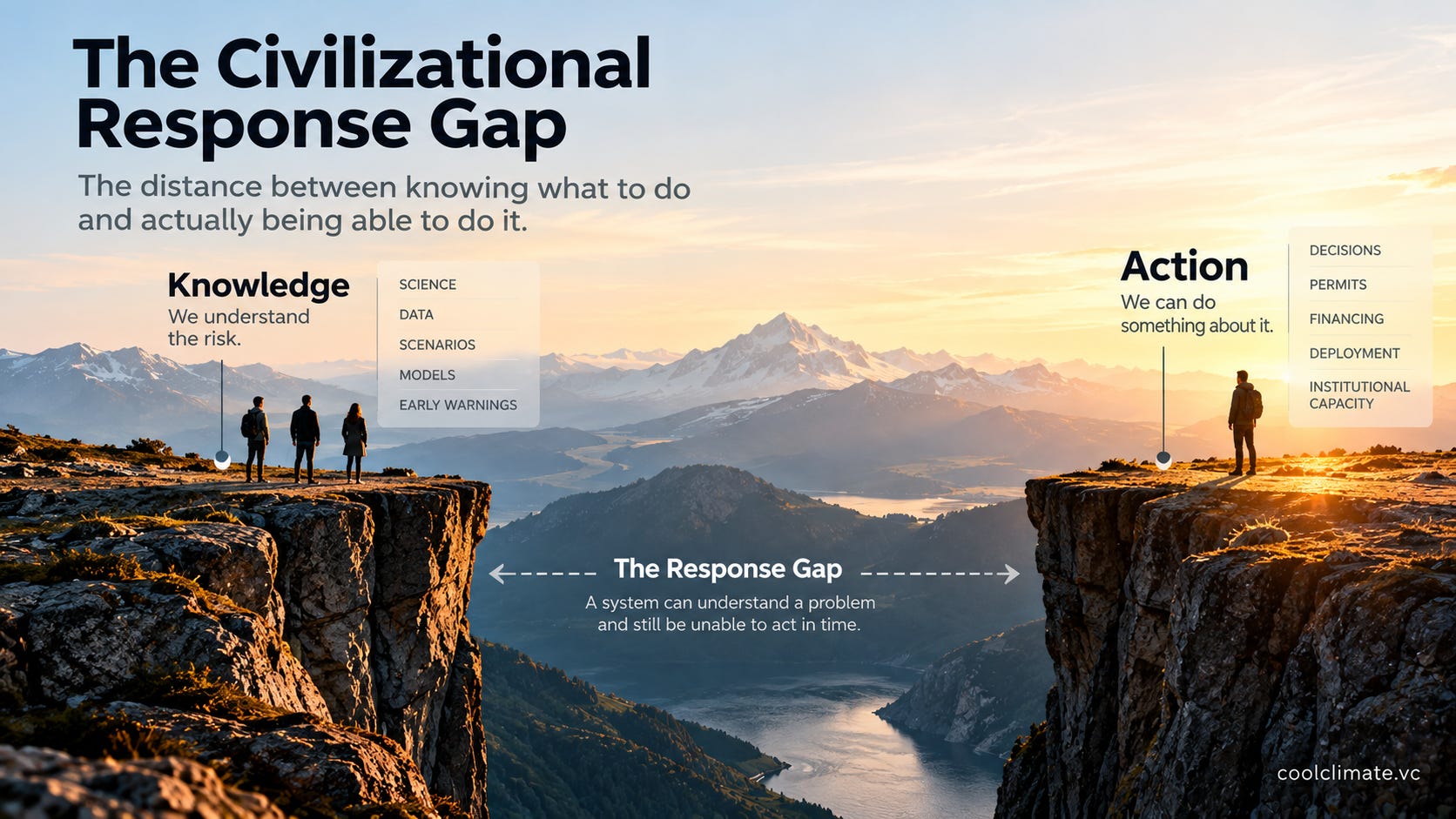
It can be understood as a race between three clocks.
The physical clock measures the window in which a response may still alter a dangerous trajectory.
The institutional clock measures how long the relevant political, economic and social capacity to act remains available.
The deployment clock measures how long it takes to gather evidence, make a decision, secure permission, arrange financing, mobilize industry and deliver an outcome.
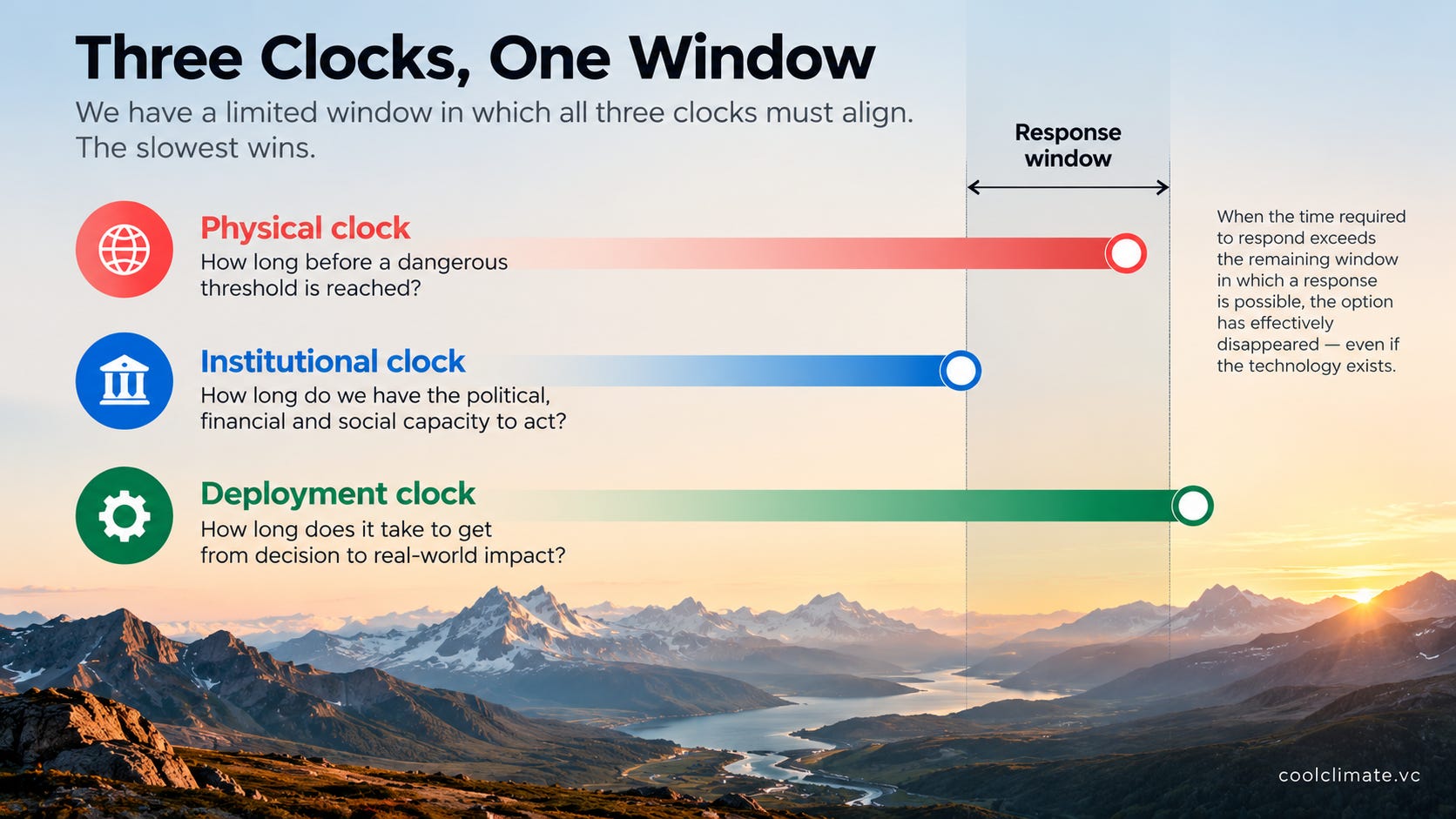
The first two establish the available window. The third consumes it.
When the time required to respond exceeds the remaining window in which a response is possible, the option has effectively disappeared.
It does not necessarily matter that the relevant technology exists.
We could be scientifically early, technologically ready and institutionally too late.
Coordination is Infrastructure We Don’t Account For
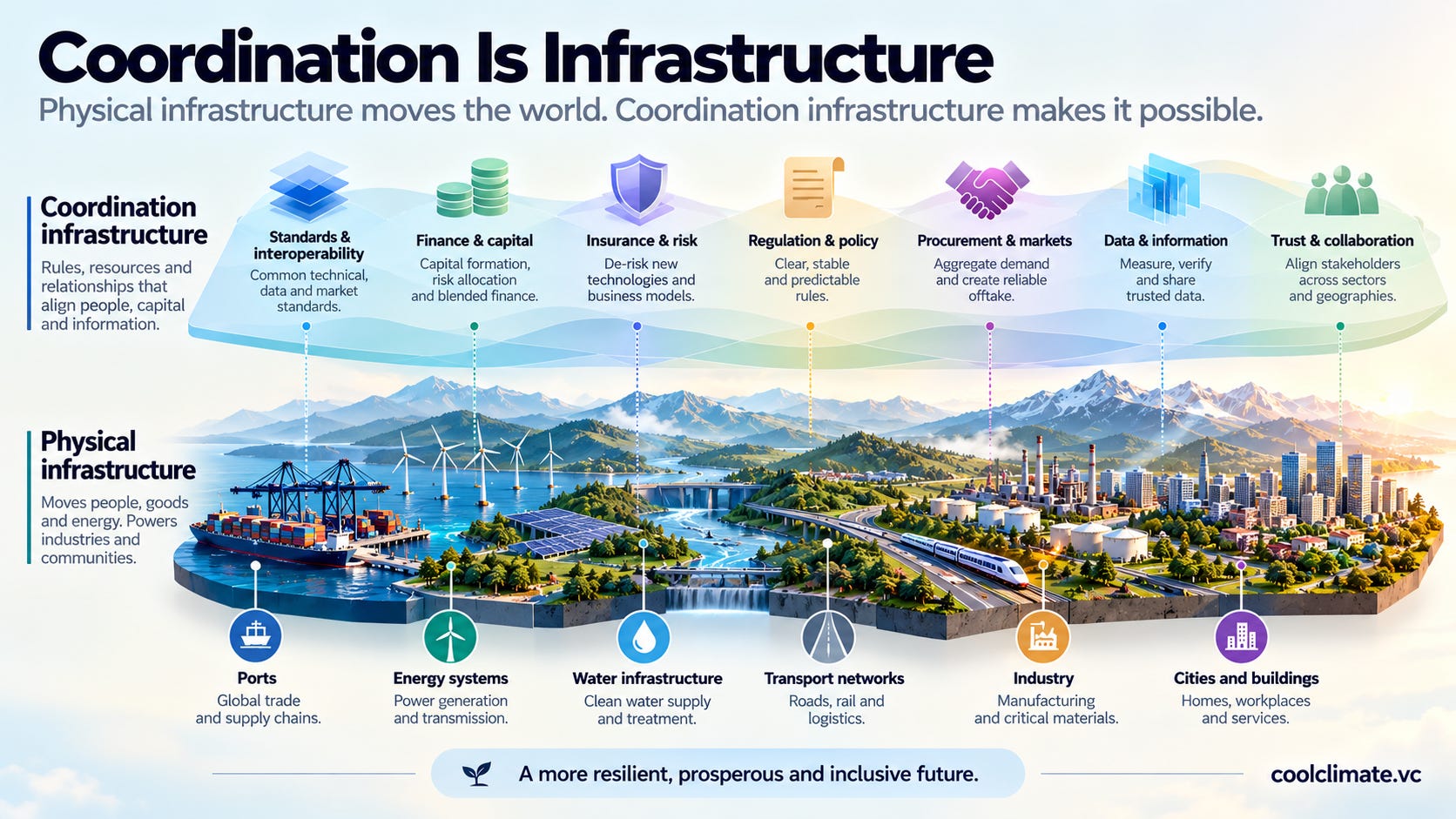
We already have a well-developed language for infrastructure. A transmission line carries electricity, a port moves goods, a reservoir stores water, a hospital creates capacity to treat illness. We understand these as assets because we can say what they do, who uses them, what happens when they fail and under what conditions they can be financed.
Now consider the mechanisms that make a complex response possible across institutions: a shared technical standard that lets otherwise incompatible companies deliver equipment into the same project; a predefined liability framework that lets insurers price an unfamiliar risk; a procurement agreement that creates credible demand before a manufacturer commits capital; a scientific monitoring system whose observations carry agreed evidentiary weight in public decision-making. These rarely get recorded as infrastructure. They get filed under administrative overhead, stakeholder engagement, precompetitive activity, or the assorted work that happens between meetings. Remove them, though, and the physical infrastructure may never get built. Their economic function is infrastructural: they create the conditions under which other productive assets can exist.
I’ve come to think coordination infrastructure deserves recognition as its own class of productive capital.
Plenty of collaborations need nothing more than a phone call and the world will survive without another platform, consortium or dashboard.
The case rests on the subset of coordination mechanisms that are durable, reusable and valuable across entire industries. A certification standard can serve thousands of companies, a common infrastructure corridor can carry multiple technologies and an agreed framework for allocating project risk can make otherwise unfinanceable investments possible. The value compounds with every adoption, its a muscle memory (& reps training) for the broader industry as a whole, a shared memory & understanding of what works.
This is why much of our Co-VC work has incorporated not just selecting promising companies but towards shaping the systems those companies need to deploy into.
We initially began years ago with our Three Futures Test framework: identifying several causally distinct futures in which an investment could become exceptionally valuable. The more we applied the framework, the clearer it became that picking the right future was only part of the work. We could often find technologies with strong prospects across several futures and then watch the same external bottlenecks keep every one of those futures from materializing.
The logical next step was to work on the bottleneck itself. Applied to the level of planetary stabilization, that means asking whether we should finance the capabilities that make whole categories of future responses possible rather than funding individual responses in isolation.
Coordinating an industry and authorizing an intervention in a shared planetary system are very different acts, and a venture consortium can’t simply be scaled up into a planetary decision-making body.
The atmosphere is a commons with no purchasing department and the populations exposed to an intervention’s consequences can’t be represented the way customers are.
Legitimacy, sovereignty and consent are part of what makes collective action sustainable; treating them as procedural friction on the way to efficiency gets the design backwards. The cure for fragmented authority can’t be concentrated authority. Coordination can still be designed, financed, tested and improved; the design requirements are just more demanding.
The atmosphere is a commons with no purchasing department.
Finance the Ability to Decide
Most funding systems prefer a straightforward line between investment and output: capital goes in, research advances, a technology is demonstrated, a project is built, and an identifiable benefit appears. Planetary stabilization breaks that line.
What if the most valuable outcome of a research program is discovering that an intervention should never be attempted?
What if we invest in monitoring, modeling, engineering readiness and governance capacity, and conclude twenty years from now that none of the proposed interventions is necessary or acceptable?
Through a conventional project-finance lens, that is an asset that never generated its intended cash flow. Through a systems-risk lens, it may be an extraordinary return. (AI security, anyone? I’m just saying, planetary stabilization systems risk scenarios have some similarities with AI and its Pandora’s Box / capabilities unleashed on our unprepared collective digital economies)
We know how to value options in finance: the owner acquires the right, without the obligation, to act under specified conditions.
The analogy is useful for civilizational preparedness as long as we keep a clear line between an option to make an informed collective decision and a private right to intervene in the planet. The value lies in preserving the ability to choose responsibly once the future becomes clearer.
We have learned how to pay for damage & we are slowly learning how to finance avoided damage. The next challenge may be learning how to finance avoided helplessness.
That implies a different financial architecture:
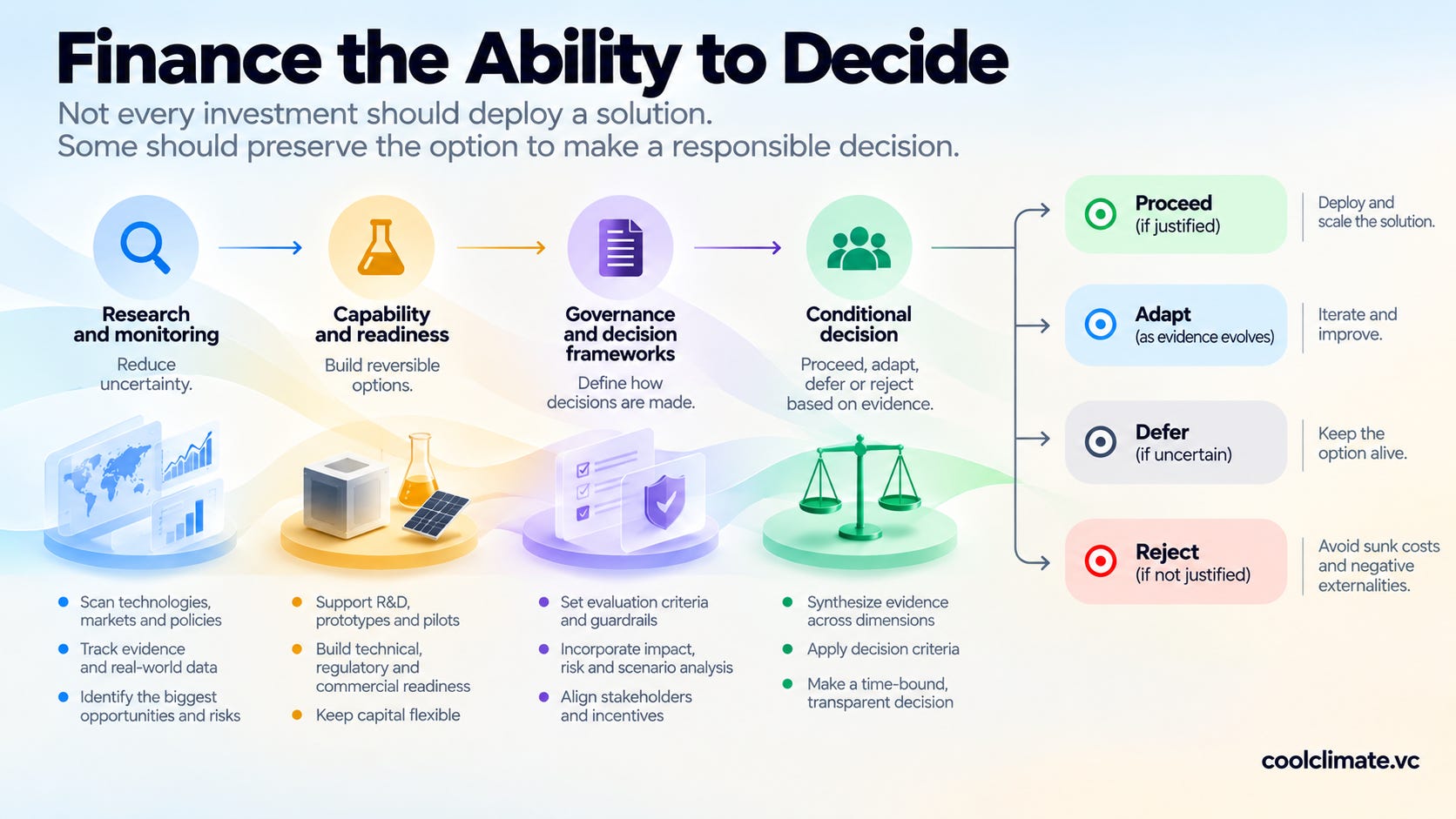
Fund independent scientific observation and uncertainty reduction first.
Build reversible engineering capabilities where appropriate.
Put institutional arrangements, shared safety standards and liability frameworks in place before a crisis, and preserve operational capacity that could support several possible responses.
Then let subsequent funding depend on evidence, legitimacy and explicit decision gates: proceed, adapt, defer or reject, with all four counting as valid outcomes.
In this approach, a negative scientific result can be a sound investment and so can a legitimate public decision not to proceed. The relevant metric is how much decision-making capacity the investment preserved and how much dangerous uncertainty it eliminated.
I have been calling this Civilizational Real-Options Underwriting.
It builds on a familiar idea from hard-tech financing, that different risks call for different capital and different institutions to assume them.
Venture investors can finance commercially valuable technologies.
Governments can support essential public goods and maintain strategic capability.
Philanthropy can absorb exploratory research risk.
Insurers and development financiers can help create repeatable ways to allocate risk once the evidence supports doing so.
The objective is narrower than making every stabilization intervention investable and it leaves the decisions that properly belong to the public with the public. I know some readers will be asking whether the public is even capable of making decisions like these. I take that question up in a future piece I’m writing for Distillations at the Frontier, which argues that AI could make public alignment possible down to the individual level.
More Intelligence, Less Collective Agency?
Another complication is arriving at almost exactly the same moment. Artificial intelligence is rapidly expanding our capacity to model complex systems, synthesize scientific literature, evaluate scenarios and potentially accelerate discovery. In principle, that should be especially valuable for climate stabilization: few problems require us to reconcile so much information across so many disciplines, spatial scales and time horizons.
The application I find more interesting is a different one… AI’s greatest civilizational contribution may come from making institutions better at working together, more than from making each of them individually more intelligent.
A single scientific observation means something different to a climate researcher, an insurance underwriter, a national security adviser, an infrastructure operator and a minister responsible for public spending. Each translates the same underlying reality into a different decision language. Much of the information is lost in translation, and some of it never travels at all.
The people nearest the system often hold the richest direct information and the least authority to act on it, while the people with capital and authority sit several institutional layers away. I named this the Proximity Inversion in The Crowd That Read One Book.
To reach anyone who can act, information has to climb those layers, and each one makes it more legible to the next institution, usually by stripping away the local context that made the original observation valuable. By the time it arrives, the decision-maker is working from an abstraction of the original problem.
AI creates the possibility of a different architecture. Imagine a network of independently verified, narrowly authorized systems that translate scientific uncertainty into decision-relevant scenarios, reconcile regulatory requirements with engineering plans, identify missing financial commitments, and make the dependencies between institutions explicit. The point is an intelligence layer that helps human institutions understand each other’s constraints, surface disagreement and coordinate the decisions they remain accountable for making, with authority staying where it already sits.
This is what I mean by Coordinated Agency. Agency goes beyond information; it is the capacity to convert understanding into purposeful action. Coordinated agency is the capacity of multiple independent actors to do that together while keeping the independence that makes each of their contributions valuable.
And here is the catch (& risk)… AI could just as easily erode the conditions that make collective intelligence work. In The Crowd That Read One Book, I also explored the risk of concentrated machine intelligence: institutions adopting models that look competitive and independent but inherit similar assumptions, training distributions and failure modes. A crowd can aggregate errors into wisdom when its members arrive with sufficiently independent information. Give everyone the same assumptions and the crowd becomes a very efficient mechanism for reproducing the same mistake.
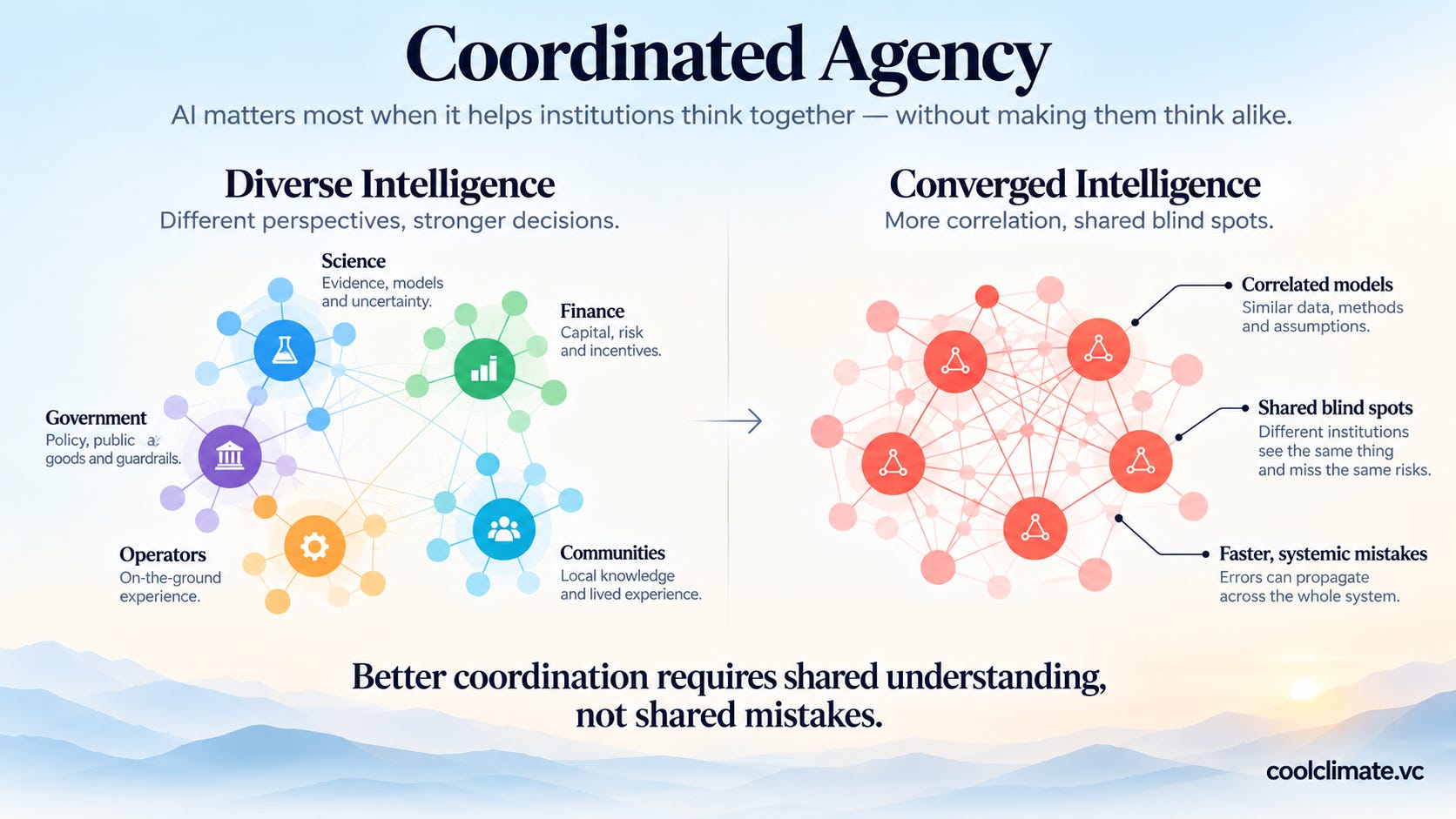
Apply that to the institutions responsible for risk. What happens when banks, governments, insurers, scientific organizations and infrastructure operators all rely on closely related models to interpret the same emerging crisis? Each one’s analysis may improve while their judgments become correlated. The worst case is a shared mistake propagating simultaneously through institutions that were supposed to provide independent checks on one another, which is far more dangerous than any single system getting something wrong. A civilization of individually intelligent institutions can still become collectively fragile. (Just ask anyone deeply intimate with US politics and the ongoing erosion of the concept of Checks & Balances)
So a serious architecture for coordinated agency has to preserve disagreement, independent sensing, multiple causal models and meaningful human authority. Making institutions think alike produces conformity; making them capable of thinking together produces coordination. The more we automate the first, the more deliberate we will need to be about protecting the second.
A civilization of individually intelligent institutions can still become collectively fragile.
Sovereignty is a Form of Stabilization
Return to the island official in New York. Their country’s vulnerability predates any Arctic tipping point. It began with the much more immediate reality that food and fuel come from elsewhere and that events beyond their government’s control can interrupt both.
That suggests at least two complementary ways to reduce civilization’s exposure to an unstable planet:
We can reduce the forces driving physical destabilization, through emissions reductions, ecosystem protection, carbon removal and, where scientifically and politically justified, carefully evaluated additional measures.
And we can reduce how much human systems depend on uninterrupted stability in the first place.
The second deserves more attention than it often receives…
A household with distributed power and storage can keep critical electricity running through a grid disruption.
A community with diversified water sources is less exposed to a single drought or infrastructure failure.
A region that produces a greater share of its essential food inputs can reduce some of its vulnerability to disruptions in global trade.
None of these makes a community independent of the planet or immune to catastrophic change, and local production is sometimes the less resilient option: redundancy can come just as well from geographic diversification, trade, spare capacity or mutual assistance. I know this cuts against the current national security narrative, in which self-sufficiency is treated as the foundation of military and economic power. But every one of those ambitions rests on a climate stable enough to sustain it. Self-sufficiency only moves the dependency, from other people’s ports to the climate itself and no national strategy is sovereign over that.
Still, the architecture of dependency determines how a shock travels. An interruption that disables one highly centralized system can cascade into widespread failure. The same interruption hitting a system with independent supply pathways, local operating capacity and fallback arrangements may remain a manageable disturbance.
The architecture of dependency determines how a shock travels.
This is where our systems investment lens takes on another meaning. Distributed water generation, energy storage, decentralized treatment, local materials recovery and alternative food production are separate markets for climate technology yet under the right conditions they also combine into sovereign resilience: the capacity of a community or country to retain meaningful freedom of action under external stress.
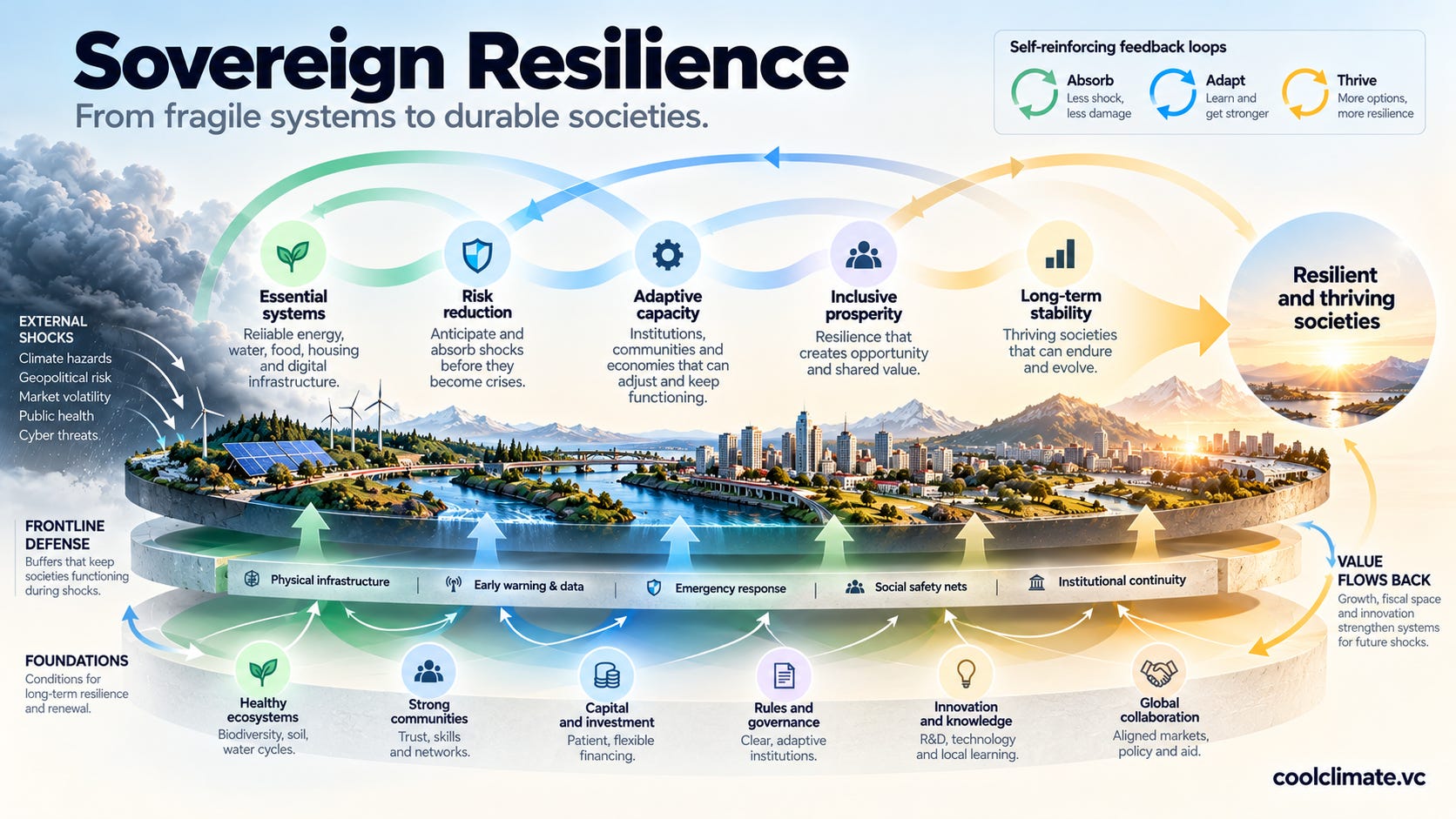
By sovereignty I mean selective freedom from the dependencies whose failure would eliminate the ability to choose, which is a long way from isolationism or the fantasy that every jurisdiction should solely produce everything it consumes.
That capacity has a second-order effect. A community that can sustain essential services through disruption preserves fiscal, social and institutional capacity for everything else, and its leaders can make decisions from relative stability instead of emergency dependence. Distributed resilience protects people from planetary instability (which we still need to solve for) yet it also preserves the institutional capacity required to take part in stabilizing the planet. That is a feedback loop worth designing for.
It also suggests that some of the most consequential stabilization investments won’t resemble planetary interventions at all. They will look like decentralized utilities, adaptive agriculture, maritime logistics, municipal infrastructure, local manufacturing and the financial structures that let them become dependable services.
Mundane things, by the standards of a conference on Earth-system thresholds, which may be exactly why they are easy to overlook… or even consider as I suggest The Other Tipping Point.
What Would We Actually Build?
At this point the critique is predictable, and fair. Coordination is one of those words that can explain almost anything while committing its speaker to almost nothing. I have attended enough conferences where everyone agrees coordination is essential, then leaves the room and returns to institutions that keep behaving exactly as before.
If coordinated agency is going to be a real operating discipline, it has to produce something falsifiable.
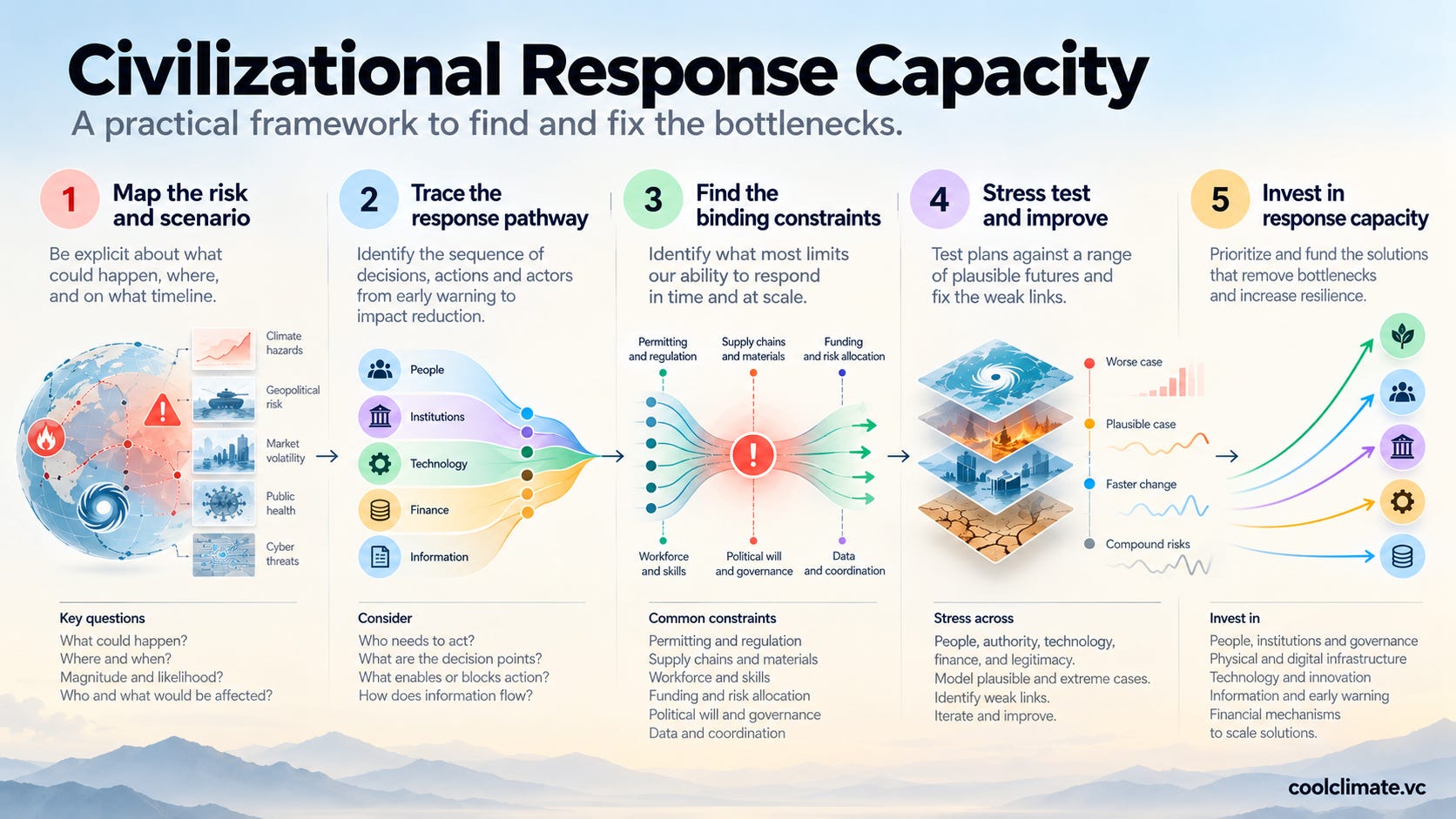
I would start with a Civilizational Response Capacity framework, which measures the Civilizational Response Gap for a specific risk.
Pick one: a concerning change in Arctic conditions, a compound food-system disruption, or an emerging threat to critical coastal infrastructure.
Define a plausible decision scenario, stating the uncertainty explicitly instead of disguising it inside a single forecast.
Then trace the entire response pathway. Who detects the change & what makes the observation credible? Who has the authority to determine that action should be considered, and who must consent? What technical capabilities need to exist, which financial commitments are missing, who bears liability, and which institutions actually execute the response? How long would each step take? And, crucially, which steps can run in parallel, and which can’t begin until another institution acts?
The output is an estimate of response lead time, its critical path and the bottlenecks that could be shortened without sacrificing scientific rigor or legitimate governance.
This is familiar work in complex engineering projects and industrial supply chains and far less developed as a comparative discipline for global systemic risk.
We should be able to run institutional stress tests in the same spirit that banks run financial stress tests and infrastructure operators run emergency exercises. Give a group of real decision-makers an escalating, uncertain scenario and observe what they know, who they contact, what authority they believe they hold and where the process stalls.
Then run the exercise again with better scientific translation, pre-negotiated decision protocols, independent AI assistance or different financial arrangements.
Did response time improve? Did the quality of decisions improve? Was legitimate participation preserved? Did coordination reduce risk, or simply let a bad decision travel faster? Those answers would be worth more than another statement of shared ambition.
There is a useful discipline here for capital allocators: fund the binding constraint.
If a response can’t proceed because there is no credible monitoring capability, more engineering prototypes may add little near-term value.
If the science is adequate but the authority to decide is unresolved, more scientific precision alone may not change readiness.
If the technology and permission structures exist but nobody can carry construction or performance risk, the missing intervention may well be financial.
Did coordination reduce risk or simply let a bad decision travel faster?
This is systems underwriting applied to civilization’s operating capacity and it comes with limits…
Some climate changes may be beyond practical prevention on relevant timescales. Some proposed remedies may introduce unacceptable new risks. Some constraints exist because societies have rightly chosen to limit concentrated power.
An honest response-capacity framework has to separate the constraints worth removing from the safeguards worth protecting and drawing that line is part of the work.
The Window is the Resource
When the risks are large enough, it is tempting to assume the answer must be an equally large technology: something capable of repairing an ice sheet, cooling an ocean, altering atmospheric chemistry or reversing ecological loss. Some ambitious scientific programs may eventually prove valuable. Others may fail or teach us why they should never proceed. They deserve study with rigor, humility and a clear sense of the consequences.
The size of a physical problem, though, says little about where the most important constraint on solving it resides. The decisive bottleneck may be a financial agreement, a legal authority, a monitoring standard, an independent scientific assessment, or a vulnerable country’s capacity to keep its essential services running long enough to take part in collective decisions. It may be the ability of institutions with different mandates to maintain a coherent understanding of one another without collapsing their judgments into a single consensus.
The larger the problem, the more attractive a singular solution becomes and the more I work on complex systems, the less leverage I find in singular solutions.
I have previously written about looking at first-of-a-kind projects as living systems, collections of specialized parts whose success depends on their ability to sense, respond and hold together as a whole. The projects that survive uncertainty tend to be the ones capable of learning without disintegrating; the accuracy of the initial plan matters less.
Civilization may be approaching a similar test… we are becoming extraordinarily capable of observing and altering our environment. Our scientific instruments detect changes far beyond human perception, our computational systems simulate ever more complex interactions and our industrial capacity can reshape landscapes, oceans and potentially aspects of the planetary energy balance.
Our capacity to govern these capabilities collectively has not advanced at anything like the same rate.
We have accumulated extraordinary power without building proportionate mechanisms for coordinated agency and that imbalance is becoming a systemic risk of its own.
The lesson I am carrying into this summit in Reykjavík is that technology, finance, institutional design and governance form a coupled system, and more of one cannot indefinitely compensate for the absence of another.
Climate stabilization can no more be reduced to better meetings and financial instruments than it can be reduced to hardware.
The Three Futures Test framework we apply to investments works here too, with civilization as the position.
One future is where scientific and technological progress gives us new ways to reduce catastrophic risk. A second is where physical change outpaces our ability to prevent it and demands extraordinary adaptation. A third is where our institutional systems deteriorate far enough that even good technical options become unavailable.
We can’t know with confidence which combination will define the coming decades, but we can invest in the capabilities that remain useful across all three: independent observation, institutional adaptability, distributed resilience, financial flexibility, legitimate collective decision-making and the ability to act on new evidence.
That is the deeper logic of coordinated agency: deliberately creating the conditions under which independent actors can make consequential decisions together. Global consensus, by comparison, can be both slow and dangerously homogenizing.
The inaugural Global Risk and Stabilization Summit is attempting something important by bringing scientific, financial, governance and frontline perspectives into the same conversation. My hope is that we begin translating that shared conversation into a measurable response capability.
The possibility that troubles me most is that we understand a catastrophic threshold in time, recognize the consequences, identify a plausible response and then discover that the institutions required to act can no longer assemble the necessary pieces.
The window in which civilization can coordinate a response does not renew on its own. Every unaddressed shock can narrow it, every institution that loses capacity can shorten it and every year spent building disconnected capabilities while the binding constraint goes unresolved consumes some of what remains. We are running out of time and we are also depleting the capacity to use the time we have.
We have spent decades measuring & refining how close the planet may be to its tipping points. Perhaps we should begin measuring how close we are to our own and whether we can learn to move that threshold further away.
Mehrad Yaghmai:
Yours is the most valuable and insightful analysis of the issues relating to climate change that I have found in a full year of researching the issue. However, it dodges some elephants in the room.
I would like to discuss with you concise, realistic, brass tacks layout of:
1. the size of the response needed;
2. the forcing functions needed to overcome the institutional deficiencies you elaborate;
3. the preconditions likely needed to enable the forcing functions to be effective;
4. the most cost-effective, doable action to be targeted for implementation.
For example:
SIZE OF RESPONSE
Since there is no known technology capable of lowering atmospheric carbon fast enough to avoid catastrophic sea level rise within a number of centuries, quadrillions of dollars and/or thousands of years will likely be needed to find and implement novel technology to stop and reverse sea level rise, and dealing with the migrations forced in the meantime will require additional massive expenditures to avoid political instability.. This needs to be dramatized and accepted by the public (see below).
FORCING FUNCTIONS
Realistically, one of the following (a list to elaborate) is likely needed to catalyze global response:
1. AMOC slowing dramatically;
2. Dead pool above the Hoover Dam;
3. Tundra-methane aggravated northern arboreal wildfires creating a global breathing crisis;
4. Abandonment of Tehran due to water shortage;
5. Unstoppable migration of Bangladeshis into West Bengal.
PRECONDITIONS
1. Replacement of Trump in the US and Putin in Russia and Xi in China with less bellicose politicians.
2. Bankruptcy and/or restoration of solvency in the world's leading democracies;
3. A media or news event raising worldwide popular recognition of the climate crisis;
4. Insolvency of global property reinsurers.
COST-EFFECTIVE ACTION
Clearly, a worldwide carbon tax that rises slowly and certainly to prompt investments before hurting consumption is one.
Institutional innovation, as per your work, is the other.
-------------------------------
My examples may not be the best. But the concept of this type of realistic followup to your analysis is recommended.
I would enjoy contributing to your follow-on work.
__________________
Ronald K. Randall
+1 201 888 3633
ron2randall@gmail.com
Sadly, there is zero recognition in this piece that we operate within an ecocidal framework.
Climate change is just one aspect of global ecosystems collapse; both of these phenomena are the direct consequence of our entrenched behaviour patterns. We are on a finite planet of 12 billion global hectares. We consume 20 billion global hectares per annum. We have been consuming more than 12 billion global hectares per annum for over 50 years. This is the definition of ecological overshoot. The carrying-capacity is exceeded at about 6 billion global hectares, this allows space for biodiversity to flourish. The last time humans consumed less than 6 billion gha per annum was about 100 years ago. Consumption per capita was much less and population was about 2 or 3 billion.
Growth economics, wealth inequality, patriarchy, colonialism, striving for military supremacy, and pronatalism can all be categorised as a 'fluency' response from our limbic system. These are all unwise behaviour patterns during ecosystems collapse, but our critical thinking gets by-passed in favour of business-as-usual.
https://www.linkedin.com/pulse/limbic-loopholes-barbara-williams-2icae/