


Listen to the summary:
Days before I flew to Reykjavík for the inaugural Global Risk and Stabilization Summit last week, I wrote The Tipping Point We Don’t Measure. The argument was that alongside the physical tipping points in the climate system sits an institutional one: the point at which the organizations responsible for responding have lost enough financial, political, industrial or social capacity that meaningful intervention becomes impossible, even while a technically viable option still exists. I suggested that, in some circumstances, that this second type of threshold could arrive before the first.
I came home from Iceland more convinced of it and with a clearer mental model for what the work we need to do…
Our socioeconomic infrastructure is how a civilization coordinates. Markets, public budgets, insurers, supply chains, labor and public trust together form the machinery through which a society notices a threat, argues about it, pays for a response and carries it out. If that machinery loses its capacity to react, the existence of a technology that could solve the problem stops mattering, because no one is left in a position to deploy it.
Along with climate stabilization we have to consider socioeconomic stabilization: keeping the coordinating capacity of our societies intact, so that whatever we eventually decide to do about the climate, we are still able to do it.
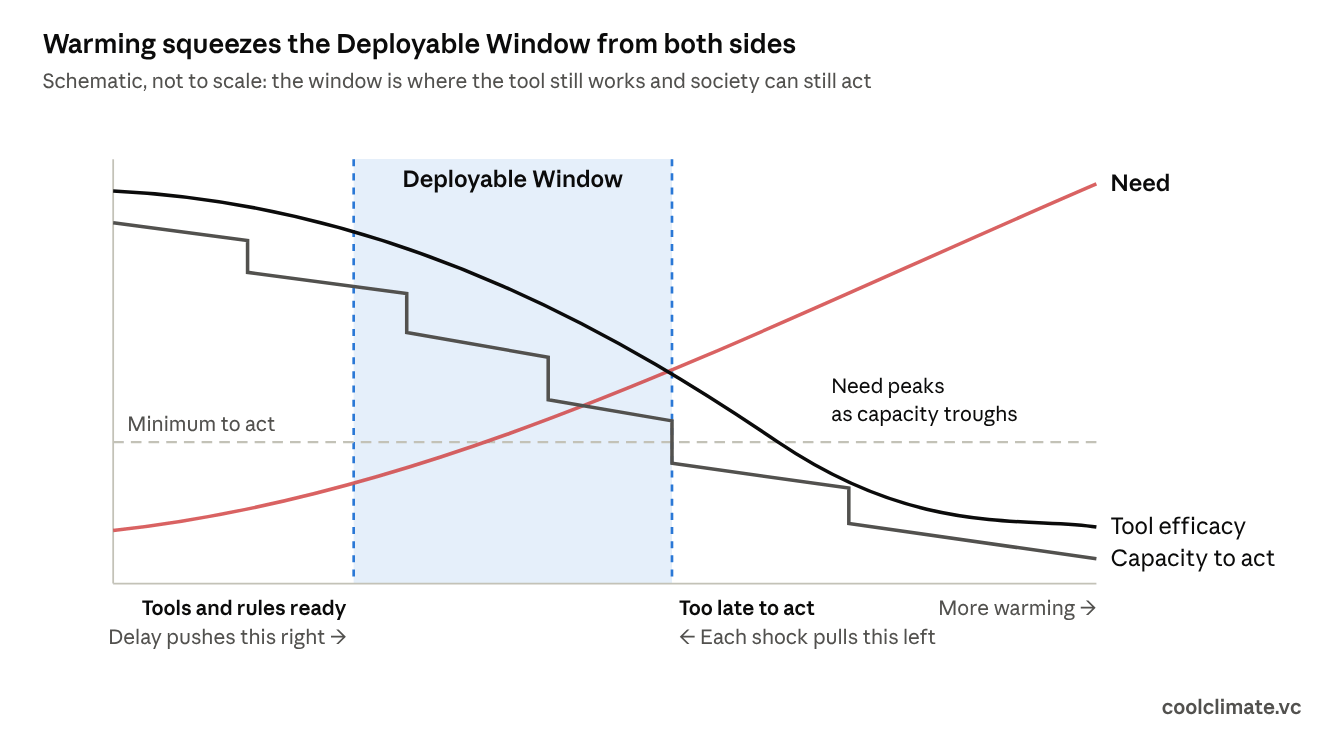
Reykjavík also gave the idea a shape I can draw. Every increment of warming shrinks the stabilization option from both ends. The tools grow weaker, as there is less cloud to brighten and regional fixes that work today start to backfire. The societies that would wield them grow weaker too, with thinner budgets, strained institutions and less trust to spend.
The span where a tool still works and a society can still act on it is what I call the Deployable Window, and warming squeezes it from both sides at once. Delay costs us twice and the moment we most need an intervention is likely to be the moment we are least able to use it.
The Next Shock Lands Harder
There is a vicious cycle that starts to unfold when our infrastructure are hit with back-to-back events, when our time to re-build & harden takes longer than the next event about to hit...
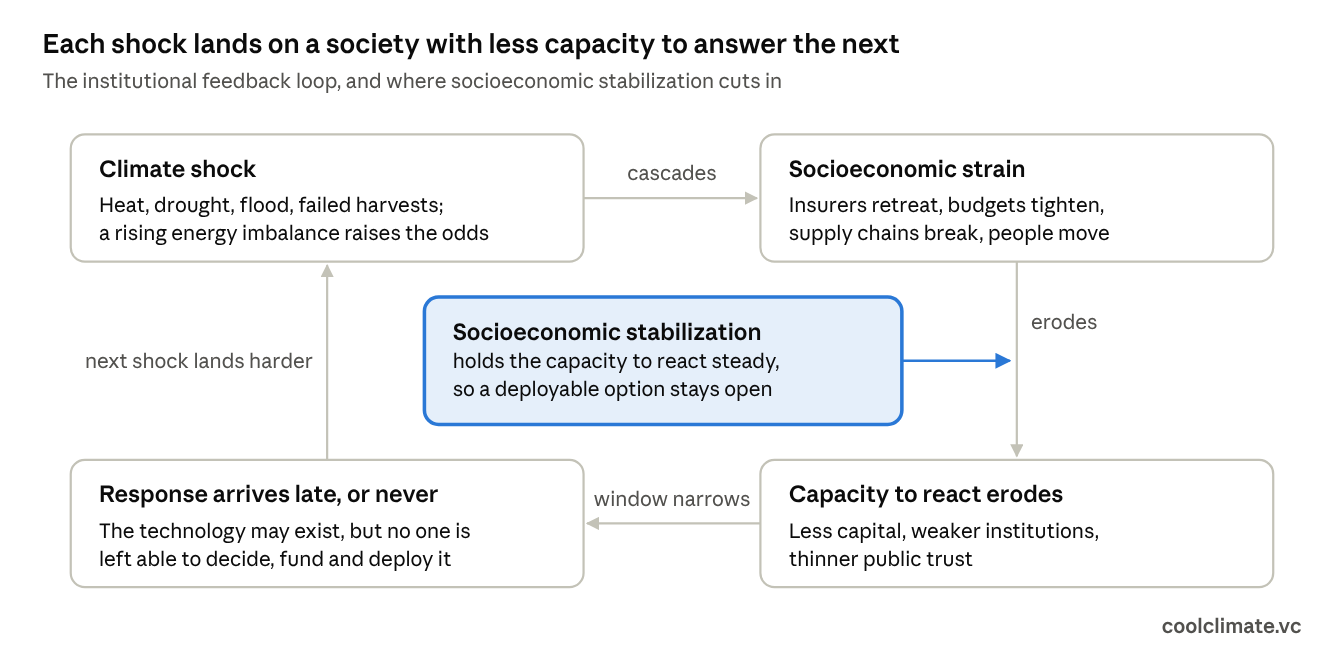
Nepal was living inside that loop as we convened in Reykjavík. The weekend before the summit, a landslide dammed a Himalayan river and then burst, sweeping away homes and bridges and damaging a hydropower site downstream. On its own it was a modest event, a dry landslide no one blames on climate. What made it dangerous was its timing: it struck a country still recovering from something far worse.
Seven weeks earlier, a glacier collapse in the same river system had killed more than 1,300 people, damaging 13 hydropower plants and wrecking the crossing that carried nearly half of Nepal’s exports to China. An early-warning system built for monsoon floods never saw it coming. Rebuilding will cost an estimated US$4.7 billion; the UN’s Loss and Damage Fund sent US$20 million. Scientists are still debating how much warming loosened that mountain. The socioeconomic half of the story needs no such study: the second shock hit a grid, a road network and a budget still rebuilding from the first.
The Debate in Reykjavík
Around 250 people gathered in Reykjavík to work on ways to stabilize Earth’s climate, from reflecting sunlight with stratospheric aerosols or brighter ocean clouds to holding ice sheets and sea ice in place. The summit ran under the Chatham House Rule & two write-ups capture it better than I could: Robert Höglund’s readout on Marginal Carbon and an investor’s view from my friend and frequent collaborator Susan Su, The climate intervention era is here. Robert describes a field of about a thousand people still working out whether its tools work and whether they will ever be needed; Susan watched some of the world’s largest family offices and philanthropies arrive to consider funding it for the first time.
It is still very much a debate. Some want a staged research roadmap that a single government agency could fund, some propose limited deployment from the early 2030s, and others want a moratorium that would rule out even publicly funded research. Robert lands where I do, that we “at least need to get the solutions deployment-ready.”
My own takeaway sits one layer down: whatever the field concludes, its insights are only as useful as our capacity to act on them, and that capacity is eroding in places we rarely look. Earth’s energy imbalance has more than doubled in two decades, and our ability to measure it is deteriorating as the satellites that track it are retired. We are losing sight of the most important number in the climate system just as it accelerates.
Readiness Has Two Halves
Robert’s conclusion is where I want to extend the argument. Deployment readiness usually means the technology: particles characterized, delivery engineered, monitoring in place. The other half is the readiness of the societies that would have to decide on deployment, pay for it, govern it for decades and live with its uneven consequences. To be ready to deploy frontier emergency solutions, we first have to keep the capacity to deploy anything at all.
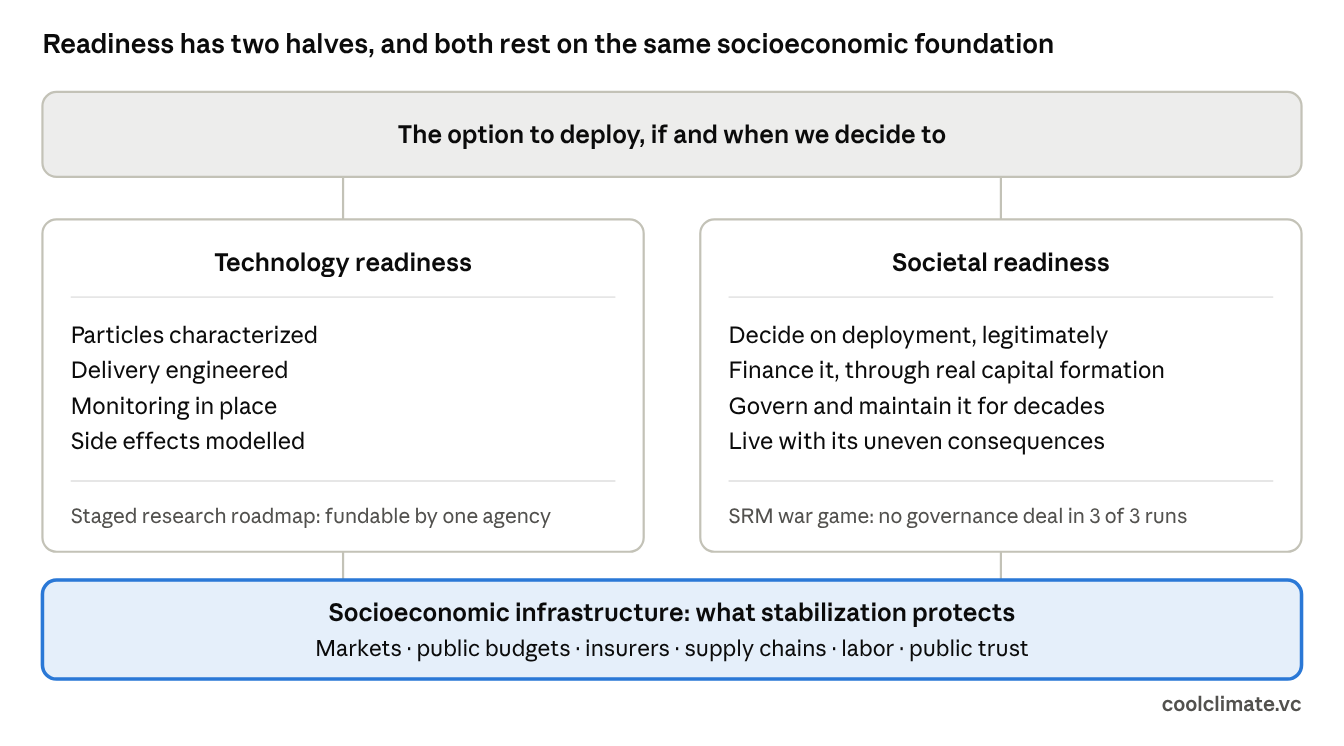
The summit kept circling that second half. Sustained deployment of something like stratospheric aerosols would need a stable coalition of governments, and a technology that must be maintained for decades is only as dependable as the institutions maintaining it, institutions that sit on economies and budgets exposed to the very warming it is meant to address. A UK-funded war game reported by WIRED tested exactly that: across three crisis simulations, participants never agreed on how to govern solar geoengineering. The technology was on the table the whole time; the coordination never arrived.
Susan arrives at the same gap from the capital side. The field fixates on fundraising, she argues, when the real shortfall is capital formation: having a credible answer if governments or markets showed up tomorrow with hundreds of billions of dollars for Arctic stabilization. In her words, “There’s government, and there’s governance, and we’re behind on both.”
Much of my work under emrgnce sits in that gap: building the financial and institutional plumbing that moves first-of-a-kind technologies from pilot to deployment, through Co-VC initiatives, shared working assets and capital structured so the industry wins. Reykjavík widened that frame from adoption to readiness.
If some of these interventions may one day be needed, the capability to deploy them, and the socioeconomic stability that keeps it from decaying, has to be built before the emergency, because an emergency is the worst moment to discover the plumbing is missing.
A Tool With a Closing Window
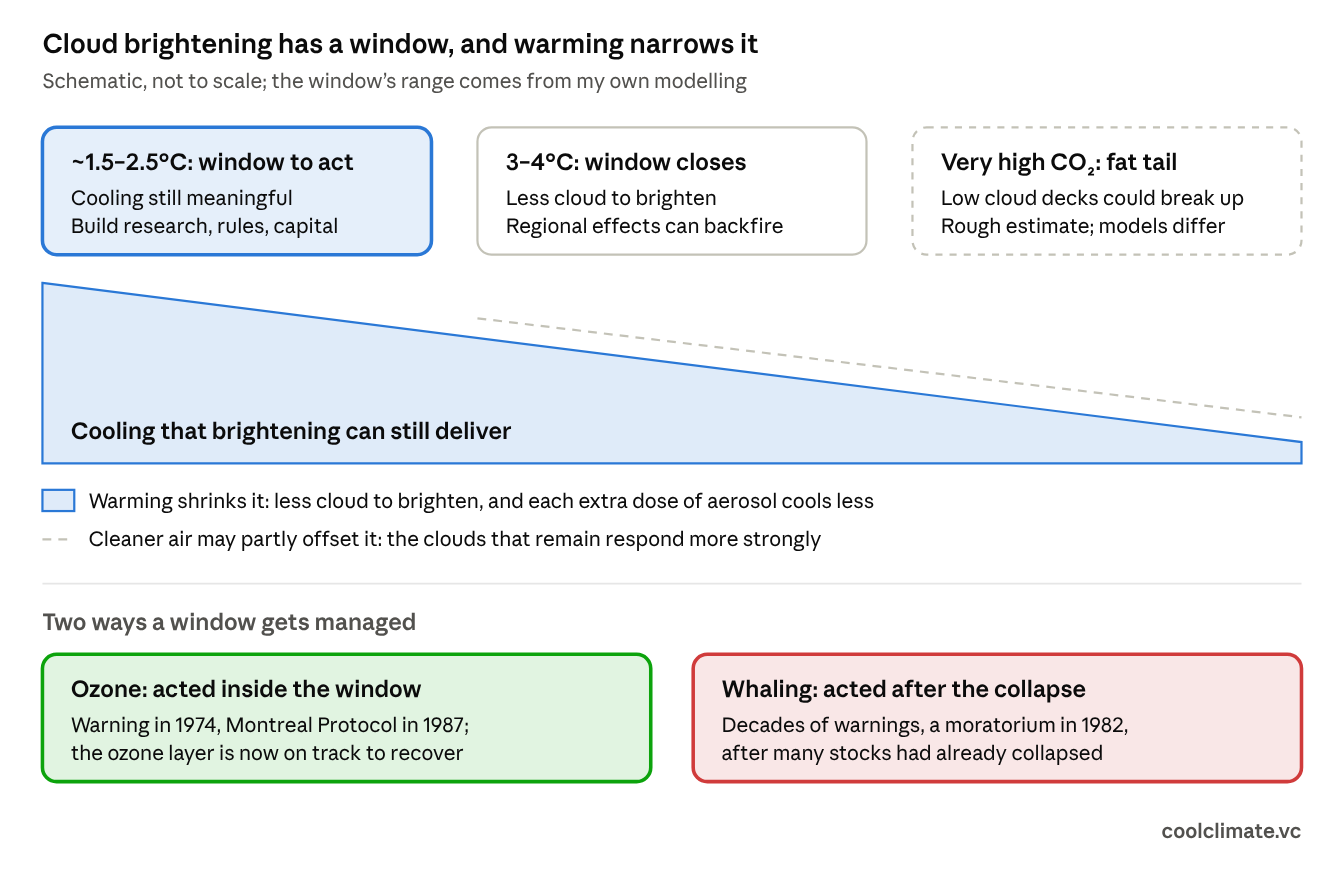
The proposal I kept coming back to in Reykjavík was marine cloud brightening: spraying a fine sea-salt mist into low ocean clouds so they reflect more sunlight. I like it for its locality, since a regional intervention may carry less geopolitical baggage than stratospheric aerosols. It has a capacity problem of its own, though, so after the summit I modelled its boundaries. In one study, doubling CO₂ cut aerosol-driven cloud cooling by more than 30%, mostly because a warmer world leaves less cloud to brighten. In another, North Pacific brightening that cools the western United States today starts to backfire by mid-century, raising heat risk in Europe.
Cleaner air pulls the other way, making the remaining clouds more responsive, so the net effect is uncertain. At the far tail, one study found the low cloud decks themselves could break up at very high CO₂, adding about 8°C of warming. Its authors called that a rough estimate, and the losses that matter for policy arrive long before it.
The precedents cut both ways. The world acted on ozone within 13 years of the first warning, and the layer is now recovering; it acted on whaling only after the stocks had collapsed. For cloud brightening, the ozone path means building the research, governance and capital while the window is open, roughly 1.5–2.5°C of warming in my modelling. That is why the pushback against even researching these tools worries me: it spends the window before we know whether the option is worth keeping.
When Societies Lose the Capacity to React
History has run this experiment many times, and the pattern is consistent enough to be useful.
The physical shock decides how hard a society gets hit. Its coordinating capacity decides what happens next.
Around 1200 BCE, the eastern Mediterranean was an interconnected world of palaces, trade routes and diplomatic correspondence. A megadrought, broken trade networks, mass migration and political crises brought much of it down. In After 1177 B.C., his sequel to the story of that collapse, the archaeologist Eric Cline shows how unevenly the societies of the region fared afterwards. The Hittite empire vanished. Egypt survived, but the Nile’s reduced flow slowed its economy and drained its military strength, leaving it weaker and prone to coups. The Assyrians and Babylonians were hit again and again by drought, famine and plague, and kept recovering with their social systems intact, while the Phoenician city-states, rising in the vacuum the Hittites left behind, built new trade networks across the Mediterranean and flourished. The region shared one shock, and the outcomes split along each society’s capacity to adapt its institutions.
Three thousand years later, the Ming dynasty gives the sharpest version of the lesson I know. The mid-seventeenth century was among the coldest stretches of the Little Ice Age, and Geoffrey Parker’s Global Crisis traces how failed harvests, war and revolt rolled from England to Japan between 1618 and the 1680s, with some contemporaries estimating that a third of the world died. The Ming faced drought, famine, frontier war and fiscal crisis at once; the cooling had wrecked the military farm system that fed its frontier armies, pushing up military spending as revenue fell. To protect the treasury, around 1629 the Chongzhen emperor cut funding for the imperial postal and courier service, throwing large numbers of men out of work in the northern provinces hardest hit by disaster. One of them was a post-station messenger from Shaanxi named Li Zicheng. In 1644 he entered Beijing at the head of a rebel army, and the Ming were finished.
Sit with the mechanics of that. Under fiscal and climate stress, the state cut the network it used to communicate and coordinate across an empire, and in the same stroke supplied the leadership and recruits of the rebellion that ended it. A rational budget decision dismantled the coordination capacity of a civilization.
The North Sea flood of 1953 shows the opposite path. On the night of 31 January, a spring tide and a north-westerly gale broke through dikes across the south-western Netherlands, flooding more than 150,000 hectares and killing 1,835 people in a country still rebuilding from war. By 18 February the government had instituted the Delta Committee to make sure it could never happen again. Its work drew on the mathematician David van Dantzig’s method of weighing the cost of damage against its probability, produced a Delta Law, and set in motion the Delta Works, a generational program of dams, storm surge barriers and sluices that took more than four decades to complete. The Dutch could respond at that scale because the coordinating apparatus already existed, from a national water authority dating to 1798 to centuries of local water boards, and because the shock landed on a society with the capacity to absorb it and act.
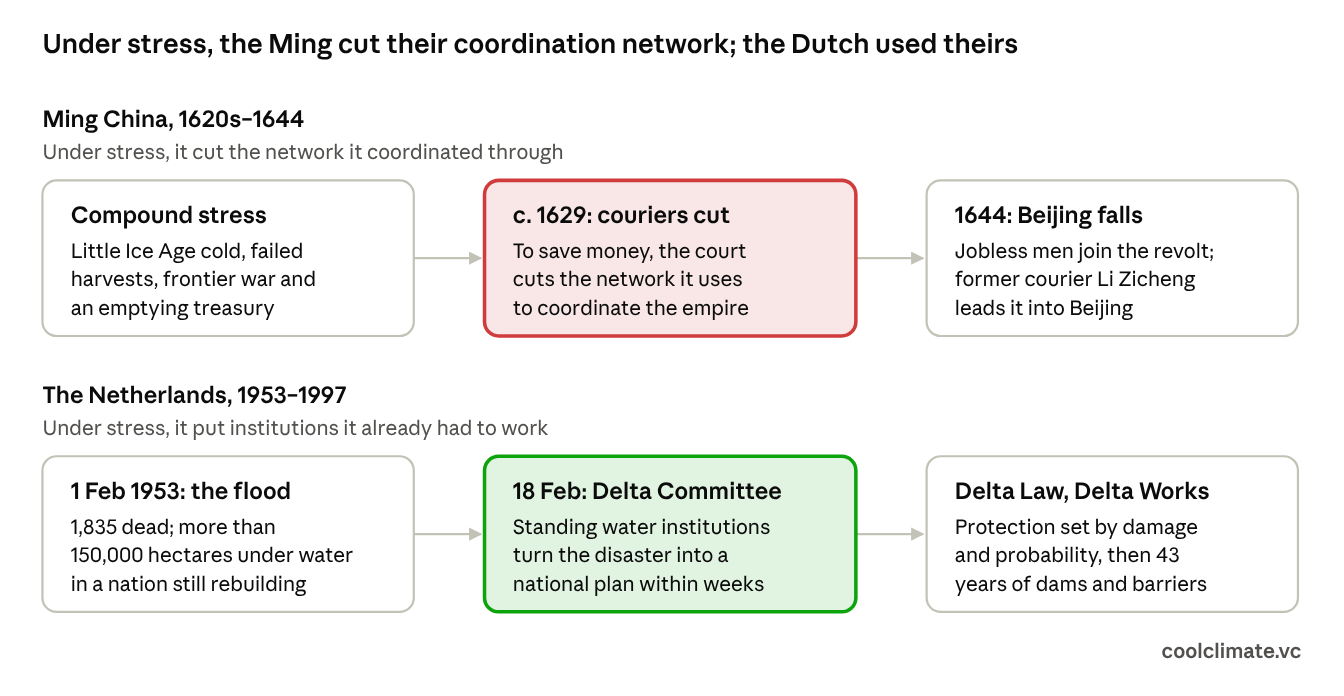
The anthropologist Joseph Tainter argued that whether a society endures or collapses depends on the success or failure of its problem-solving institutions, and that collapse follows once the returns on further investment in complexity begin to diminish.
I read that as a statement about reaction capacity... a society tips when the cost of its next necessary response exceeds what it can still mobilize. The Ming crossed that line, and the Dutch of 1953 never came close.
The Breadbasket Has No Borders
Modern cascades move faster, because the systems that carry them are global.
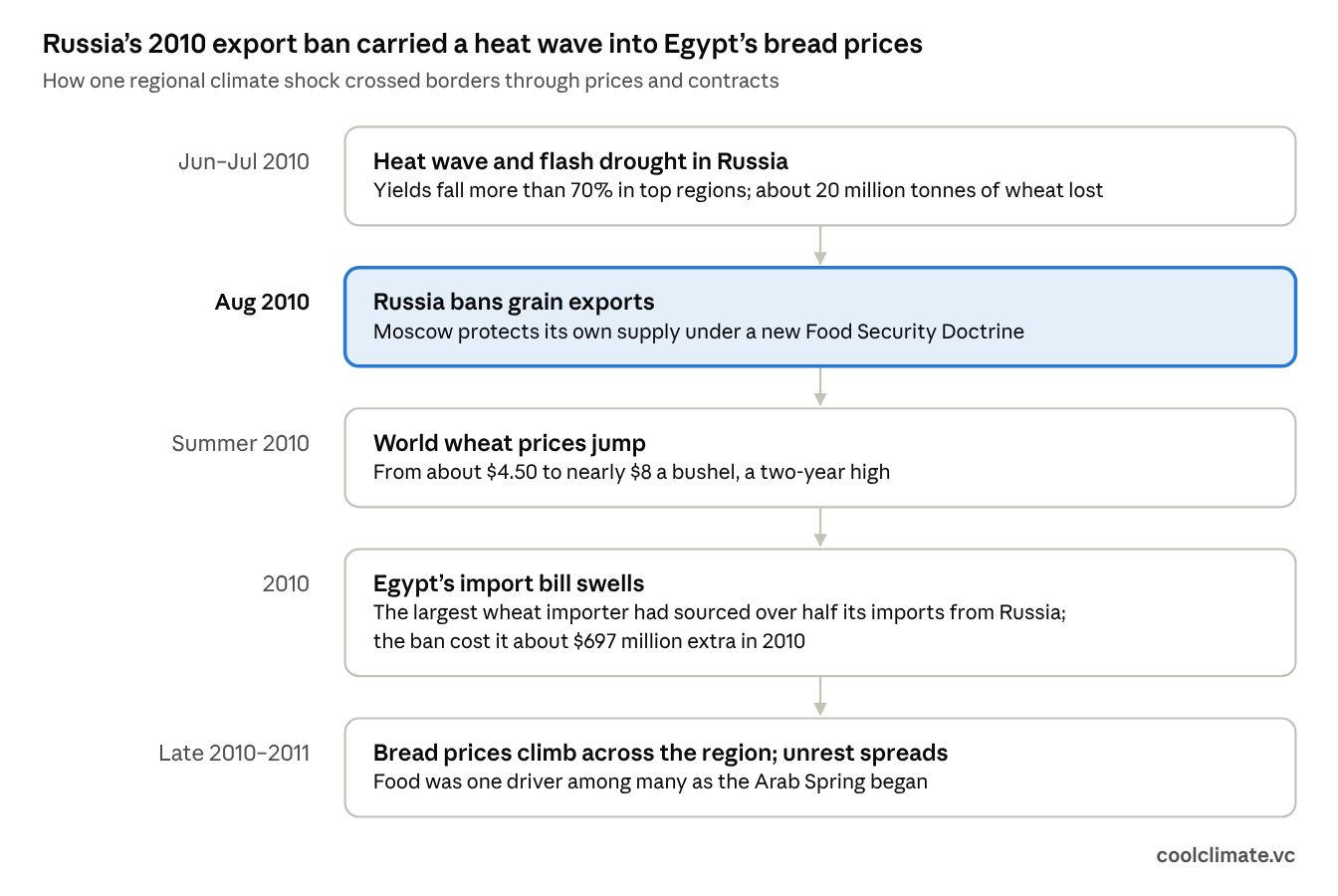
In the summer of 2010, a flash drought and heat wave cut wheat yields in Russia’s top-producing regions by more than 70 percent and took about 20 million tonnes out of the national harvest. In early August, invoking its new Food Security Doctrine, the Russian government banned wheat exports to protect domestic supply. Egypt, the world’s largest wheat importer, had sourced more than half of its imported wheat from Russia the previous year, and its former trade minister estimated the ban cost the country an extra $697 million in 2010.
Bread prices climbed across the Middle East and North Africa, and within months the Arab Spring had begun. Food was one driver among many and its weight is still debated, but the chain running from a heat dome over Moscow to bread prices in Cairo is short, direct & clear.
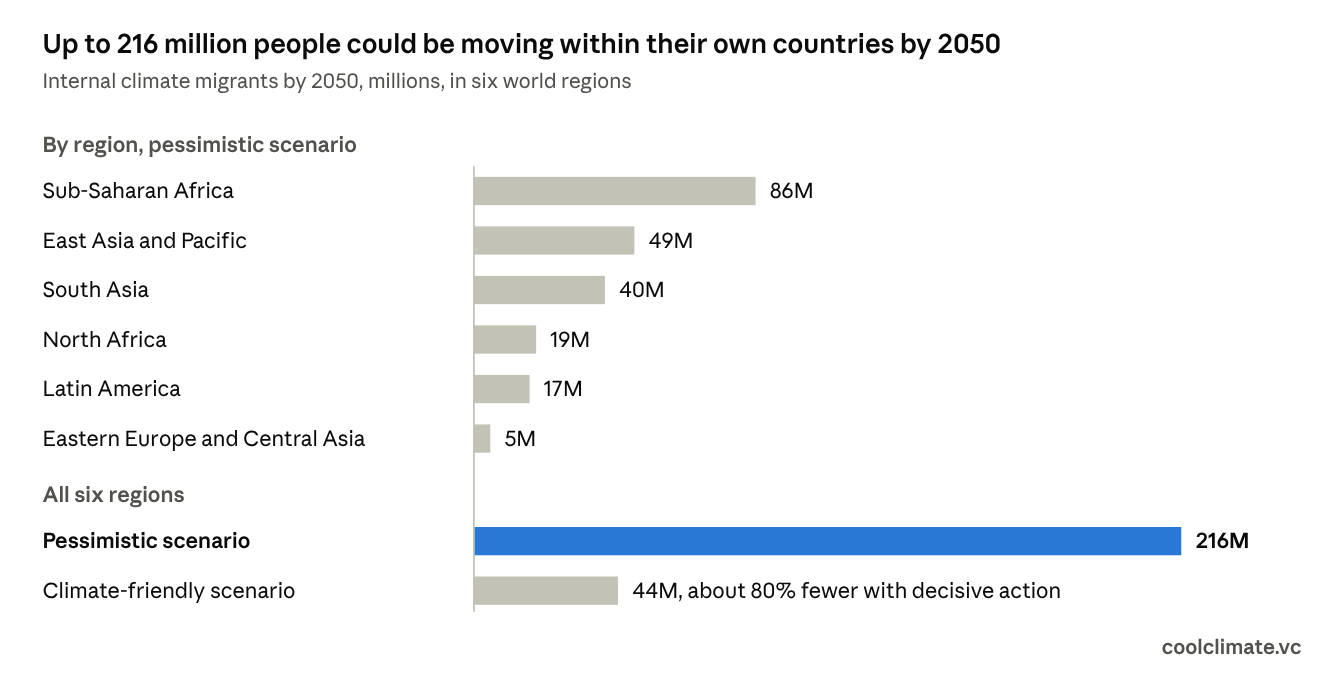
Manufacturing travels the same roads. When Thailand flooded in 2011, it accounted for 40 to 45 percent of the world’s hard drive production; more than a dozen factories went under water and the shortage rippled through the electronics supply chain into the following year. People move along those channels too. The World Bank’s Groundswell modelling projects that climate change could push 216 million people to migrate within their own countries by 2050, with hotspots emerging as early as 2030, and that decisive action could cut that figure by around 80 percent.
None of these shocks stayed where it started. Each one moved through prices, contracts, factories and families, through the same socioeconomic infrastructure we rely on to absorb it, and each left that infrastructure a little thinner for the next.
Whose Status Quo?
This brings me to the question I kept circling in Reykjavík, one the field’s own vocabulary invites. Stabilization, taken literally, means holding a status quo in place, and even within the field the term is still debated, as Robert notes.
For much of the world, the status quo is a necessity. It keeps people in their homes and harvests within the range farmers planned for, and it underwrites the economic capacity that funds schools, hospitals and growth. For others, destabilization can look like opportunity inside their own bubble of an economy or worldview: a longer growing season, a new Arctic shipping lane, distressed assets at a discount, a competitor’s crisis, a wave of talent arriving at the border. That is a political conversation, and an honest one to have; I won’t pretend everyone’s interests line up.
If we accept stabilization as a shared goal, though, the case rests on cascading risk, and it holds even for those who believe they come out ahead. The destabilization of a neighboring country or region arrives at your door as migration, as components and manufacturing shifting in ways you did not plan for, and as the breadbasket you import from failing in the same season as your own. If you are not ready for that, the short-term gain gets repaid with interest.
In 2003, Vladimir Putin mused that two or three degrees of warming “wouldn’t be so bad for a northern country like Russia,” adding that people would spend less on fur coats and the grain harvest would go up. Seven years later the grain harvest was what burned, and the export ban Moscow imposed to protect itself helped push one of its biggest wheat customers toward unrest. The would-be winner of warming became the epicenter of one of its defining food shocks.
Underneath all of this sits physics that negotiates with no one. The planet is running an energy surplus that has more than doubled in two decades, and that heat will express itself somewhere: in somebody’s harvest, somebody’s coastline, somebody’s supply chain. Susan makes the sobering point that even with emissions at zero tomorrow and every historical tonne removed, the oceans would keep giving back their stored heat for another 100 to 150 years, so no path back to today’s stability skips adaptation and cooling interventions. A temporary beneficiary is standing inside the same imbalance as everyone else, and it eventually catches up.
Holding a long position on someone else’s destabilization is, in practice, a short position on your own supply chain.
Stabilizing the Capacity to Choose
So here is where I come out of Reykjavík... the debate over whether we should ever deploy these technologies is necessary, and it belongs in the open, backed by the research it requires and centered on the countries most exposed to both the risks and the interventions.
My own view is that we need the readiness, and even the capability, in place wherever that debate lands. It is the real-options logic I keep returning to: a society that holds an option can still choose not to exercise it, while a society that never built it, or has lost the capacity to carry it out, has no choice left to make.
I traced this pattern in my writeup, The Lifeboat on the Roof, through Jimmy Carter’s solar panels. He put 32 of them on the West Wing roof in 1979, in the middle of an oil shock; by 1986, with oil cheap again, they came down for a roof repair and went into a government warehouse. One of them now sits in a solar museum in Dezhou, China, a souvenir of an industry someone else went on to build. The distinction I drew there carries straight into this argument: a reserve is a life jacket that keeps you afloat for a fixed number of days, and a lifeboat is what gets you somewhere. Socioeconomic stabilization is the work of keeping the lifeboat on the roof, and seaworthy, through the years when the water looks calm.
And as I argued there, the lifeboat has become a distributed build: states, utilities, ports, municipalities and private capital now hold pieces of a hull that Washington has set down twice.
That readiness rests on socioeconomic stability:
insurers who keep underwriting
municipalities that can still borrow
supply chains with enough slack to absorb a shock
institutions people still trust to tell them the truth
and capital structured to carry first-of-a-kind deployments through the valley between pilot and scale.
Those are the pieces I spend my days and they are the same pieces that let a society react to anything at all.
In The Tipping Point We Don’t Measure I proposed a Civilizational Response Capacity framework to measure how close we are to the institutional threshold. Reykjavík convinced me it needs a companion agenda in socioeconomic stabilization, pursued with the same seriousness we are beginning to bring to stabilizing the climate itself. If you work on either side of that line, in the science of intervention or in the economic plumbing that would have to carry it, I’d like to hear where you think our capacity is thinnest.
We can argue for years about whether to cool the planet. The work in front of us is making sure that when the argument ends, there is still a society capable of acting on the answer.
This originally was appeared on LinkedIn.
You make an excellent point about the deployment timeline. Methane abatement is a classic example: the tech and low cost detection/repair tools exist today, offering disproportionate near-term impact on global temperatures. While gigaton-scale permanent carbon removal is essential for the long haul, delaying near-term deployments like methane mitigation for future "silver bullets" risks letting the Goldilocks window pass completely.
No known technology is scalable enough in time to avoid the migrations forecast. Who is preparing for the migrations?